Greetings, new (or seasoned) wargamers, and welcome to my guide on wargame terrain. I want this guide to be very in-depth but spread over multiple parts. I love the terrain. It is wargaming, more so than the models themselves. I have spent fortunes on terrain that I am proud to have on the table. Click here for the rest of the series.
What is Terrain
In Wargaming, terrain is simply something we use to avoid battles on flat surfaces. Looking back through historic battles, terrain plays a starring role in how the battle shapes out: Germanic tribes ambushing Roman legions in dense forests, fierce fighting in Stalingrad over a grain elevator, and even the shallows at the Battle of the Nile.
When we play wargames, depending on the game, the terrain will change how our models move about the battlefield. There are games where terrain is a significant part. Rules for elevation, river crossings, and trenches all factor into our generalship. Hours are spent discussing target priority, strategic usage, and ideal lists, but using terrain is even more critical.
Getting Started
There are levels upon levels of terrain available for purchase. You can make it yourself, 3d print it, buy 3d prints, complete terrain kits, fully painted items, use non-traditional items, get fully custom-made-to-order commissions, purchase modular build kits, and endless other options.
But let’s say you bought a starter set, and you are tired of your miniatures shooting at each other across empty space. Maybe you have watched a video online about how to play your newest game, and they have these handcrafted realistic buildings, luscious grass, LED lights, flowing rivers, and jungle canopies. You look on Etsy and see this terrain set for $1,000. You put your miniatures away in a box, ending your wargame experience.
You don’t have to have beautiful terrain to wargame. If you are so overwhelmed by your first games by the sheer amount of options and all the shit you have to buy, it’s impossible to love the hobby.
In fact, if you are curious about wargaming, I would advise printing out paper models and paper terrain and getting a game started for $20 and an hour of work rather than $2,000 and 100 hours. Most games have a free ruleset available as a PDF for starters. See if you enjoy the game part. Then maybe visit a local game store. (My town of 7,000 has one; I’m confident the internet can help you.) Most stores have terrain you can use and tables to play.
Your First Terrain Set-Up
More people play casually at their kitchen table with their kids and friends than in a store with dozens of others. Stores are intimidating. You don’t want to ask for help or feel clueless. Gamers will walk in with backpacks filled with the latest and most fantastic devices and commission-painted armies, and you have a mound of grey plastic. It’s ok.
Feel free to use books, pots and pans, CD cases, cups, and mugs when playing at home. Break out a piece of paper and draw a river. It will serve its use, and honestly, books as buildings and hills are far more functional than most wargame terrain you may buy.
You want your terrain to be varied but balanced, not giving one side an advantage. One side has a stack of books overlooking the entire battlefield; the other should also. One side has a mousepad minefield, and maybe the other has a blue dinner plate used as a lake to restrict movement. You want your space between terrain to be large enough for the most prominent units to pass through most areas. You want a few areas with long sightlines so your snipers and other shooty units can shine. You want others with tight corridors so melee units can charge and have a go.
The models with the most significant footprint tend to be the most important. It wouldn’t be a fun game if your shiny new tank couldn’t drive anywhere. Below is a setup I did while writing this article in my shop with stuff from my desk.
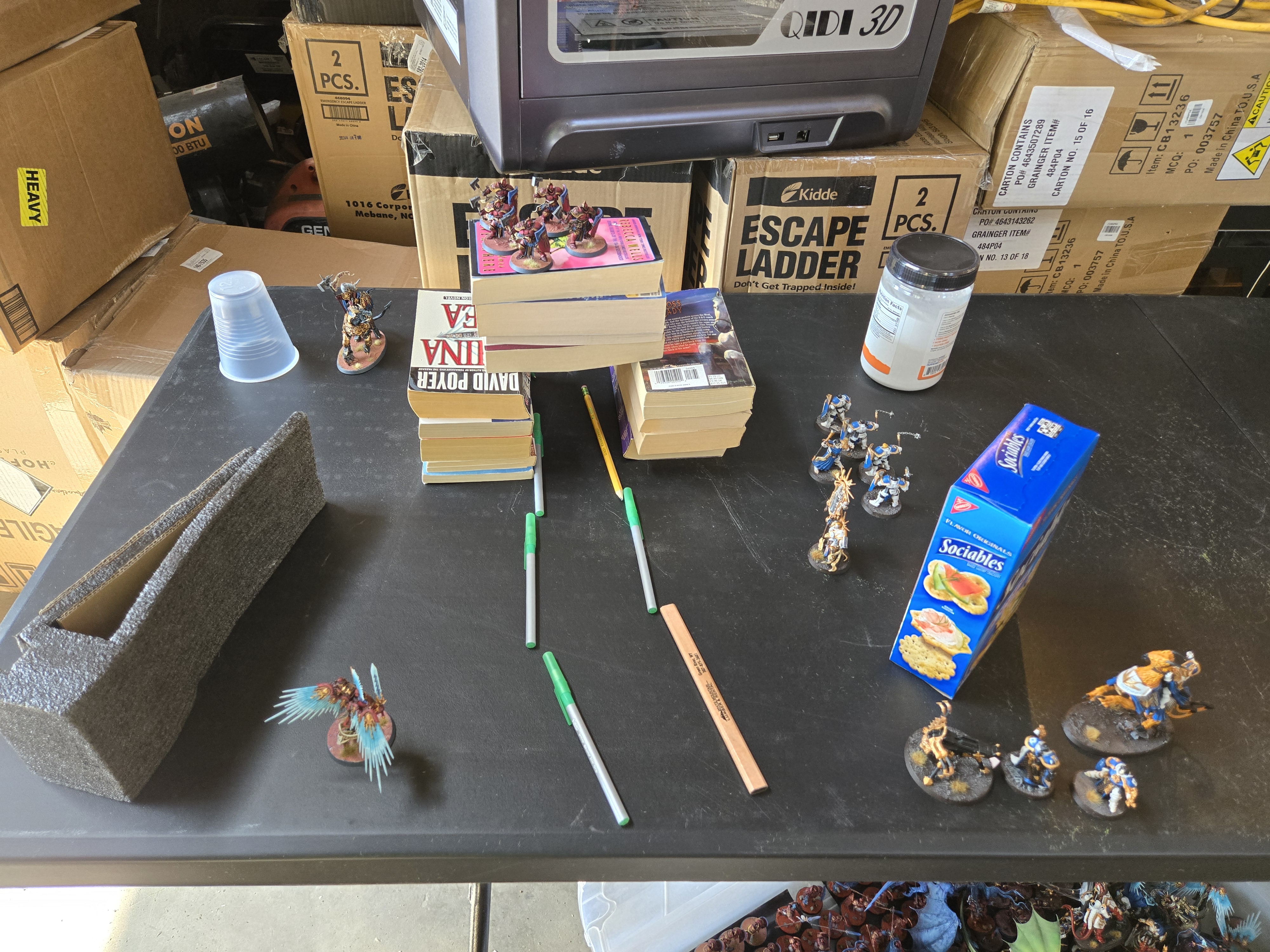
It looks just fine and is more functional than many of the fancy boards I have played on.
A Table
Warhammer, Marvel Crisis Protocol, Bolt Action, all have a recommended table size. Here is the kicker; it’s not required. Any coffee table, kitchen counter, or floor is acceptable. The most critical piece is to play the game and have fun. If we are not enjoying ourselves, then why waste our time.
If you really, really, really, want to buy a table, to start, buy the 30″ by 30″ folding card table for $15 at Walmart. It’s functional, large enough to play 750 points on, and if you decide against gaming long-term, you can use it for something else.
I prefer a table you can sit at. Also, this is just me. Having alternate surfaces to store dice trays, rulebooks, army boxes, and other items that we wargamers seem to think we need to successfully eliminate the enemy.
 stonewalljackman