July 12th 1801 2nd Battle of Algeciras Wargame Scenario

On July 12th 1801, six British ships of the line pursued and attacked nice French and Spanish ships in the strait of Gibraltar. The French and Spanish were attempting to flee the British but were caught in the middle of the night. The ensuing fighting caused confusion as both sides fired upon their own forces.

To wargame this particular battle will require the use of an umpire or other party to determine who can see whom and what.

Set-up use black seas rules

3 players

2 separate identical tables with a grid clearly marked.

6 British ships of the line and 2 frigates, 9 Spanish and French ships of the line with 3 frigates. plus several extra ships.

No terrain is needed

Light markers

Set-up

Each player should set up their ships on a different table.

The wind should be set with both players sailing with the wind. The Spanish should be spread out with three ships trailing behind the rest of the fleet. The British should be within one move of the Spanish ship.

The umpire should indicate the following, a marker where the closest enemy ship is, and a marker anytime shots are fired. As the battle commences and more ships become involved. The roll of a d6 should be incorporated for friendly shots fired with the 1 indicating the direction to move the marker, and the number of inches away. The goal is to add to the confusion and potentially allied ships being fired upon. Finally if a ship is on fire it should be clearly shown on the opponent board.

An example, the 4th turn of the game a British ship fires where it thinks a Spanish ship is located. The Spanish ship fires where it thinks a British ship is located. The umpire should place two markers on each board. Each marker based on the roll of the dice from the ship that fired.
July 11th 1804 Hamilton vs Burr Scenario

On July 11th 1804 Aaron Burr shot Alexander Hamilton in a duel near Weehawken New Jersey. The duel pitted two political power houses who wanted to settle their differences once and for all.

Wargame

2 players

Custom rules

3×3 terrain

Densely wooded terrain

3 models per side

This was a different scenario to write compared to many other fights. I didn’t want the game to hinge on a single die roll, but rather on movement.

Set-up

Each team of three should be set up within 2” of the table edge. The goal is to kill the leader of the other side. Each model gets a flintlock pistol and a dagger.

A game round starts with a roll off. The winner goes first. That player may activate one model. Then the 2nd player may activate two models. The first player activates their remaining two models. The 2nd player activates their final model.

When you activate a model you can do the following things;

Reload in cover

Shoot and cover

Move and shoot

Move and cover

Move and run

Move and attack

Run and attack

Movement

Models move 4” they can run an additional 2” but they sacrifice their ability to shoot, or cover.

Shooting ranges are 0-4” short range, 4” to 6” standard range, and 6” to 9” long range.

Shooting Modifiers

Regular shooting you hit on a 5+ on a d6

Short range +1

Did not move +1

Long range -1

Target in cover -1

Not having a clear line of sight -1

After shooting your gun is empty and must be reloaded. You cannot move and reload.

To attack you must be within 1” of an enemy. A successful attack hits on a 4+. The only modifier is if you successfully ran and attacked +1.

To successfully run and attack you must declare the attempt and roll a 4+. On a failed roll your model should move half the distance towards the model you were charging.

After being shot or stabbed successfully, the model that was attacked should see what happens. On a 5 or 6 no damage occurs. On a 2,3 or 4, the model is wounded. On a 1 the model is killed.

Leader models (Burr and Hamilton) can have 1 wound, but on the 2nd they are killed. Their aids will flee once a wound is taken.

July 10th 1921 Bloody Sunday Wargame Scenario

July 10th 1921 the day before a truce between the Irish Republican Army and the Protestant Loyalists was a day of pure violence. 17 deaths and 2,000 people homeless as both sides attacked homes and businesses of the other.

Wargame

2 players

Wild West rules or mobster rules will work well

20 models per side, some with grenades or Molotov cocktails

Small Irish village or dense street on a 4×4 board.

Scenario

The IRA player should identify 2 buildings they are defending from the loyalists. The loyalists must use two explosives to destroy the building. The IRA wins if neither building is destroyed while the two sides draw if only one is destroyed. The loyalists should have a car to increase mobility.

Set-Up

Both sides indicate a building to dispatch their forces from. 4 fighters may enter per turn.

July 9th 660 Battle of Hwangsanbeol Wargame Scenario

The Battle of Hwangsanbeol was very much a 300-type battle. 5,000 Soldiers of Baekje faced off against 50,000 soldiers of Silla. At the time, Korea had a limited cavalry, and battles were often decided by who fought harder and braver. During the battle, the underdog Baekje forces fought and repelled the Silla five times. The Silla were nearly broken when General Kim Pumil sent his son Gwanchang to single-handedly fight the enemy.

Order of Battle
Silla
Kim Yu-Sin
50,000 Soldiers

Baekje
Gyebaek
5,000 Soldiers

This was a challenging scenario to create a wargame for, but I wanted to give it a try. I want to lean into the fantasy aspect of the engagement like Achilles and Hector’s single combat outside Troy.

Wargame Rules Of Gods and Mortals or Broken Legion.
Models Needed: 10 Silla models, 1 Hero, and 50 Gyebaek Models.
Board Size 3×3 or smaller.
No terrain needed a pallisade just for aesthetics.

The Game
Place the Silla models on one end of the board. Their goal is to die heroically and not be captured. The models become captured if three or more Gyebaek models are within the engagement range of a single Silla model and are not engaged elsewhere. The Gyebaek models are attempting to capture but not kill the Silla models. The Silla forces should be superior in every way to the Gyebaek.

July 8th 1709 Battle of Poltava Wargame Scenario

The Great Northern War, which began in 1700, marked the end of the Pike and Shot era of warfare and ushered in the horse and musket era. The early stages of the era lacked the organization that we are used to in the Napoleonic era and still had some resemblance to massed bodies.

The Battle of Poltava was essentially a siege of several redoubts and forts that secured a key pass into Russia. The defensive Russians also had more forces than the Swedes, creating an interesting scenario. The Swedes tried to isolate each redoubt and take them one by one. The Russians were able to reinforce the redoubts. The Swedes were victorious in several instances.

Order of battle
Sweeden
Charles XII
16,500 soldiers
34 cannons

Russia
Peter I
42,660 soldiers
86 cannons

Wargame: Use a rank and file horse and musket ruleset, such as Rank and File.
2 Players
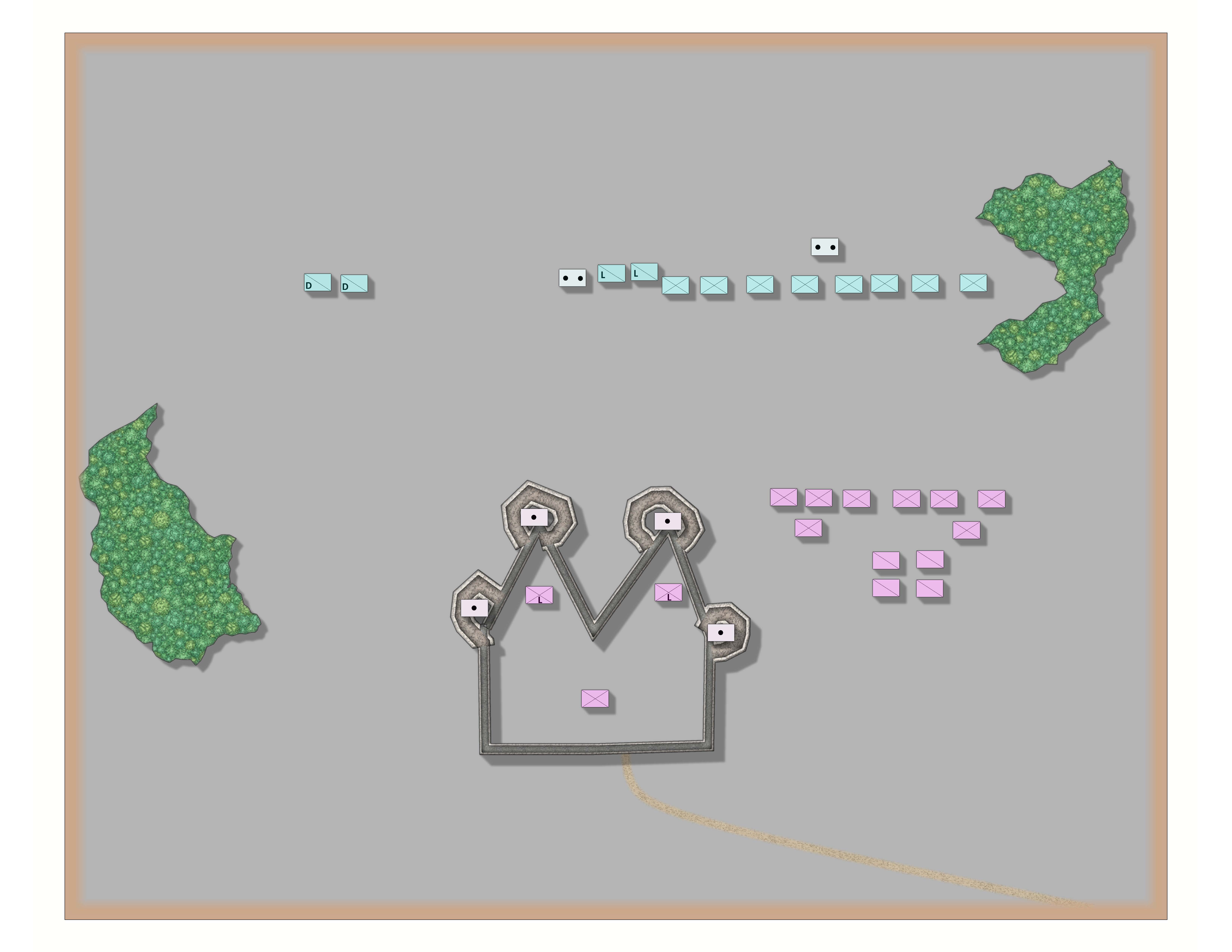
4×4 Board, with a large redoubt in the center flanked by some forests.
Models Needed: 24 or so elements of Swedish infantry 25% should be heavy infantry, 3 large Swedish artillery batteries, and 10 elements of cavalry. For the Russians 16 or elements of infantry 25% should be heavy infantry, artillery for the rebout and 12 elements of cavalry.

Set-Up

The Swedes should be prepared to assault the fortress, while the Russians should be defending it. The defensive facilities were hastily constructed and did not have the capacity for the entire Russian contingent, leaving many troops to fight outside its walls.

Objectives
Sweden seize the redoubt. Russia destroy 75% of Swedish artillery.

July 7th 1520 Battle of Otumba Wargame Scenario

The Battle of Otumba was the Aztecs’ last chance to expel the Spanish invaders from their homeland. Outnumbered 20 to 1, Cortés and his men fought bravely but were nearly crushed under the weight of numbers. In a last-ditch attempt to survive, Cortés sent his best soldiers to attack the Aztec command.

Wargame: any medieval skirmish game. Could also use Age of Sigmar or other rules.
2 Players
4×4 Table
6 Conquistador Models armoured and mounted
100 Aztec, lightly armed and Armoured, plus 1 leader

The scenario is simple: the Spanish want to kill the leader, the Aztecs want to stop them. use basic terrain, rocks, creeks, whatever you have.

Special Rules- Movement of the conquistadors should not be blocked by the Aztecs due to their mounts.

July 6th 1809, Battle of Wargram Wargame Scenario

The Battle of Wagram was one of the largest battles of the Napoleonic Wars. Napoleon took six weeks to prepare his offensive against Vienna, assembling an army of French, German, and Italian troops, 150,000 strong. Austria responded in kind, fielding 170,000 soldiers with 388 guns.

The battle was costly on both sides, with over 80,000 total casualties. Day two featured an interesting early engagement. An Asutiran column with 32 battalions, 40 squadrons, and around 60 cannons attacked the French flank. The French III Corps under Davout commanded 31,600 soldiers, 6,200 cavalry, and 120 cannons.

Both sides were to call reinforcements to the area. Our game will start in the early hours of the morning and proceed.

Rules: Use any corps-level Napoleonic Wargame Rules, ours is set for General D’Armee

2-4 Players

Models Needed: 34 French Battalions and 50 Squadrons. 50 Austrian Battalions and 40 Squadrons. 10 French artillery stands, and 8 Austrian Artillery Stands

Table Size 12×4

Terrain. Generally flat. The French should start with a height advantage while the Austrians assault.

Objectives

The Austrians surprised the French in the early morning hours, but underestimated the French numbers. Their goal will be to seize a French command post behind the French lines. The French must counterattack or the Austrian reserves will come into the field and overwhelm them. The French goal is to push the Austrian forces back to the heights.

Set-Up

The French should be in two separate commands, one for each Flank. Each command should have 12 battalions and 10 squadrons with four batteries. The remaining battalions should be in reserve. The Austrians should start on the offensive with 32 battalions in two columns on the table, along with the 40 squadrons. Each column should have three batteries for support. The remaining Austrian forces should be in reserve.

Special Rules

Reserves. Napoleon noticed the threat of the flank attack and sent over his heavy cavalry reserve. These should begin to enter the table after the 4th turn on a 6, then a 5, and so on.

After the 7th turn, Austrian reserves should enter the fray.

July 5th 1943 Battle of Kursk Wargame Scenario

The Battle of Kursk in 1943 remains the largest tank battle in history. The front line was over 1,000 miles long, and the fight itself lasted seven weeks. 3.4 million soldiers from both sides participated, with 10,000 tanks and 35,000 pieces of artillery.

The battle took place in two key areas. The North near Bolkhov, and the South around Kharkov. The center of the field bore a striking resemblance to the Battle of the Bulge. The offensive started out as a German operation. We are going to take charge of the Soviet counterattack.

Order of Battle
Germany
Gunther Von Kluge
941,000 Soldiers
3,253 Tanks
9,467 Guns
2,110 Aircraft

Soviet Union
Geogry Zhukov
2,500,000 Soldiers
7,360 Tanks
25,000 Guns
2,800 Aircraft

Wargame any 6mm Game like O Group or Baccus 6mm Rules. You could also go up to 15mm with Flames of War. You want the game to incorporate Airstrikes, artillery, armour, and infantry.
Player 2-20. This game is designed for many commanders in different areas, divided as you see fit, you could even put an umpire to work here.
Models Needed, as many as you want, literally. I doubt many people own 1,000 tanks, let alone 10,000
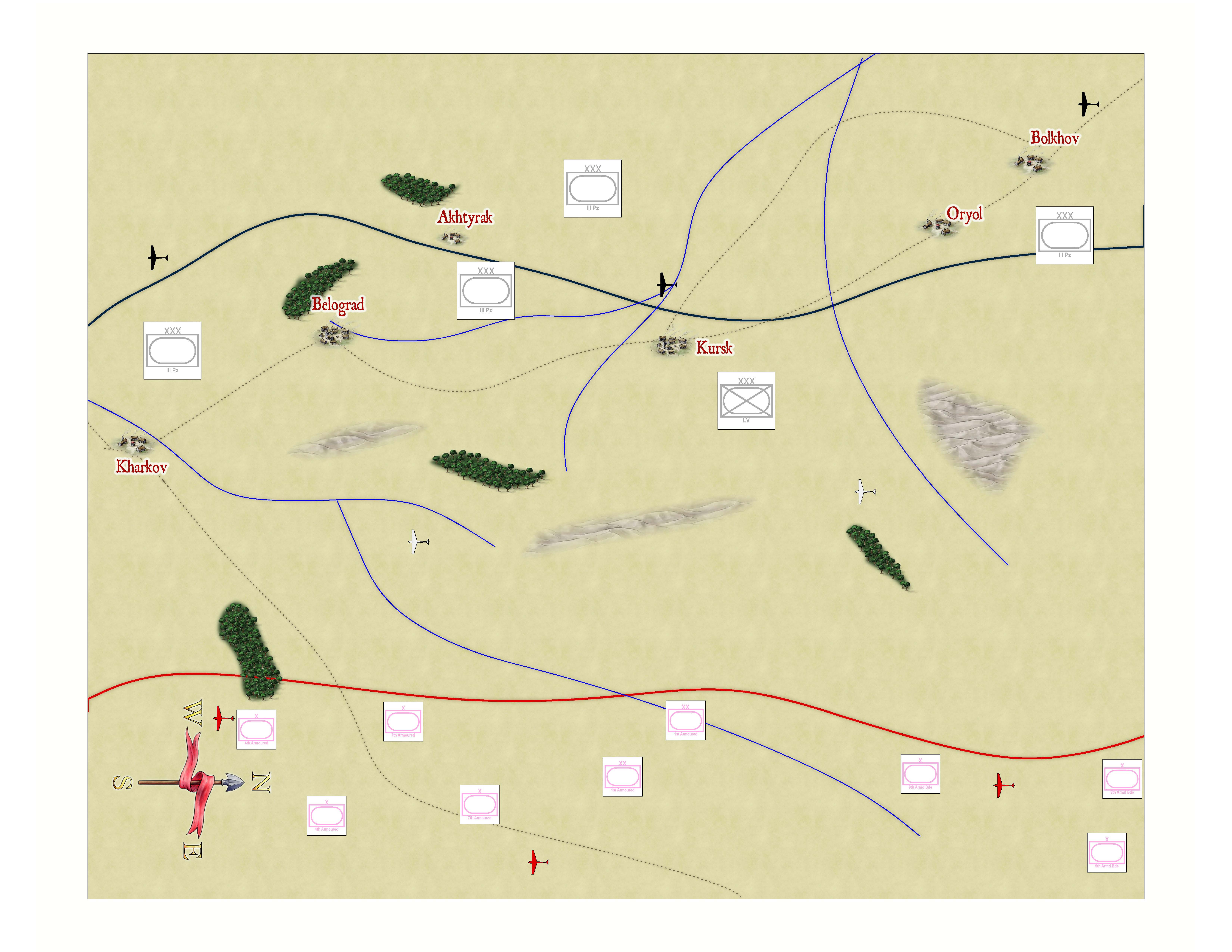
Table Size: The game can be played in two ways. You can use the above campaign map with different sectors and fight battles in the various sectors, changing terrain for each sector battle. Or you can put as much of the fight as you want on a single table (best in 6mm or 2mm).
Fighting Battles. The Soviets should have about 20% more units on the table, in terms of points, than the Germans.

Campaign Map,

Units should be able to move 2-3 squares, depending on the road situation. Discuss with your opponent.
Air support will only be available within 5 squares of the airbases marked.

Objectives
The Soviets want to retake the marked cities on the map. The Germans want to hold their ground.

July 4th 362 BC Battle of Mantinea Wargame Scenario

The battle of Mantinea in 362 BC was fought between two rival Greek city-states. Thebes and Sparta. While Sparta and Athens are the best-known city-states in ancient Greece. Thebes was renowned for its rich culture and esteemed educational institutions. It was located in the plains and had many agricultural exports.

Thebes was no slouch militarily either. In 371 BC, 8 years before our battle. Thebes defeated a Spartan army at the Battle of Leuctra.

The Battle of Mantinea was part of a larger civil war between the Thebans, led by the Boeotian League, and Sparta and Athens, which were aligned against their growing power. Thebes allied with the Spartans during the Peloponnesian War of 431 BC, which caused resentment in Athens. During the battle, the Spartans were able to slay the leader of Thebes. Although Thebes won the battle, they were unable to capitalize on their victory and achieve greater success due to the death of their leader.

Order of Battle
Thebes, commanded by Epaminodas
30,000 infantry
3,000 Cavalry

Sparta, commanded by Agesilaus II
20,000 Hoplites
2,000 Cavalry

Wargame Rules: Hail Caesar, DBMM, any other large Bronze Age battle system
2 Players
Models Needed
Two armies’ worth of hoplites and skirmishers with light cavalry. The Theban military should be about 20% larger than the Spartan army. For example, if you are playing DBMM 400, the Thebian should have 480. Historically, the famous Spartan warriors numbered only about 1,000, and that should be reflected in list building. Feel free to have many commanders and allies, as that was a common feature amongst the forces.
Terrain: The battle took place on a large flat plane flanked by two mountains.

Objectives:
The Spartans must try to kill the commanders for the Thebians. The Thebians must defend their commanders and rout the enemy.

July 3 1863 Gettysburg Day 3 Wargame Scenario

Day 3 of Gettysburg was marked by a massive artillery bombardment and Pickett’s famous charge. Two cavalry actions, Northeast and Southwest of Gettysburg, were less well-known but equally important.

Our game will focus on the Northeast action. The Southwest action was basically a slaughter for the Confederates with few Union casualties.

On the Northeast, three Confederate cavalry brigades and three infantry brigades attempted to assault the Union right flank. Five Union cavalry brigades met the onslaught of a very mobile battle covering 5 square miles.

Wargame
For use with Across a Deadly Field or Other Civil War wargame
2 Players
Equal amounts of forces for the Union and the Confederates
6×4 Table with woods, farms, roads, and small creeks

Set-Up
Set up a table, and each player picks a side. Place 3 objective markers around the battlefield. One should be at the center of the table, the other two on each side, wherever the table owner determines they should be placed.

Players should fight to control the objectives. At the end of 10 turns, whoever controls 2 objectives wins the game. Any forces that are destroyed should be replaced from the owning player’s table edge.

Extra Rule

The two objectives near the players should move each turn. Use a scatter dice with direction to move the objectives. The central objective should remain stagnant.