June 2nd 1676 Battle of Palermo

During the Franco-Dutch War. Dutch and French forces were converging on the city of Messina who was in revolt to its Spanish rulers. The Dutch were allied with the Spanish. The French did far more damage than the Dutch force; however, battered the Dutch were the French pulled off making the victory meaningless.

French

Commander Duke of Mortemart

24 Ships of the line
5 Frigates
25 Galleys
9 FireShips

Dutch-Spanish Force

Commander Jan den Haen, and Diege de Ibarra

14 Ships of the Line
13 Frigates
19 Galleys
4 Fireships

Wargame

RuleSet Black Seas
2-5 Players
Models Needed: 100
Tablesize: 4×8
Terrain: Enough islands or rocks to create a bay.

Set-Up

The Spanish ships should be arrayed in line formation at the mouth of the bay. The Dutch ships should be arrayed in a similar fashion on the opposite side, facing the same direction.

The French should have their ships arrayed in a line approaching from the Spanish side. Frigates and galleys should be in the space between the two lines.

Objectives;

The French must inflict as much damage as possible on both fleets without losing a capital ship. The French must also evade the coastal batteries, which should have the firepower of a first-rate ship of the line.

The Spanish and Dutch forces need to use their screen to avoid losing any ships of the line. They do not need to inflict any damage. The fleet may flee at any time into the bay.

Additional Rules:

Fireships played a significant role in the battle, dealing most of the damage to the French.

Coastal batteries cannot be destroyed and should deal high damage.

June 1st 1917 Battle of Jutland Wargame Scenario

The Battle of Jutland was the largest naval engagement of World War I and the last battleship-on-battleship engagement in history. Like most major naval engagements, it was indecisive. Both sides claimed victory. Germany sank more ships by 2:1 and killed more men by 3:1. The British were able to limit German access to the North Sea.

Order of Battle

Britain

Commander John Jellicoe and David Beatty

28 Dreadnoughts
9 Battlecruisers
8 Armoured Cruisers
26 Light Cruisers
78 Destroyers
1 Minelayer
1 Carrier

Germany

Commander Reinhard Scheer and Franz Hipper

16 Dreadnoughts
5 Battlecruisers
6 Pre-Dreadnought Battleships
11 Light Cruisers
61 Torpedo Boats

Wargaming the Encounter

RuleSet Broadside
Table Size 8×4 or larger.
Number of Players 2-7
Models needed, 100 give or take.

Set-Up

I would advise using 1:1800 scale ships for this encounter. Most ships are available as 3d prints. This scenario should be played on a large table. If a large table is unavailable, reduce the range of various ships. Maybe the maximum range of a battleship is 6″ and the ideal range is 4″.

You do not need most of the destroyers and light cruisers. If you choose to use them, they should be kept in squadrons of 4 to 6 for scouting or anti-submarine activities. The core of the action is the dreadnoughts and battlecruisers.

The main crux of a game like Jutland is to balance the two forces, even with the numerical difference. At Jutland, the British were disorganized and out of formation, while the Germans were prepared for battle.

For the setup, the British should be divided into three squadrons of 8 dreadnoughts, and 2 armoured cruisers with support ships, similar to the actual engagement. If you have more players, the British should have up to five commanders while the Germans should stick with two. The Germans should also be broken up into three, eight-ship squadrons with three or four lighter ships each. However, these should enter much closer together in a more traditional Vanguard, Center, Rearguard scenario.

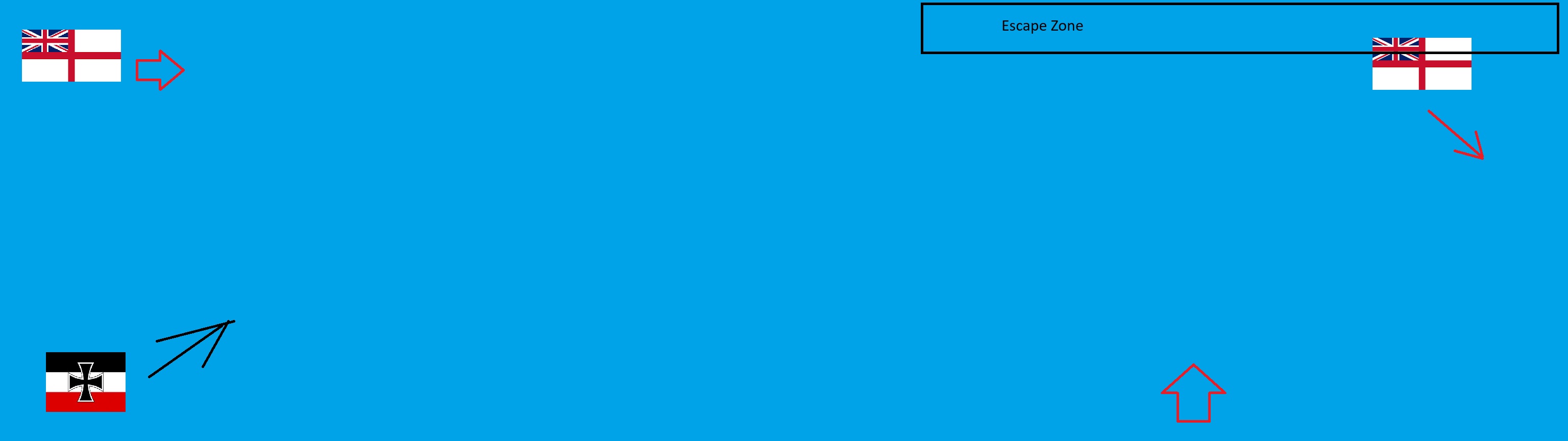
One British squadron should be about 10% away from each edge, with the Germans engaging from the bottom left. One British Squadron should be kept in reserve and begin entering the fray after an adequate number of turns. Depending on your system, it should be the middle of the game, so if a typical game is 20 turns, they should enter around turn 11.

The scenario’s challenge involves doing enough damage to the British squadron nearest the German fleet before the reserve squadrons can turn around and engage. The Germans must also escape the topmost table edge.

The British must quickly bring their forces to bear. Due to their spacing, the British should not allow their commanders to communicate with one another.

Victory;

The British will win if they inflict more damage on the Germans than the Germans inflict on them. The Germans will win if they inflict more damage or cause less damage, but every dreadnought and battlecruiser escapes.

Additional Rules
The Germans had submarines in the area; they could place torpedo markers that forced British ships to change course. British scouts could eliminate these markers if needed.

Fog played a significant role in the battle, as visibility was limited. This can be gamed by having the British reserve commander be in a different room and only communicating with one-line telegrams.

Scout forces also engaged and caused minor damage. Based on the scouting results, a pre-battle scouting game could take place, with the sides getting better positioning.

A Comprehensive Guide to Wargaming Terrain Part 7 Hand Crafting

This will be my shortest and sweetest post. There is no better way to wargame than with handcrafted terrain.

See the shortest and sweetest.

Benefits of Handcrafted

Remember what came from 3D Printing? Handcrafted is better. The care, the design, the patience. All things crucial for a wargamer. You can build anything as long as you can picture it. Thousands of YouTube videos and blog posts will help you on your way. Want to craft an airbase from Top Gun: Maverick go for it. The possibilities are endless. It is your size, vision, and hobby in the most whole way possible.

Handcrafted terrain is typically far cheaper than any other option. You can use garbage and recyclables to create stunning dioramas of perfect proportions. You can buy craft paints from Walmart, brushes from the cheapest of the cheap places, and make something of your own.

Downsides

The only downside, and unfortunately, the most consequential, is time. It takes time to build, vision board, paint, learn, and time, and more time, and more time.

The other slight downside is artistic skill. I am not an artist, but I think this can be practiced again with time.

Handcrafted Terrain Resources

My favorite youtube is Zorpazorp.

My favorite book is Terrain Essentials.

A Comprehensive Guide to Wargame Terrain Part 6 3d Printing

Very little can be said about 3D Printing that others have not written about. You can buy any form of terrain 3D printed that you can imagine. Want a scale model of Helms Deep? Boom, got it. Want a Kashyyk-style tree village, done. Want industrial acid basins and floating skull rocks? You can print them.

As wargamers, we have stopped asking if we can and started asking if we should.

I am not going to discuss how to 3D print. There are thousands of YouTube videos and guides on how to use a 3D printer and what 3D printer to buy. I will focus on my experiences with 3D printing and how that helps or hinders me as a gamer.

What to 3D Print

I personally own about ten 3D printers, two or three of which are functional at any one time. I know I am hard on printers, but I also don’t have the time, energy, or discipline to properly maintain such sensitive hardware.

I have found that the happiest part of printing is small prints of minor pieces. If I want to add a burned-out car, I can find a print for that. If I want some sandbag barricades, a few fences, or tank traps, I am happy to 3D print those.

I struggle with 3D printing because I want to do large setups. That Helms Deep scenery I talked about earlier? I hired it out. I am finding that by investing my time, buying the filament, and dealing with failures, I have forgotten or lost my passion for the project. I figured I would need $765 worth of filament, and I was able to order the scenery for $1000. Large scenery is better purchased. With the low barrier to entry in the market, you will always get a fair price.

If I need a specific building for a scenario—think Pavlov’s house for Stalingrad, or I did a Geonosian table—I am happy to 3D print it. However, I refused to 3D print my competitive 40k setup; it required over 140 prints, and I just didn’t have the energy.

How to Use 3D Prints

3d Prints are usually more durable than handcrafted or MDF items. The right 3D prints can also be stunning in detail. No matter how good the model is, a poor 3D print job tends to be unsalvageable.

I also think 3d prints must be painted to look acceptable on the table. I am well-versed in using rocks and some buildings in filament grey. They really just look like brown or grey lumps on the table. Get out your airbrush, throw on a basecoat, and then get a big drybrush and go over everything. Your models will pop on the table. You don’t have to do a bunch of details like shutters or drainpipes, just a basecoat and a drybrush.

My favorite use for 3D printing is to bring something to life. For the third time, I will refer to Helms Deep, an iconic location and one of the most significant cinematic battlefields ever. My crafting skills would be woefully insufficient to create such a majestic location. 3D printing fills that role. It is tangible and durable, and I can pack it away until next time.

Downfalls of 3D Printing

3D printing is the perfect solution for wargames. You can print exactly what you want. You can change the scale. With enough practice, you can even edit the models to your liking.

The biggest problem with 3D prints is space. The voluminous number of models available means I want all of them. I like Eastern European buildings, Western European buildings, American West buildings, South American buildings, Moon Landings, Elven buildings, and Orcish Camps, and I want them on different scales.

I literally own multiple warehouses and storage facilities and I am having trouble storing the amount of shit I have acquired for gaming. My addiction to buying 3D-printed scenery is a significant part of that problem. Looking at my most recent Etsy Orders, I have 3 full 40k or AOS terrain tables en route.

Each table typically requires a large tote to store, which requires labeling and even remembering exactly what is in that tote.

One major drawback of 3D printing is the layer lines. These layer lines will show up with a simple dry brush unless properly sanded or filled. To alleviate this, I prime most models with an automotive primer that fills most lines. It also fills in many details.

Other downfalls can include a lack of connection to said scenery. In our hobby, it is essential that we are happy with our participation. We will spend 1000 hours on a single army, painstakingly painting facial features and belts and using waterslide decals to place insignia. We take them to the table and create stories regarding the models, and we remember each and every figure. Crafting buildings from foam, measuring, and painting builds that connection. A 3D print doesn’t.

Finally, the environmental impacts of 3D printing are not insignificant. If you’re into that sort of thing, think of how much plastic can be created and wasted, the large spools, the spilled resin, and the unused models that we print because we can. That kind of workload has a measurable effect on the environment.

Overall

I would recommend 3D printing to all hobbyists in any hobby. The tool is far too versatile not to use. You no longer need a $2,000 machine with tons of software and custom-built parts. Most printers are plug-and-play. To be able to download and print a Japanese bunker in the Philippines one day and a trebuchet the next is invaluable for someone who plays a variety of games.

A Comprehensive Guide to Wargame Terrain Part 5

Feel free to look back at parts 1,2,3,4. Part 5 will focus on scatter terrain and other enhancements.

Scatter terrain is simply items scattered about the battlefield that add flair but not much to gameplay.

Scatter terrain has a special place in my wargaming soul. For photo-realistic games, scatter terrain is crucial to what we do as gamers. Why would we have a ruined structure with no rubble around its base? A WWII Battlefield with no impact craters? Fences and hedges in the Civil War and European battlefields.

The other aspect of scatter terrain is how it impacts gameplay. In 40k, a Land Raider can’t end its turn on top of a piece of terrain. If we add too much scatter, the game stops working. The same works for your rank and flank games; a fence is hell when dealing with a movement tray.

Why Use Scatter Terrain

As challenging as the scattered terrain is, it looks good on the table. Broken bits of concrete with rebar sticking out, damaged furniture, burned-out cars, and an upturned cart with a dead horse are all staples in cinematography. If you want a gorgeous table, scatter terrain is a must.

Scatter is also amazing in small skirmish games. A couch in the middle of the street becomes a cover piece in Bolt Action. Marvel Crisis Protocol lives or dies on scatter terrain pieces. A new flair is added to a caved-in ceiling on a boarding action board.

I swear by adding telephone poles and street signs to any battlefield. It just adds that extra something.

Where not to Use Scatter

Any large-scale wargame designed to be more competitive struggles with a ton of scatter added. Even less competitive but still large-scale don’t work well. Flames of War, Genera D Armee, Across a Deadly Field, DBMM, The Old World, Conquest, Age of Sigmar, and 40k don’t need scatter terrain. Stick with what the rules call for.

Best Types of Scatter

You really have to think about how you want your game to feel. Scatter that doesn’t interfere, but also has to have a purpose. Hay bales and wood piles provide cover. The same with burned-out cars. Piles of bricks just get in the way and are difficult to clean up post-game. Small, fully-painted flower gardens look nice, but don’t add to gameplay. However, a concrete sidewalk next to a city street in a modern zombie game adds so much to the feel of your table and doesn’t hinder gameplay in the slightest.

Street signs can be removed if hindering, but they look nice for photos.

My ultimate pick for scatter terrain is stuff that can be easily set up and cleaned up.

I generally only set a table for two or at most three games. I have full respect for players who go all out and spend 100 hours creating a custom table for Lord of the Rings or World War Z or whatever else. Every piece of terrain and scatter is meticulously painted, and the photo ends up in some magazine.

That’s not me. I want a functional table to play on that looks nice. End of story. If you are the type of player who wants a photoshoot-quality table, this isn’t the best guide for you. If you just want to level up your table from bleh to meh. Take my advice.

A Comprehensive Guide to Wargaming Terrain Part 4.

Next, we must discuss mats, trees, hills, and other landscape terrain.

Mats

Mats are used to cover the tabletop. There are literally thousands of designs and hundreds of manufacturers. I consider a good mat to be essential for building miniature battlefields.

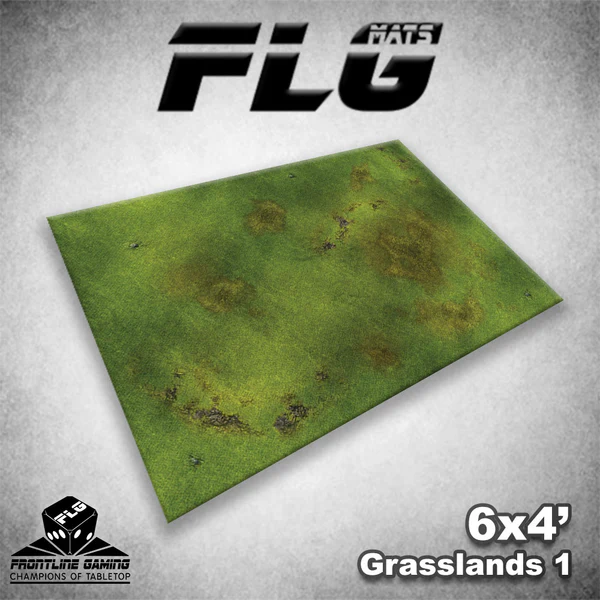
The best mats are neoprene with a non-slip rubber backing. They are very similar to mousepads. They are durable, can pack in a ton of detail, and don’t slide around the tabletop. I recommend Frontline Gaming. I think I own 30 of their mats.

There are several considerations for buying a game mat.

Material Type: As I said before, look for a neoprene mat. 95% of all games will look fine. The only exception would be if you want one of the long grass mats for historical wargaming. These have a very nice texture, but they make a mess, and spiders like to hide in the grass. I try to stay away from cloth mats. They have a better texture than neoprene but are very hard to lay flat, the same with dry-erase plastic and other similar materials.

Table size: Don’t buy a mat that is too big for your table. When shopping, the manufacturer will list the mat size; you can typically get the same pattern in multiple sizes. A 6×4 mat should be in the $100 range, but you can often find these on sale.

Game: Know what size your game needs. Star Wars Legion is 6ft. x 3ft., and 40k is 44in. x 60in. For a standard game. I have found a 6ft x 4ft mat works for almost all games, as long as it fits your table. I typically opt for 8×4 mats as that is my table size, and I can always make the battlefield smaller with things like walls, fences, and rivers.

Terrain: My biggest kicker. I don’t want jungle ruins on a moon terrain map. This is one thing that irks me about terrain. You spend tons of money and time making nice terrain, so don’t pick up a mat that matches.

Storage: If you buy a mat or seven, ensure you have a good place to store them. If mats aren’t stored correctly, they will crease. I store my mats in a Christmas wrapping paper bin.

Trees

Trees are very useful in building a wargame table. Many game systems use trees as cover, breaking the line of sight, rugged terrain, and they just look nice.

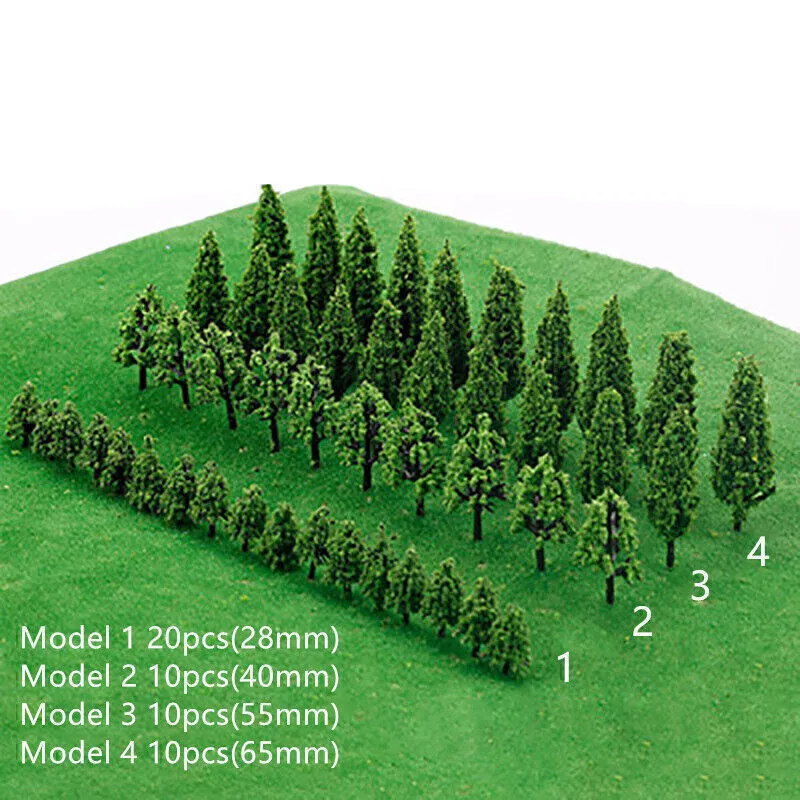
The options for trees are vast. I recommend that your first tree purchase be a Christmas village tree. These are generally cost-effective, scale well, and look fine on the tabletop. They are also quite durable.

Model railway trees are also an option. They are less durable than the Christmas variety but more detailed and typically cost slightly more.

My final recommendation is to search Etsy and see what you can find. If you are crafty, you can make your own. This is one area of crafting where I have never really been successful.

Hills

Ah, the lowly, simple hill. In our hobby, hills are far more challenging than you would think. Miniatures tend to slide down sloped hills. There is rarely a place large enough for a unit of models to stand on.

When you can find a hill that works, it dominates the tabletop. To start wargaming, I would actually stay away from hills altogether. It helps keep your game simple, and most games are designed to be played on a flat field.

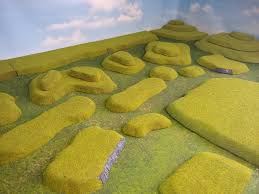
If you really want to get into hills with some of your historic games, I recommend flat-topped hills.

You can place an entire unit on the crest, and they have a good table feel. I would avoid gently sloping hills like the ones I own from Hexeton Hills. They are just too cumbersome on the table.

Other Landscape Features

There is no limit to how much you can put on a table. As someone who plays various games and periods, I lean towards universal terrain and avoid particular items. I try to keep the basics around: rough ground, fields, roads, rivers, ponds, hedges, fences, etc. Most of these have minimal impact on gameplay other than you move 1 inch less, you can’t cross this, and it provides cover. I have found that the more I scatter about the table, the more complex a game can be. They look absolutely incredible, and if that is what you are going for, by all means, make your table as detailed as possible for the best gaming experience. I would skip most of these small terrain items.

Until next time.

A Comprehensive Guide to Wargame Terrain Part 3

Now that you have played a few games, are tired of stacks of books and hardboard cutouts, and want to take the next step, I still don’t recommend breaking the bank; let’s look at budget starter terrain.

Most of this terrain will come pre-painted, limiting your upfront time and money investment. This gives you more time for gaming.

My #1 recommendation will always be aquarium terrain.

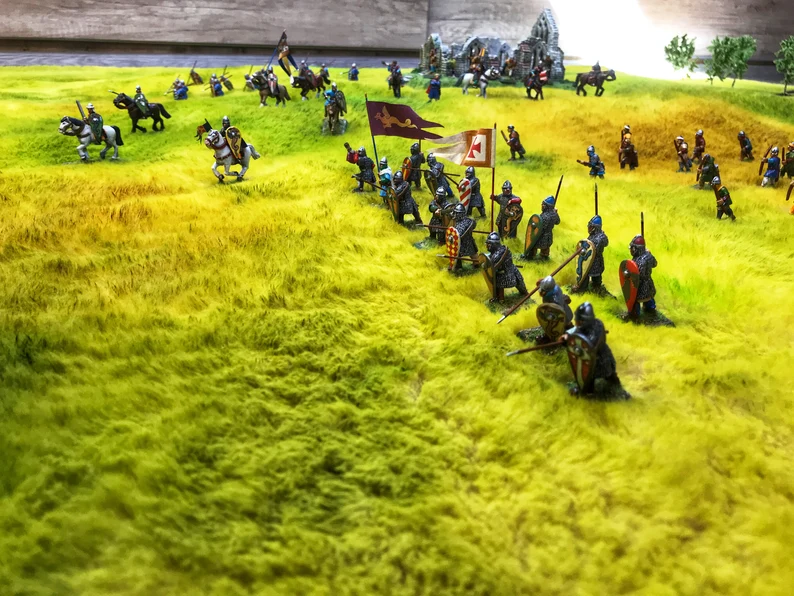
Rocks, ruins, castles, and plants—all for less than you will spend on two or three paint bottles. Ten or so good pieces will give a very nice-looking 6×4 table with interesting and varied terrain. The biggest con is that aquarium terrain is rarely thematic or scales with the models on the table. (table cost $140)

My following recommendation is to go take a walk. Find some public property along a riverbank or in the woods, grab 10 or 12 interesting rocks/pinecones/logs, and place them on a table. This terrain setup can actually be very thematic and fit your table. (table cost $0)

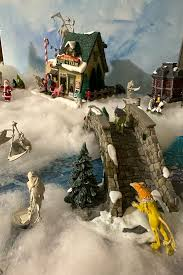
Another budget item is to visit thrift shops and church stores and look for Christmas village items. This is a great way to get a handful of buildings, perhaps a bridge, and some trees.

The terrain tends to look okay. Your battles can be pretty interesting, and you can even do fun missions, such as escorting Rudolph to the flying sleigh. The biggest downside to Christmas terrain is that it is primarily sealed, and your troops cannot occupy the buildings. (table cost $30-$200)

Trees for Christmas villages could be a category of their own. Often, these are the only trees I use. They look far better than I can make, and they fit the scale wonderfully.

My final recommendation would be to buy model railroad building kits.

Many buildings can be had for $15 or less. You can paint them however you like. They are very accurate to scale if you buy the correct scale. There are endless possibilities. My most significant downside to model railway items is there is a time investment and a hobby side. Most buildings require assembly and painting. The other con is durability. The model railway is for building models that sit and look pretty, not for gaming with frequent movement and other forms of abuse. (table cost $200-$400)

That is just a quick look at the options for terrain on a budget, for a burgeoning wargame. Tune in next time for information on gaming mats and other 2d terrain.

Flames of War Fortress Europe Soviets vs Germans

I am starting a string of 3 matches of the same game. I keep my interest longer with smaller match strings to see what happens.

I brought a decently large Soviet Force against a relatively elite late-war German Force. The Germans, as a whole, were unable to do enough damage to stem the tide of Soviet tanks and thus lost the engagement. I did misplay a little and did not dig in with the 88s. Could have made a difference, we will never know. The Soviets literally brought 21 tanks to the fight. I maybe could have positioned the 88s better to avoid so much damage the first turn, but I don’t think it would have mattered.

The mission was counterattack and the lists are below.

SovietsGermans
KVs Heavy Tank Regiment HQ4Tiger Tank HQ12
4 KV1’s Guard Tanks16Tiger Tanks x336
4 KV1’s Guard Tanks16Tiger Tanks x224
Hero T34 Tank Battalion HQ58.8 Tank Hunter Platoon 4x 8.8 CM Guns18
4 Hereo T34 Tank Company12Luchs Scout Troop 3x Luchs5
4 Hereo T34 Tank Company128.8 CM Heavy AA Platoon 2x 8.8 cm AA Guns6
3 Hereo T70 Tank Company3
Recon Company HQ2
Armored Recon Platoon6
Heavy Tank Killer Company 4x 76mm10
4x 122mm Howitzers8

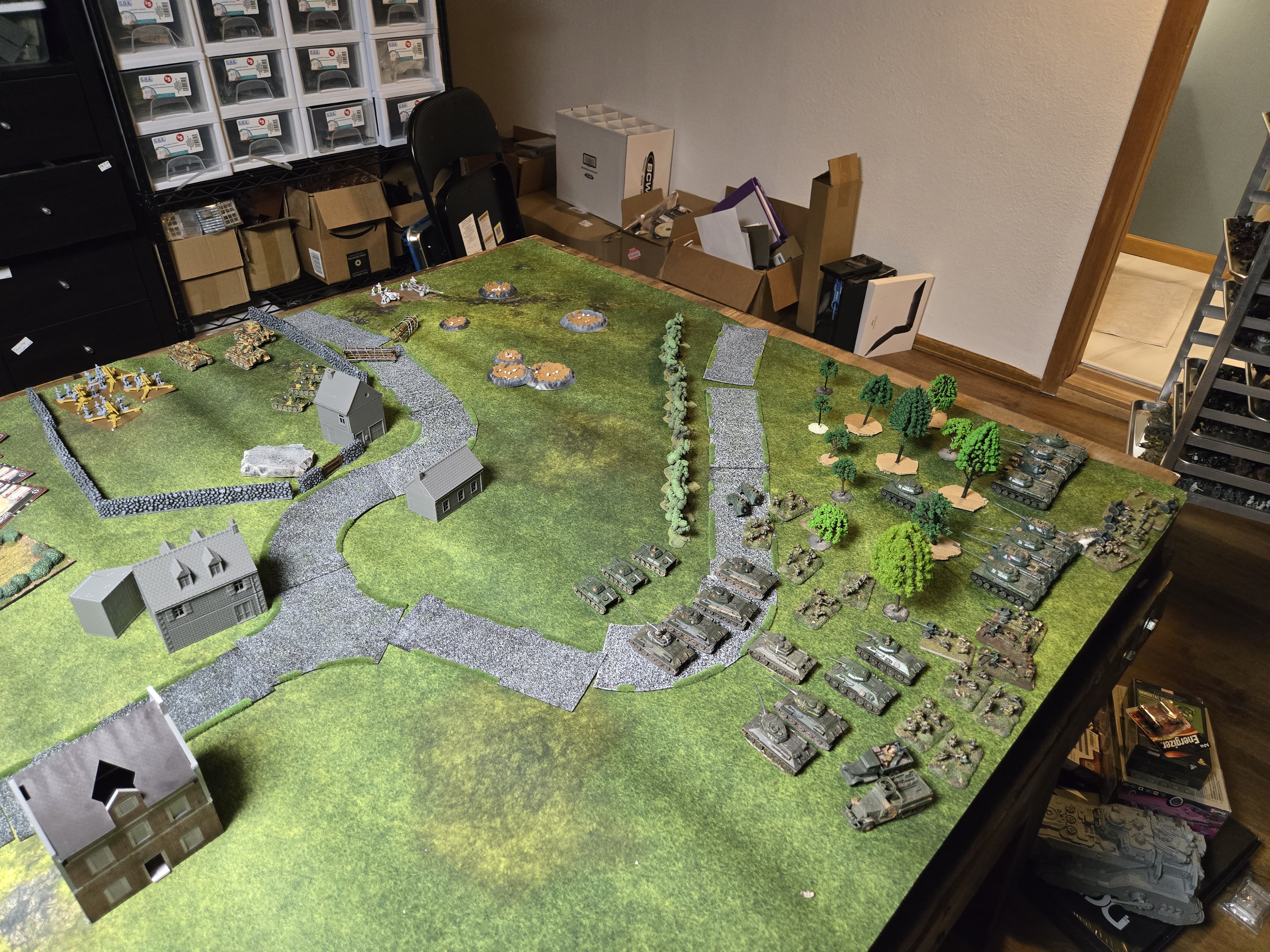
The primary deployment is below. The Germans have three Tiger Tanks in reserve; they will enter the game from the bottom left.

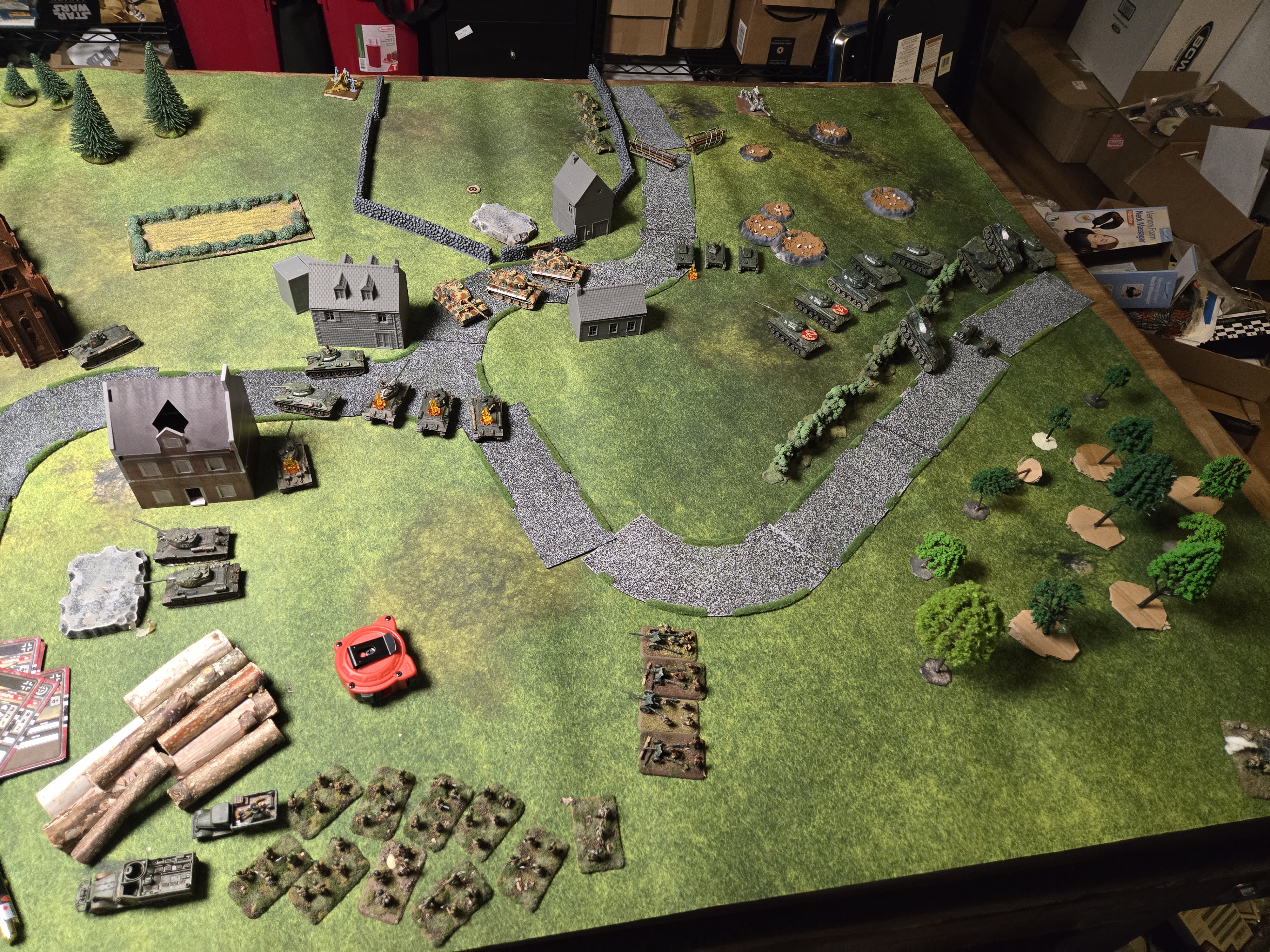
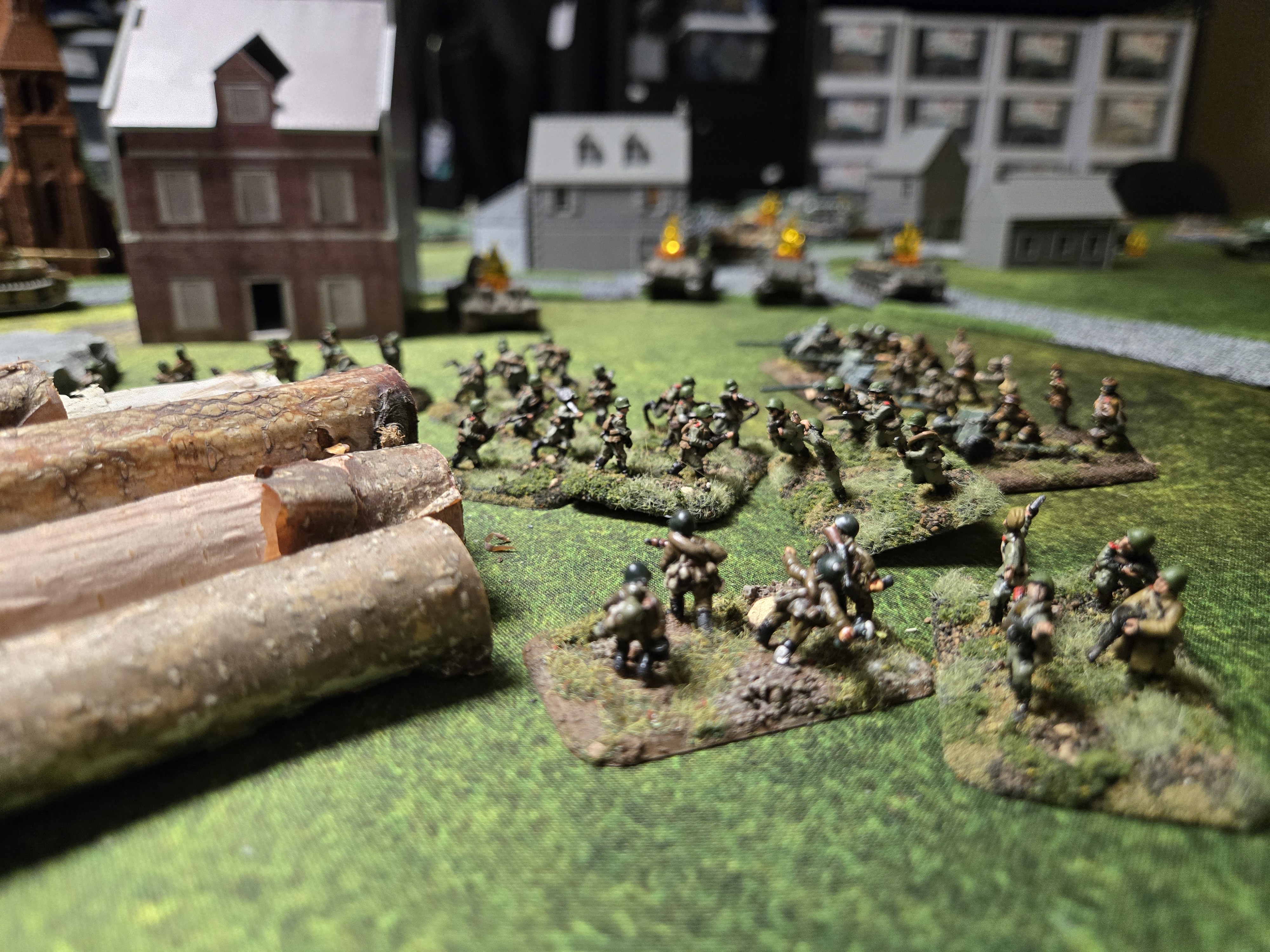
One turn in, and you can see that the German reserves have entered the fray. A very successful Soviet artillery strike estimated the leading German 88 group, killing 3 of the 4 guns. The German tanks completely desecrated the T-34s, pushing up the middle of the field while the KV1s pushed the right flank. The Germans planned to use their infantry to hold the objective. The Soviet scout droop did a great job ranging in the artillery.

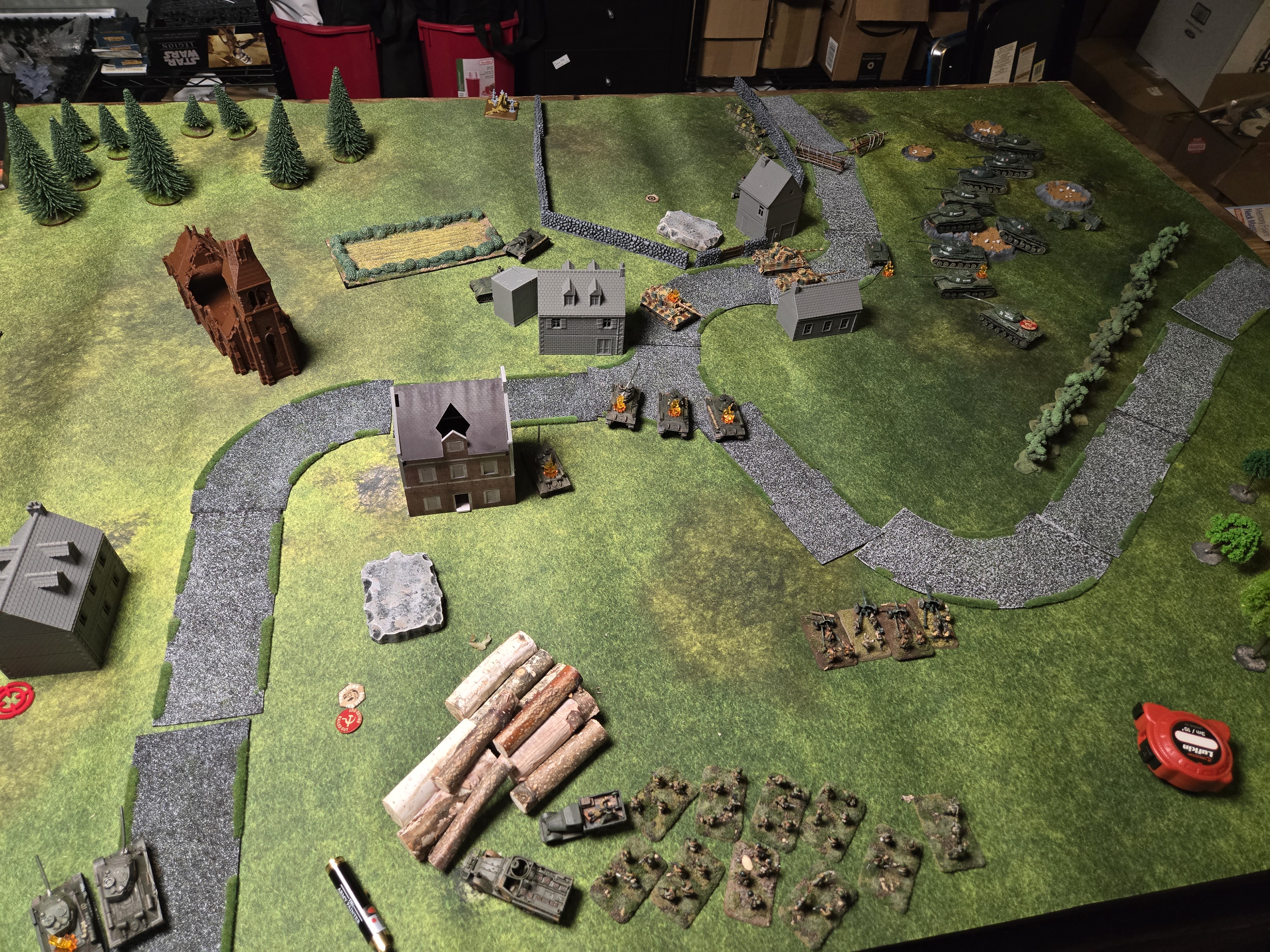
Turn 2 was much of the same, with more destroyed and bailed-out Soviet tanks. The German guns are safe for now. You can see the Soviet Tank hunters and infantry at the bottom of the table taking up positions.

Turn 3. Apparently, 4 tank hunter teams (side armor), and an artillery strike can destroy a Tiger Tank. I didn’t take many good pictures on the bottom of the board, but one of the up-gunned T34s also destroyed a Tiger. At this point, I didn’t have a plan for the Germans to win. Instead they just destroyed as much as possible and try not to lose.

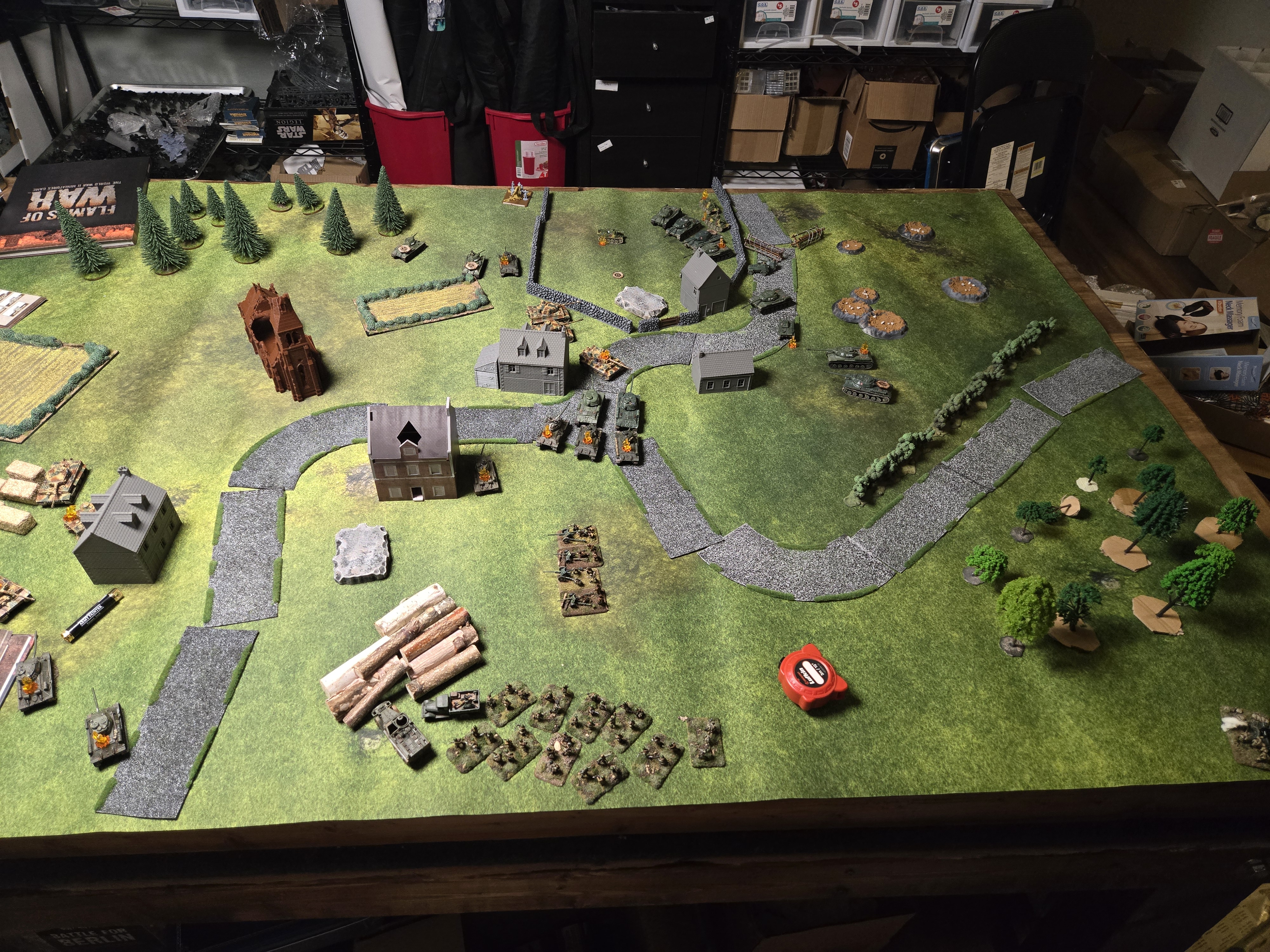
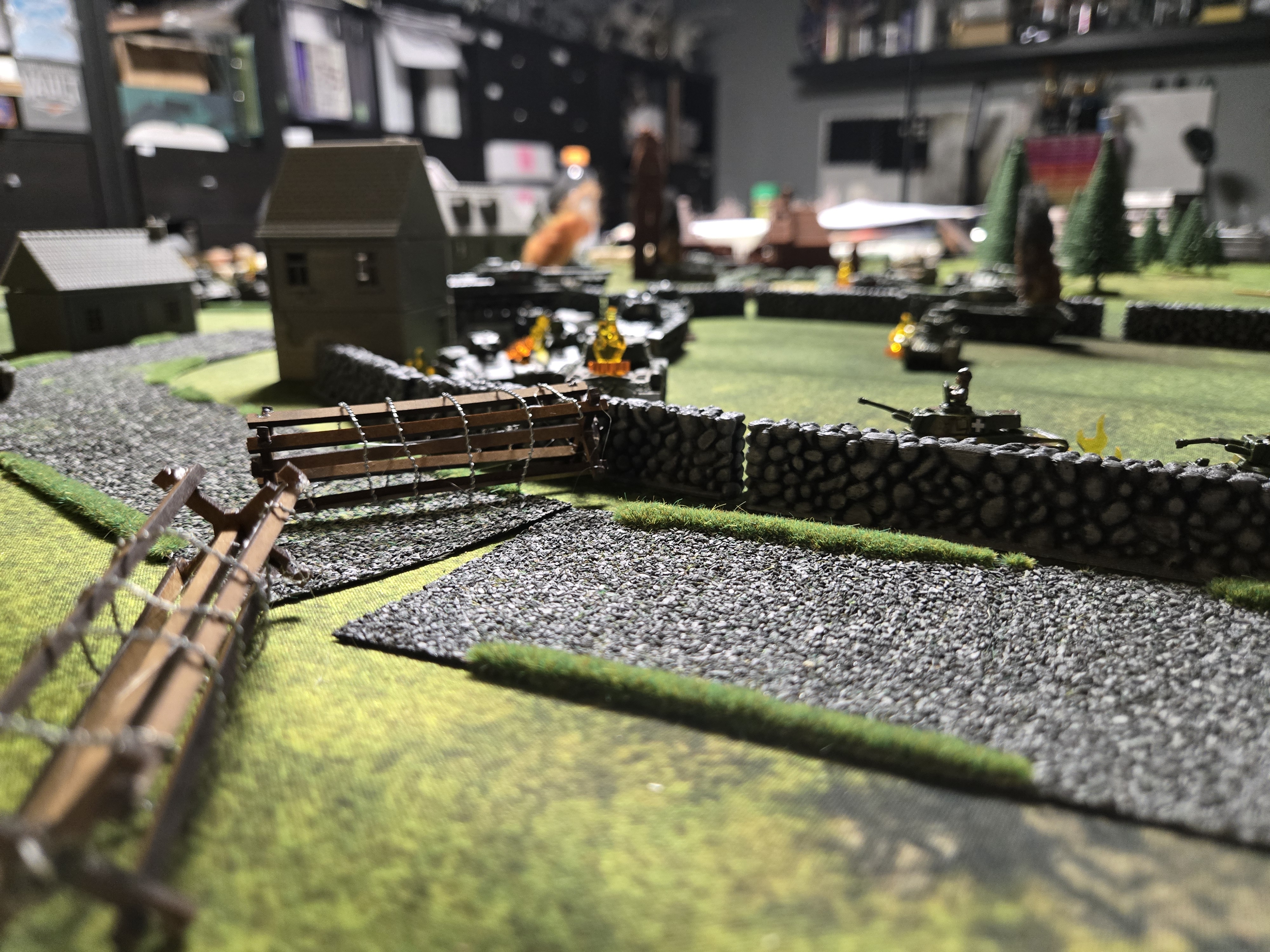
Turn 4, a brave group of T-34s tried to surround the German Tigers. They were annihilated. The lone Tiger on the bottom side was maneuvering to help his two brothers in the middle. The KV1s are pushing to completely surround the Tigers.

Turn 5: The Germans lost another Tiger and are in full pullback mode to try and salvage what they can. The Soviets are firmly rooted with 4 tanks on the objective and stand to win at the end of the following turn.

Turn 6, and you can see how it ended. The Germans were just unable to do enough damage to win the round.

A Comprehensive Guide to Wargame Terrain Part 2

You have played a few games, enjoy the hobby, and want to improve your tables.

Hooray. Terrain, as I will say, 100 times makes the game better. It is not required, but it sure is fun.

At this stage, I will avoid discussing 3D printing. I know what is out there and how amazing it is, but we are beginning hobbyists.

A Note on Scale

Wargames can use a variety of scales. Scale is determined by the height of a figure from the bottom of its feet to eye level. Warhammer models are about 32mm, so they are 32mm scale. Bolt Action is closer to 28 mm, while Marvel Crisis Protocol is 40mm. (aka Captain America is 40mm from his feet to his eye)

Scale matters when it comes to terrain. If a standard rifleman can stand, look over a building, and shoot, it detracts from the immersion. Consider this if you make or buy your own terrain. The type of game you are playing also matters. Epic Battles from Warlord games is about 10mm scale, designed for large, medieval conflicts with a couple thousand figures on the table. Narrow streets and cramped buildings wouldn’t be fun to play on.

The same can be said for Bolt Action, a 28mm WW2 game. The average army has about 30 figures and a vehicle. This game plays much better with more terrain, buildings of different heights, etc. It does not play well on an open plain with a small river.

If purchased for Epic Battles, the same river might be the width of a battalion, 150 or so yards across. In Bolt action, that same battalion is shorter than a typical Tiger Tank and little more than a stream.

It’s just something to think about. Most players I know won’t care if the house is about the same size as a Landraider or if their noble knight is just a little bigger than the door he is guarding.

What Terrain do I need?

This entirely depends on what game you are playing. Rivers don’t make sense if you play Battlefleet Gothic, a game in outer space. Like Grimdark Gothic ruins don’t make sense in the Wild West.

I always recommend starting with the basics. Roads are universal, and scale doesn’t matter much. You can buy some fabric from a local store and cut them out yourself (the cheapest option). You can paint and use cardboard, buy the neoprene roads from Amazon (my top choice), or even look at premium custom-made or 3D-printed options.

The entire above paragraph can also be said about rivers. Add a bridge, and you can have an exciting engagement. Most games allow faster travel along roads, and rivers are always an effective barrier or defensive structure.

Next time, I will add some vegetation; hedgerows and trees are universal among the wargames I played. Star Wars Legion, Flames of War, and Napoleonic all need some vegetation. Adding cover and breaking the line of sight always looks good. I have some expensive custom-crafted trees. I prefer trees for your Christmas village or the bulk boxes of fake trees you can buy on Amazon.

Hedges have always seemed a little trickier. These matter for scale, as a soldier shouldn’t be able to see over one, but a vehicle or mounted knight should. They are also a little harder to find. My favorites are plastic and 3D printing, but you can also find premade ones on Etsy. If you want to try making your own, a few YouTube videos and a trip to a craft store should yield good results.

I also think stone walls are reasonably universal. I use mine in dozens of games; they never go to waste. I buy mine on Etsy, but Amazon and 3d print shops also yield good results.

More Specific Terrain

At last count, I have armies for 47 different miniature wargames. I strive to make my terrain as universal as possible. I don’t add Soviet propaganda to my 15 mm buildings because I also used them in the Napoleonic and Ancient periods. If you’re just starting out, I recommend building one table first.

When building a table, look below at the types of games and terrain needed. Don’t worry about walls, fences, or many buildings if you are playing 15 mm Napoleonics with 400 figures on the table. Instead, focus on hills, fields, and forests. If you bought a kill team and want to expand into an entire 40k army, a grimdark ruin (3d print please) with several floors and bits of scatter is more thematic.

As always, buildings and vegetation are unnecessary if you are playing a space game like Billion Suns or a water game like Black Seas.

Types of Games

I classify boots-on-the-ground Wargames into four categories: Squad Actions (10-14 Figures), Skirmishes (20-50 Figures), Army Actions (100 figures plus), and ranked soldiers. There are other categories for naval, space, and airplanes, but that’s how I do it for boots-on-the-ground.

I know you may balk at this, but think: A squad of 10 men may fight over a house, a platoon of 60 men may fight over a compound, large structure, hill, or bridge, and an army will fight over a town or range of hills.

In squad actions, scatter terrain is vital. Broken furniture, light poles, crates, rubble, craters, computer terminals, and market stalls. When you only have 10 figures on the table, you can take your time to enhance some of the details. It generally leads to much more interesting games.

In skirmish games (think Age of Sigmar), you have a force of units on the table and generally move a few models around as a unit. No one would consider your 40-man army a full invasion force, but they look great on the table and strike a nice balance of hobby and playtime. Scatter is less critical here than elevation and line of sight. It rarely comes into play and is often just inconvenient.

In my book, army actions are typically reserved for historical events. I rarely consider using figures larger than 15mm in an army action game. This is when actual land features start to play: hills that hold entire battalions and dozens of cannons. A single fence or wall is inconsequential; the layout is more important. A forest that hides 3,000 troops, a river you can’t just walk across. A hill is several hundred feet high that overlooks a large camp. These are the types of terrain you should be working on. Unfortunately, most of these need to be crafted.

Finally, there are rank-and-file games: Warhammer Fantasy Battles, A Song of Ice and Fire, Kings of War, and Conquest. They want to act like army games, have the model counts of skirmish games, and are exceptionally difficult to move around. I treat them like army games, but I also push for utterly flat terrain. It doesn’t look as nice, but functionality is most important for the game’s playing.

Conclusion

Hopefully, this guide will help. Stay tuned for part 3.

40k League Match 5 Tyranids vs Astra Militarum

Another game, this time a devastating loss.

I had a tough time facing down 7 Lemon Russ, 2 Regal Dorns, and 4 Chimeras. My anti-tank just wasn’t practical, and it didn’t help. Instead of 3 maliceptors and 3 exocrines, I brought a Harridan.

I will see this game I did play well, just didn’t have the firepower.

Hive Tyrant (general) Synaptic Lynchpin255
Neurotyrant105
Old One Eye150
Gargoyles x2170
Carnifexes230
Exocrine x2270
Harridan610
Maleceptor170
Pyrovores40

Round 1

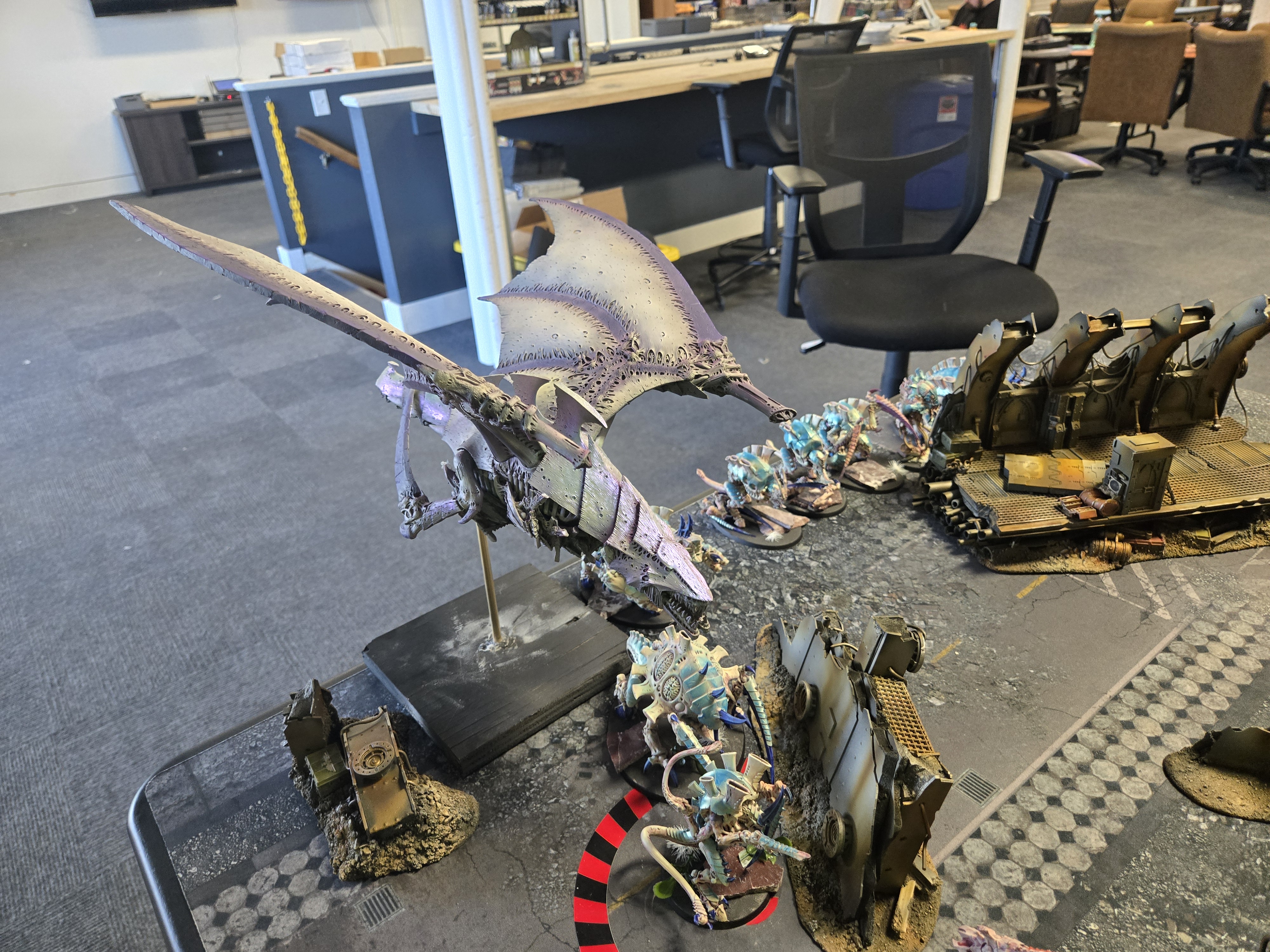
Nice shot of the Harridan overlooking his troops. His size and scale are compared to the Hive Tyrant and Maleceptor below.

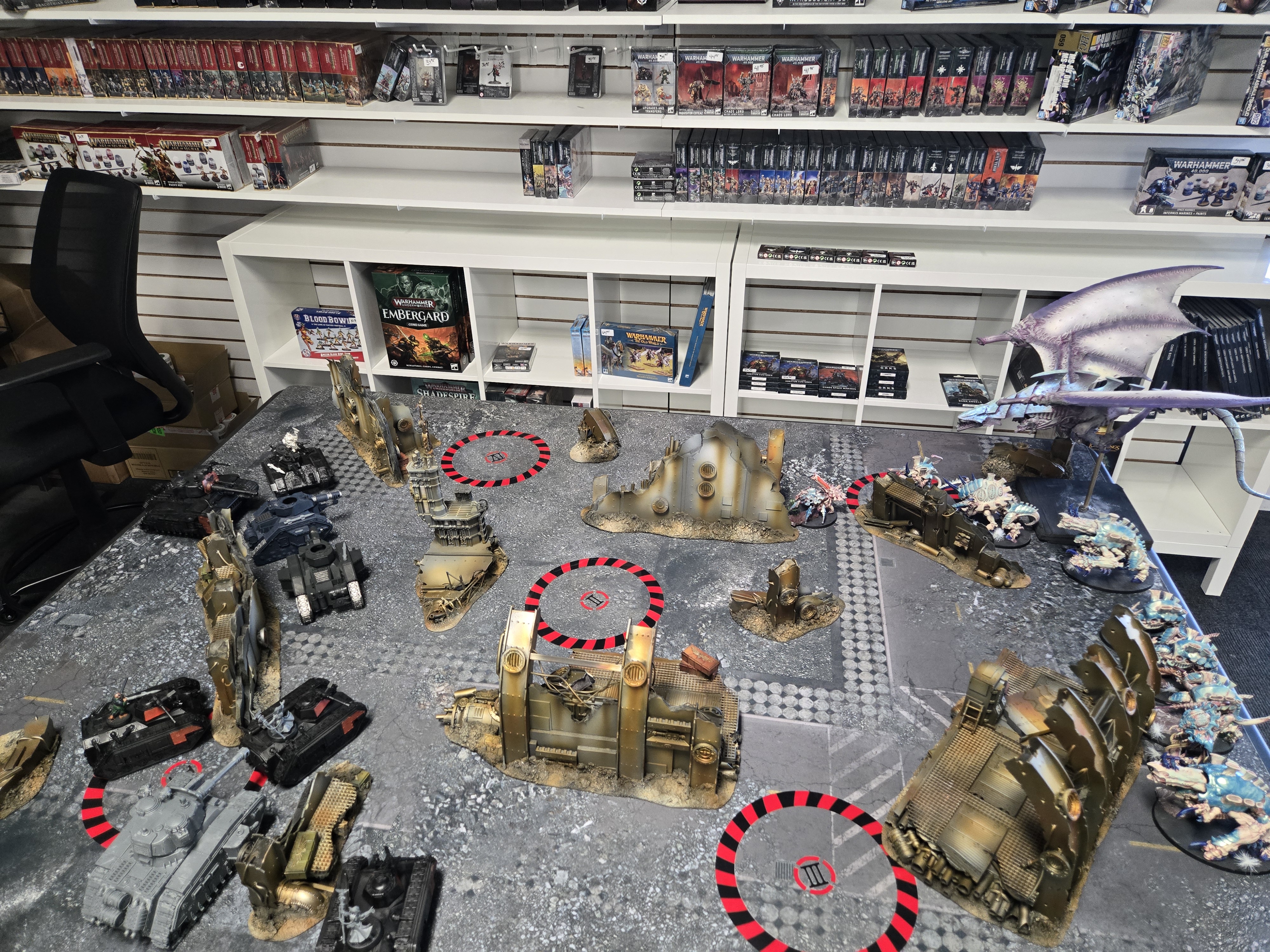
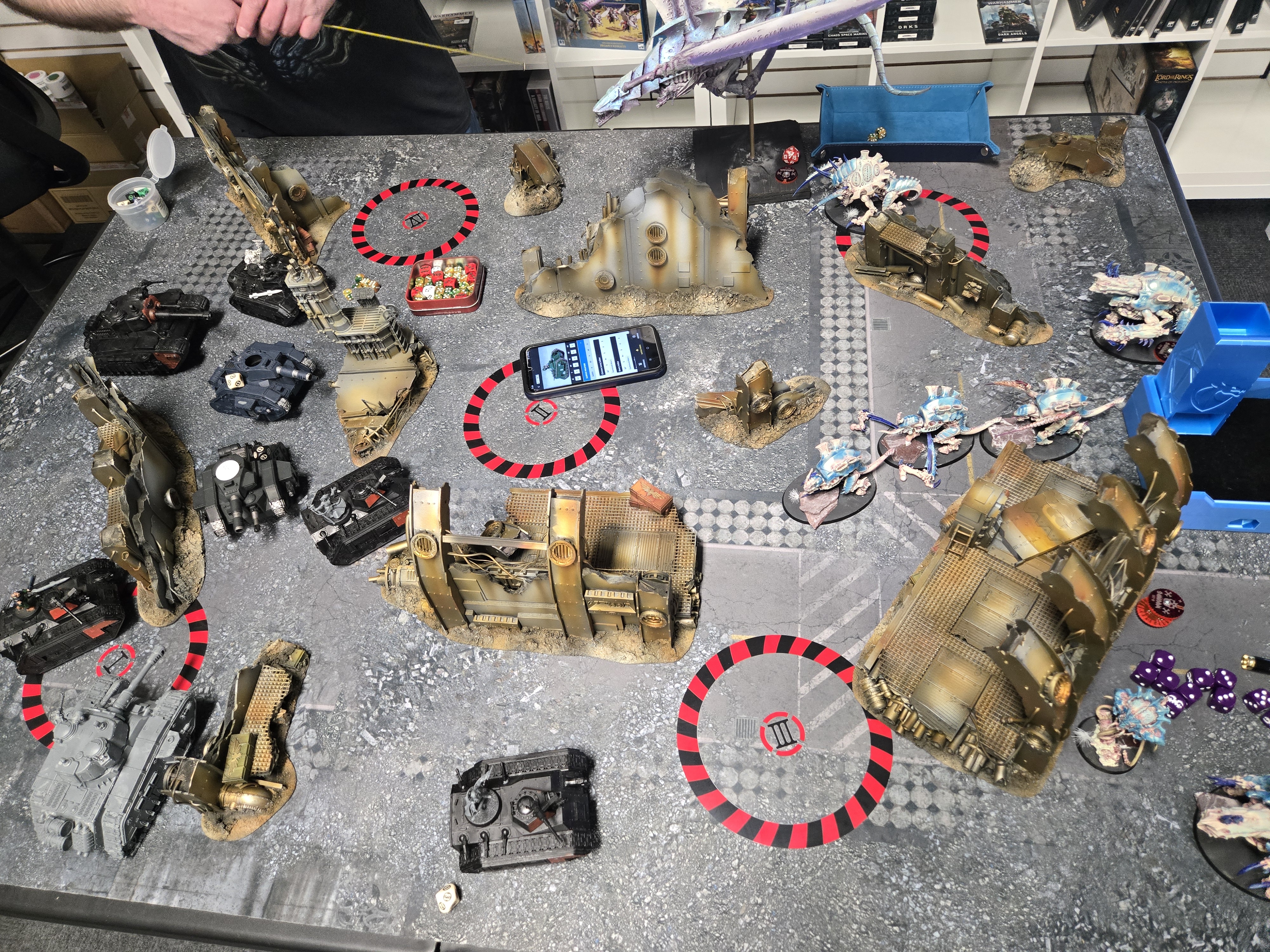
Our initial setup looked something like this. After looking at my opponent’s list, I knew I was going to have a tough time.

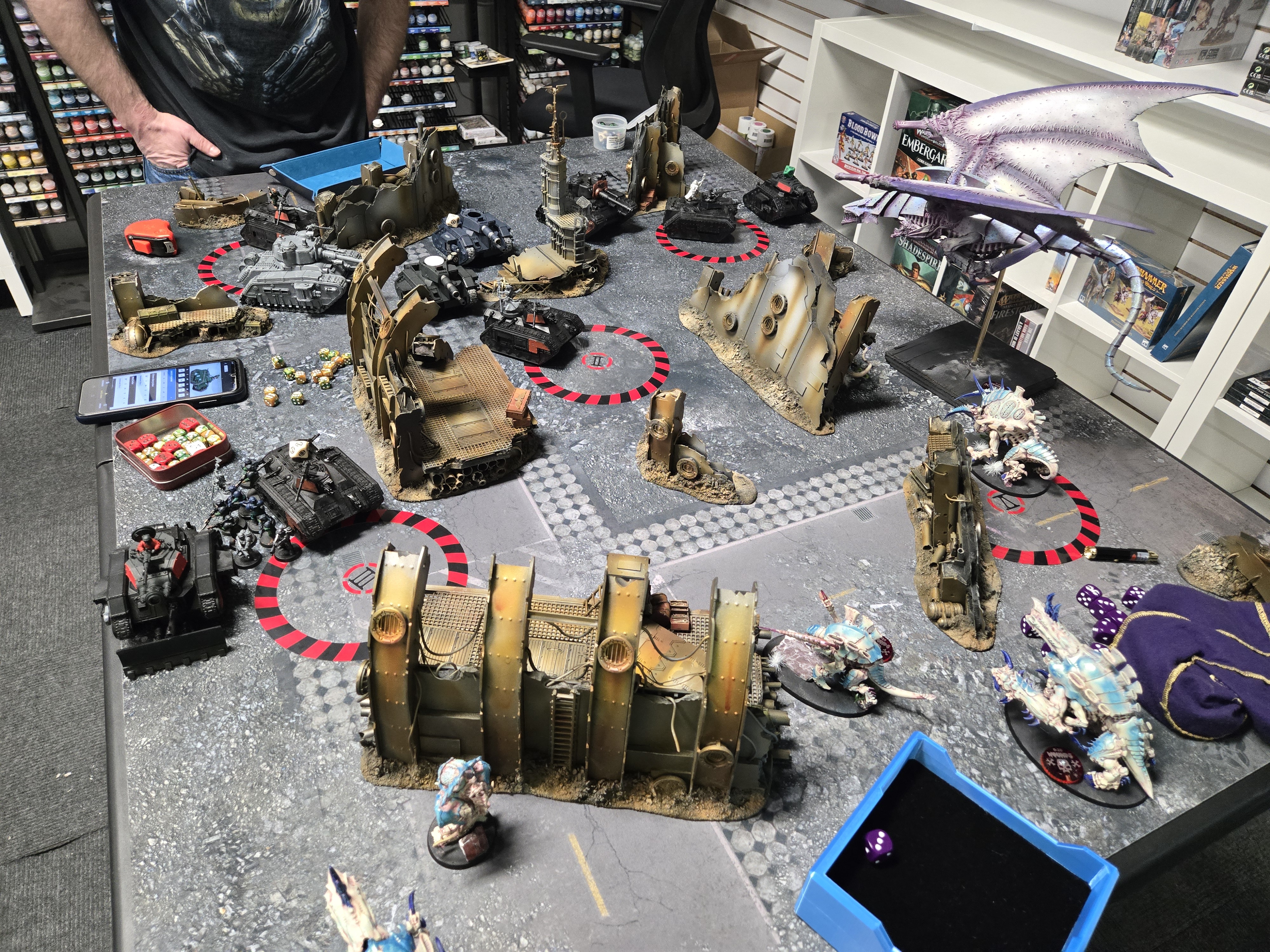
I pushed up with my melee units while he held firing lines with his tanks. This was very standard. I probably should have screened my carnify with gargoyles on the advance.

He didn’t shoot particularly well. I didn’t either, and after the first round, absolutely zero units were destroyed.

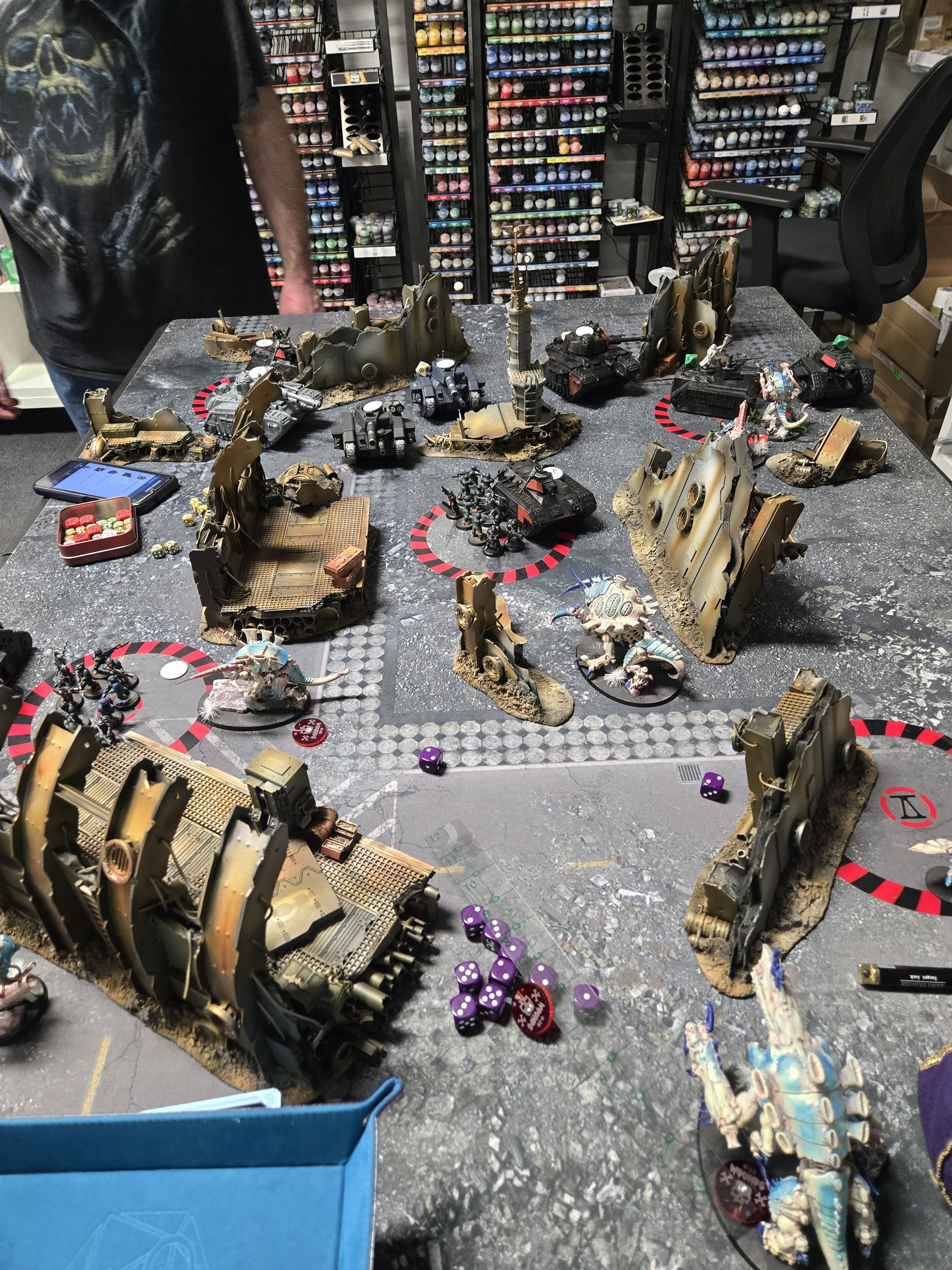
After round 2, I lost my carnify and still have not destroyed a tank. Plus, he was able to bring on two more from deepstrike. The game was over at this point. Both exocrines had less than 3 wounds remaining.

This was the end of round 3, as you can see, with minimal firepower. He would get to shoot again to start round 4. I let him try to table me, then conceded.