A Comprehensive Guide to Wargame Terrain

Greetings, new (or seasoned) wargamers, and welcome to my guide on wargame terrain. I want this guide to be very in-depth but spread over multiple parts. I love the terrain. It is wargaming, more so than the models themselves. I have spent fortunes on terrain that I am proud to have on the table. Click here for the rest of the series.

What is Terrain

In Wargaming, terrain is simply something we use to avoid battles on flat surfaces. Looking back through historic battles, terrain plays a starring role in how the battle shapes out: Germanic tribes ambushing Roman legions in dense forests, fierce fighting in Stalingrad over a grain elevator, and even the shallows at the Battle of the Nile.

When we play wargames, depending on the game, the terrain will change how our models move about the battlefield. There are games where terrain is a significant part. Rules for elevation, river crossings, and trenches all factor into our generalship. Hours are spent discussing target priority, strategic usage, and ideal lists, but using terrain is even more critical.

Getting Started

There are levels upon levels of terrain available for purchase. You can make it yourself, 3d print it, buy 3d prints, complete terrain kits, fully painted items, use non-traditional items, get fully custom-made-to-order commissions, purchase modular build kits, and endless other options.

But let’s say you bought a starter set, and you are tired of your miniatures shooting at each other across empty space. Maybe you have watched a video online about how to play your newest game, and they have these handcrafted realistic buildings, luscious grass, LED lights, flowing rivers, and jungle canopies. You look on Etsy and see this terrain set for $1,000. You put your miniatures away in a box, ending your wargame experience.

You don’t have to have beautiful terrain to wargame. If you are so overwhelmed by your first games by the sheer amount of options and all the shit you have to buy, it’s impossible to love the hobby.

In fact, if you are curious about wargaming, I would advise printing out paper models and paper terrain and getting a game started for $20 and an hour of work rather than $2,000 and 100 hours. Most games have a free ruleset available as a PDF for starters. See if you enjoy the game part. Then maybe visit a local game store. (My town of 7,000 has one; I’m confident the internet can help you.) Most stores have terrain you can use and tables to play.

Your First Terrain Set-Up

More people play casually at their kitchen table with their kids and friends than in a store with dozens of others. Stores are intimidating. You don’t want to ask for help or feel clueless. Gamers will walk in with backpacks filled with the latest and most fantastic devices and commission-painted armies, and you have a mound of grey plastic. It’s ok.

Feel free to use books, pots and pans, CD cases, cups, and mugs when playing at home. Break out a piece of paper and draw a river. It will serve its use, and honestly, books as buildings and hills are far more functional than most wargame terrain you may buy.

You want your terrain to be varied but balanced, not giving one side an advantage. One side has a stack of books overlooking the entire battlefield; the other should also. One side has a mousepad minefield, and maybe the other has a blue dinner plate used as a lake to restrict movement. You want your space between terrain to be large enough for the most prominent units to pass through most areas. You want a few areas with long sightlines so your snipers and other shooty units can shine. You want others with tight corridors so melee units can charge and have a go.

The models with the most significant footprint tend to be the most important. It wouldn’t be a fun game if your shiny new tank couldn’t drive anywhere. Below is a setup I did while writing this article in my shop with stuff from my desk.
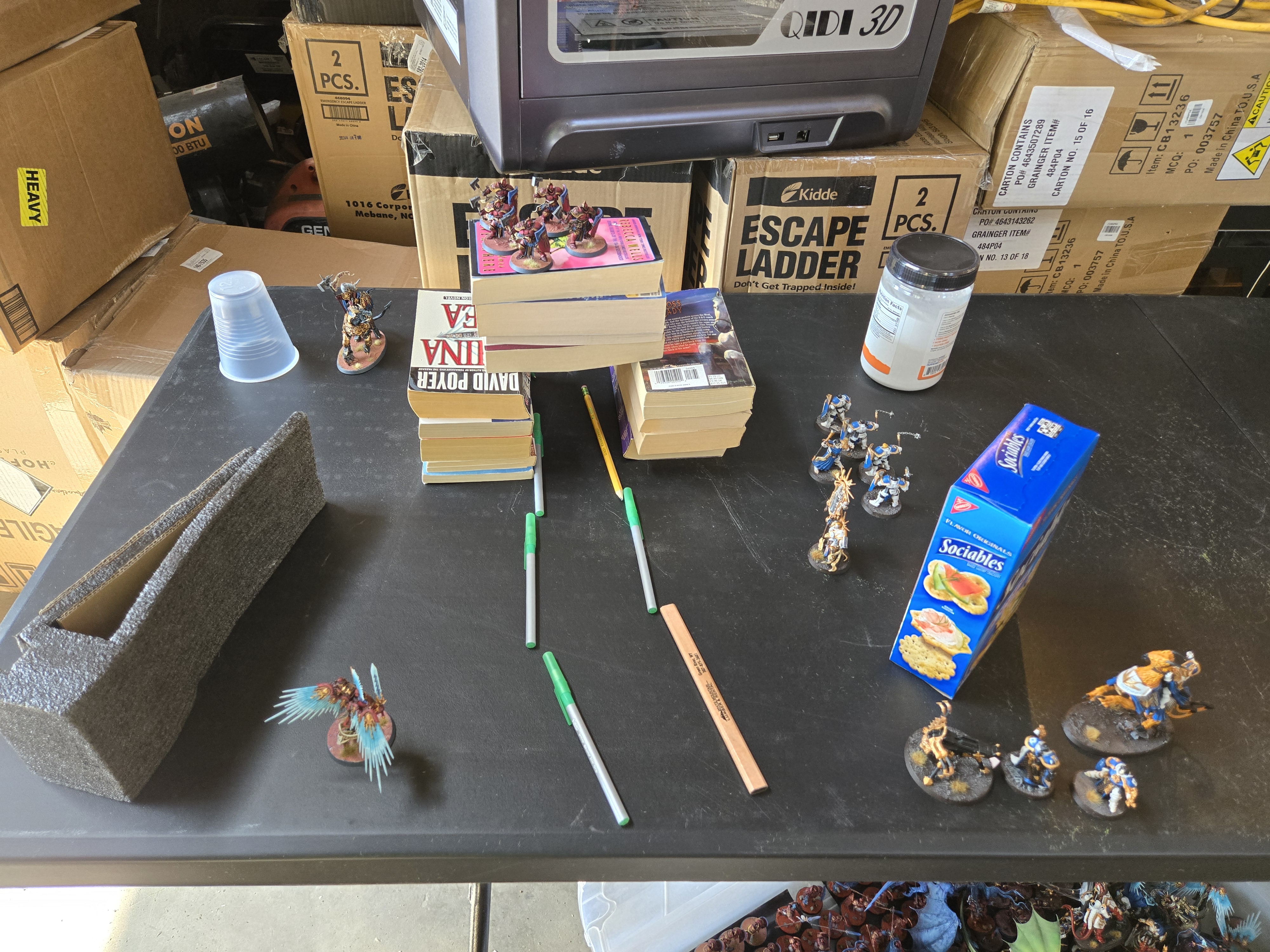
It looks just fine and is more functional than many of the fancy boards I have played on.

A Table

Warhammer, Marvel Crisis Protocol, Bolt Action, all have a recommended table size. Here is the kicker; it’s not required. Any coffee table, kitchen counter, or floor is acceptable. The most critical piece is to play the game and have fun. If we are not enjoying ourselves, then why waste our time.

If you really, really, really, want to buy a table, to start, buy the 30″ by 30″ folding card table for $15 at Walmart. It’s functional, large enough to play 750 points on, and if you decide against gaming long-term, you can use it for something else.

I prefer a table you can sit at. Also, this is just me. Having alternate surfaces to store dice trays, rulebooks, army boxes, and other items that we wargamers seem to think we need to successfully eliminate the enemy.
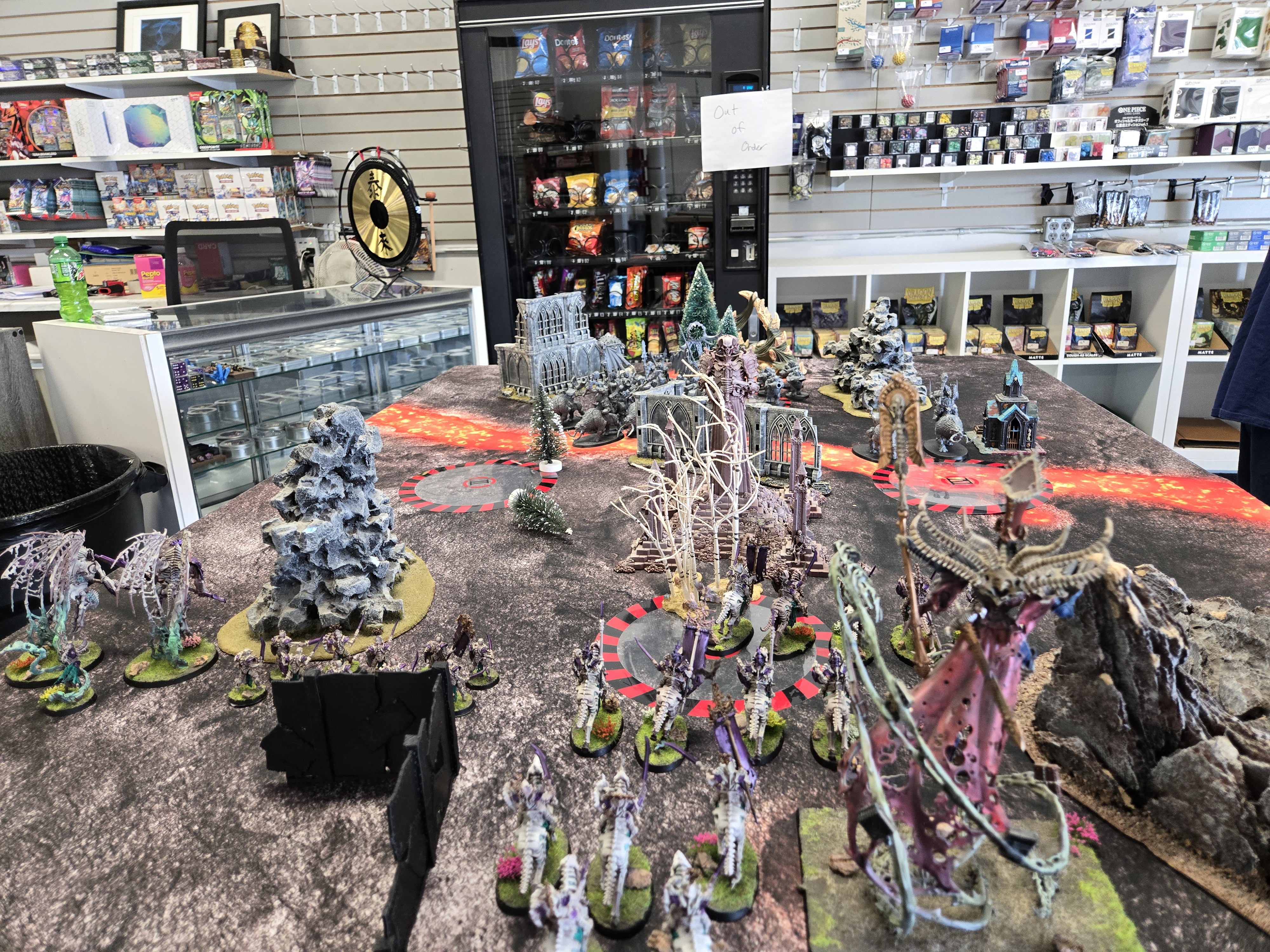
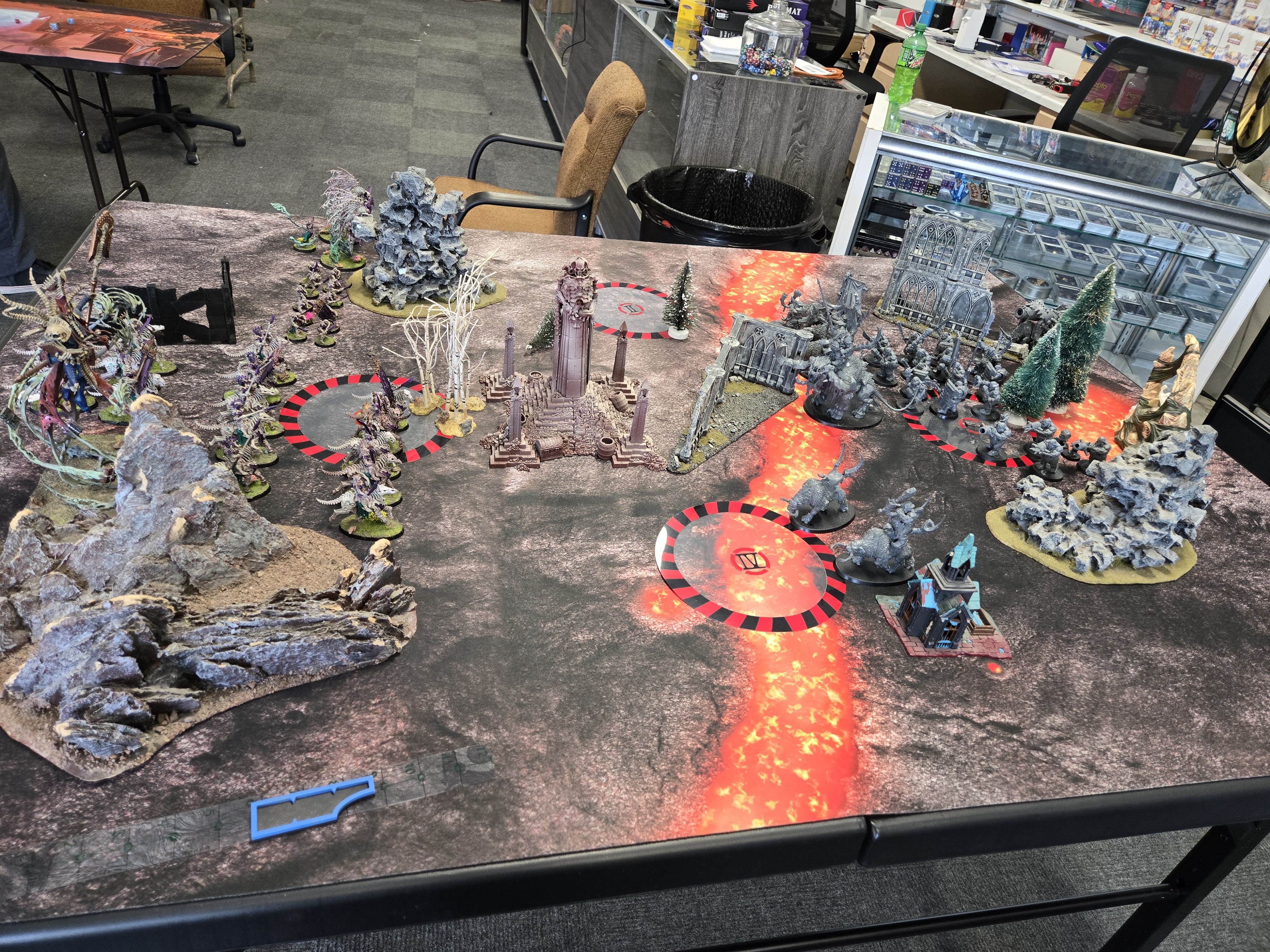
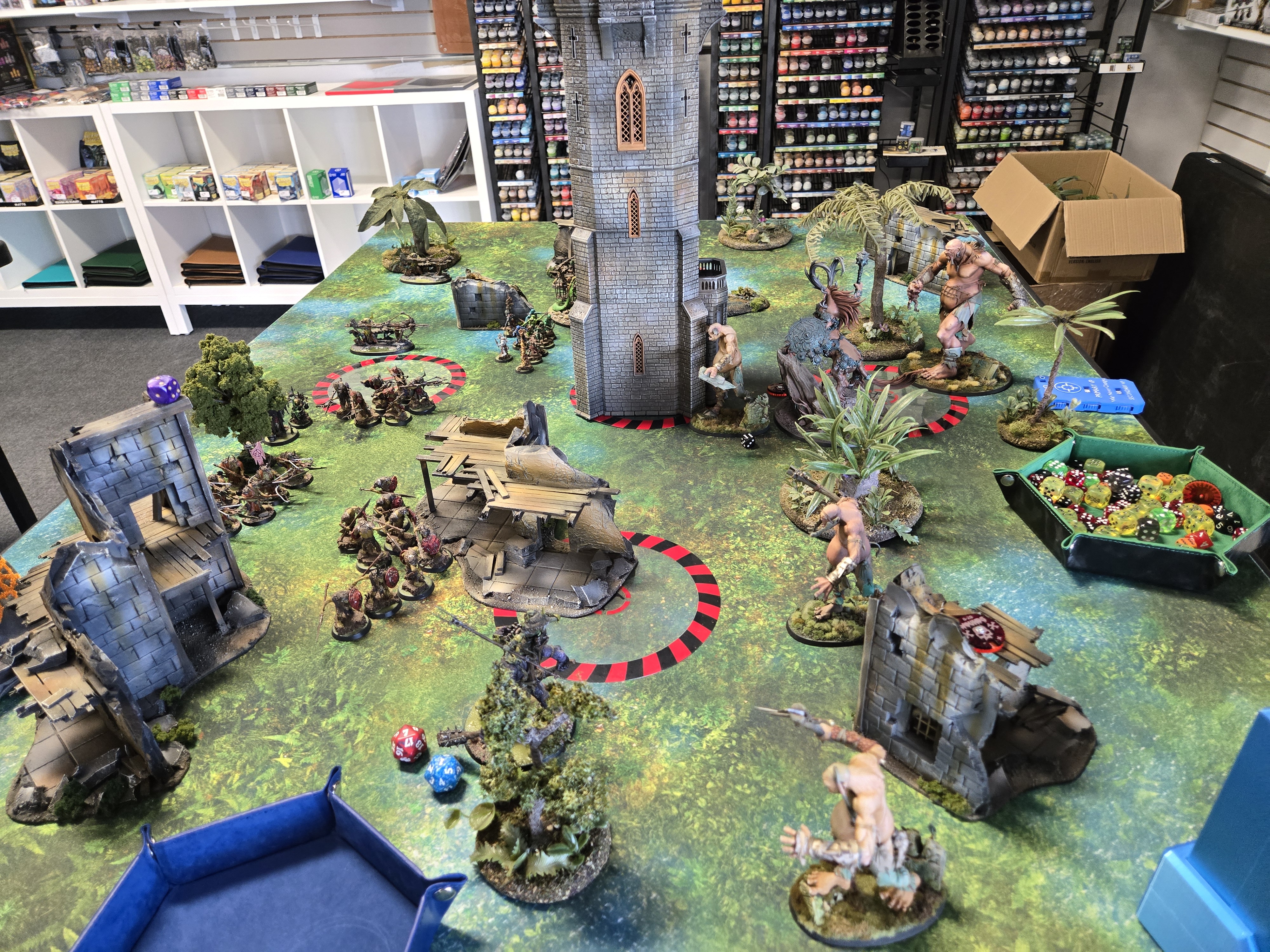
AOS Leage Match 3 Bonereapers vs Ogors

This weekend, I played my 3rd league match using the Ossiarch Bonereapers. I lost miserably.

Conclusions
– Like any game, a tuned list generally performs better than a list full of things
– If you want to be competitive, you need board control
– Running and hiding is acceptable
– Knowing thy enemy is important

Our lists are as follows.

BonereapersOgors
Nagash900Tyrant160
Deathriders x3600Leadbelchers150
Mortisan Ossifactor110Gluttons Reinforced480
Morghast Archai270Butcher150
Mortek Guard120Ironblaster200
Frostlord on Stonehorn320
Mounfang Pack (reinforced)
360
Mounrfang Pack180

My opponent was very aggressive and recklessly rushed forth with a small mournfang pack to take one of our neutral objectives.

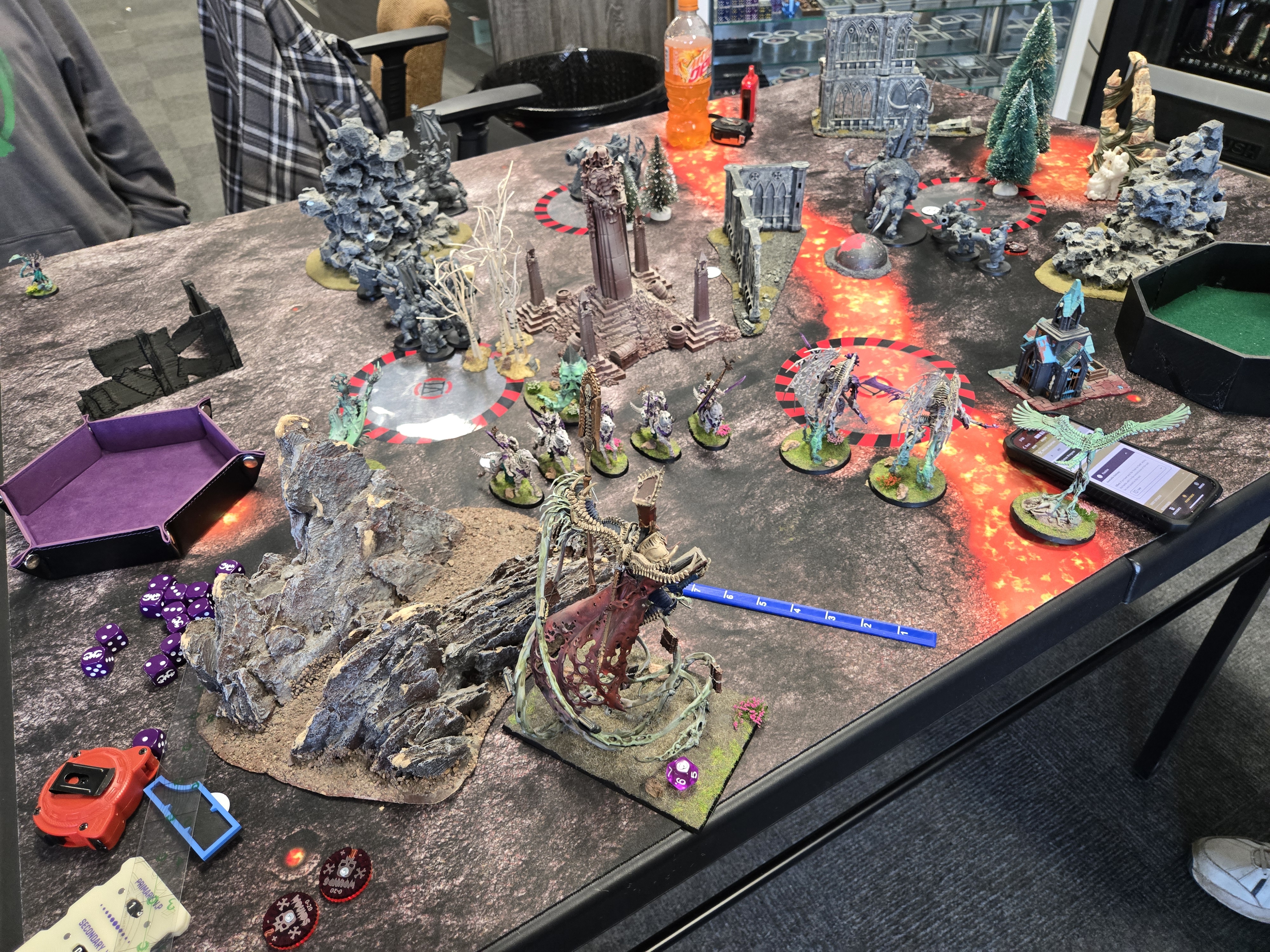
I quickly destroyed this unit and thought that the lower side of the board would be clear. I underestimated the swiftness of his units. I also thought my morghasts and more guard would be able to hold a stronger line than they actually did.

Turn 2 I pulled back a little to stay out of charge range while pushing my cavalry up the other side. Nagash was shooting off his 9 spells every turn.

Turn 3 is where I lost the game. Nagash had to make a 5-inch charge against my opponent’s Stonehorn, and I missed. I also allowed him to charge my morghasts and mortek guard, destroying them. Really just all-around lousy play. I missed several abilities, such as Nagash being able to heal units. I poorly charged my cavalry and morghasts allowing his stonehorn to countercharge, damage the morghasts, and still not be in combat.

At the start of turn 4, I did plan on conceding. I had a chance, maybe with a double turn, but the double turn did not happen. He killed every unit except Nagash. There was just zero chance of me catching up. Nagash was only in charge range of his lead belchers and gluttons, and there was no way I was doing 40 damage there.

AOS Leage Match 2 Bonereapers vs Sylvaneth

This week, I brought out a freshly painted batch of Ossiarch Bonereapers. I faced Jason and his band, Sylvaneth.

Overall, I was impressed with how much damage my force could do. I thought this would be a good matchup for me since he went big, but my bigs are bigger and better. I loved Katakros. There is a reason he is staple number 1 in the army.

As far as AOS 4.0 goes, them game is balanced. I hope we have more missions soon.

My army list is below.

Generals Regiment Kavalos Lance2,000
Katakros Mortarch of the Necropolis520
Kavalos Deathriders200
Morghast Archai Reinforced540
Regiment 1
Mortisan Ossifector 110
Immortis Guard200
Regiment 2
Mortisan Soulmason160
Mortek Guard 120
Teratic Cohort150

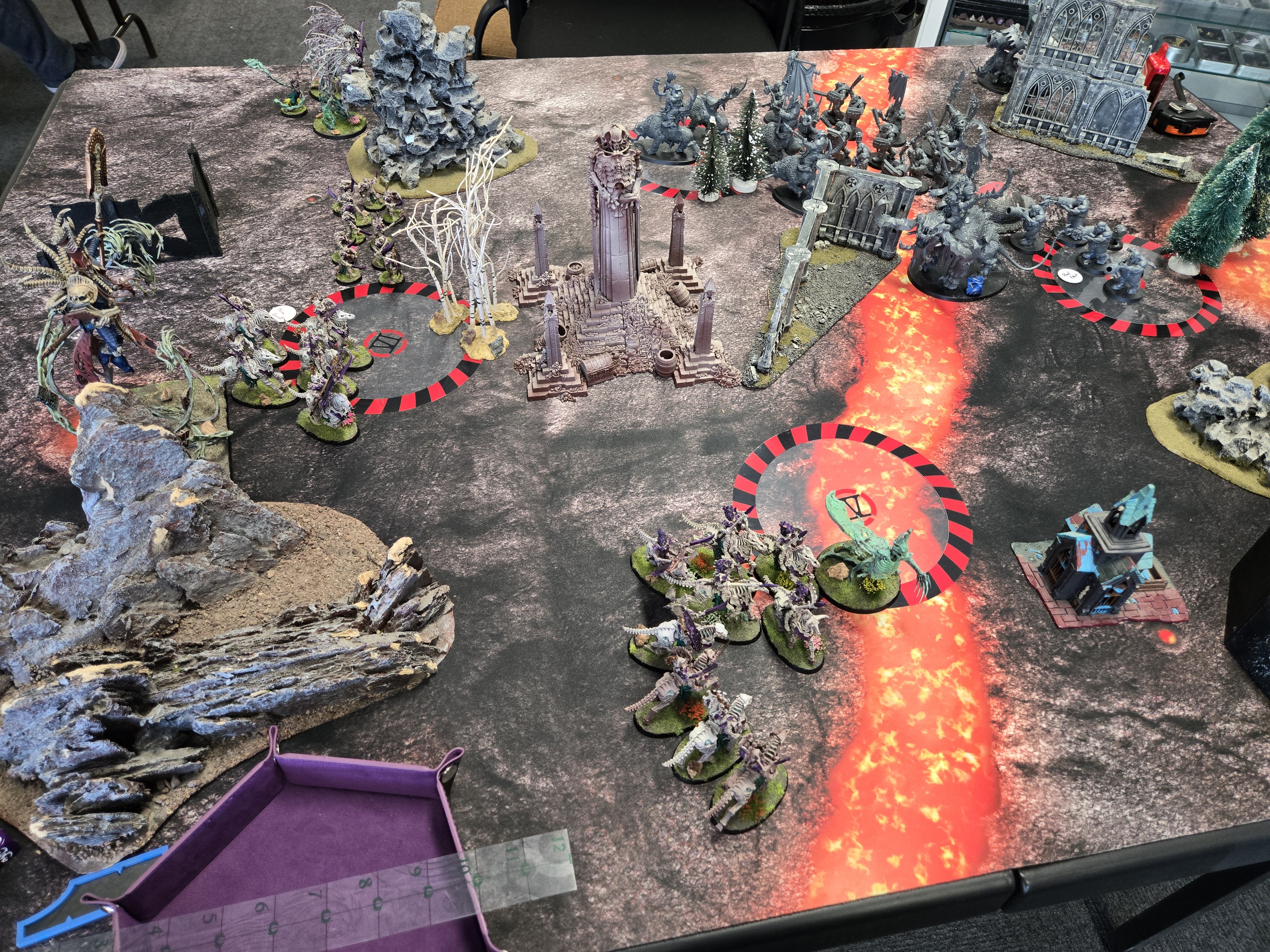
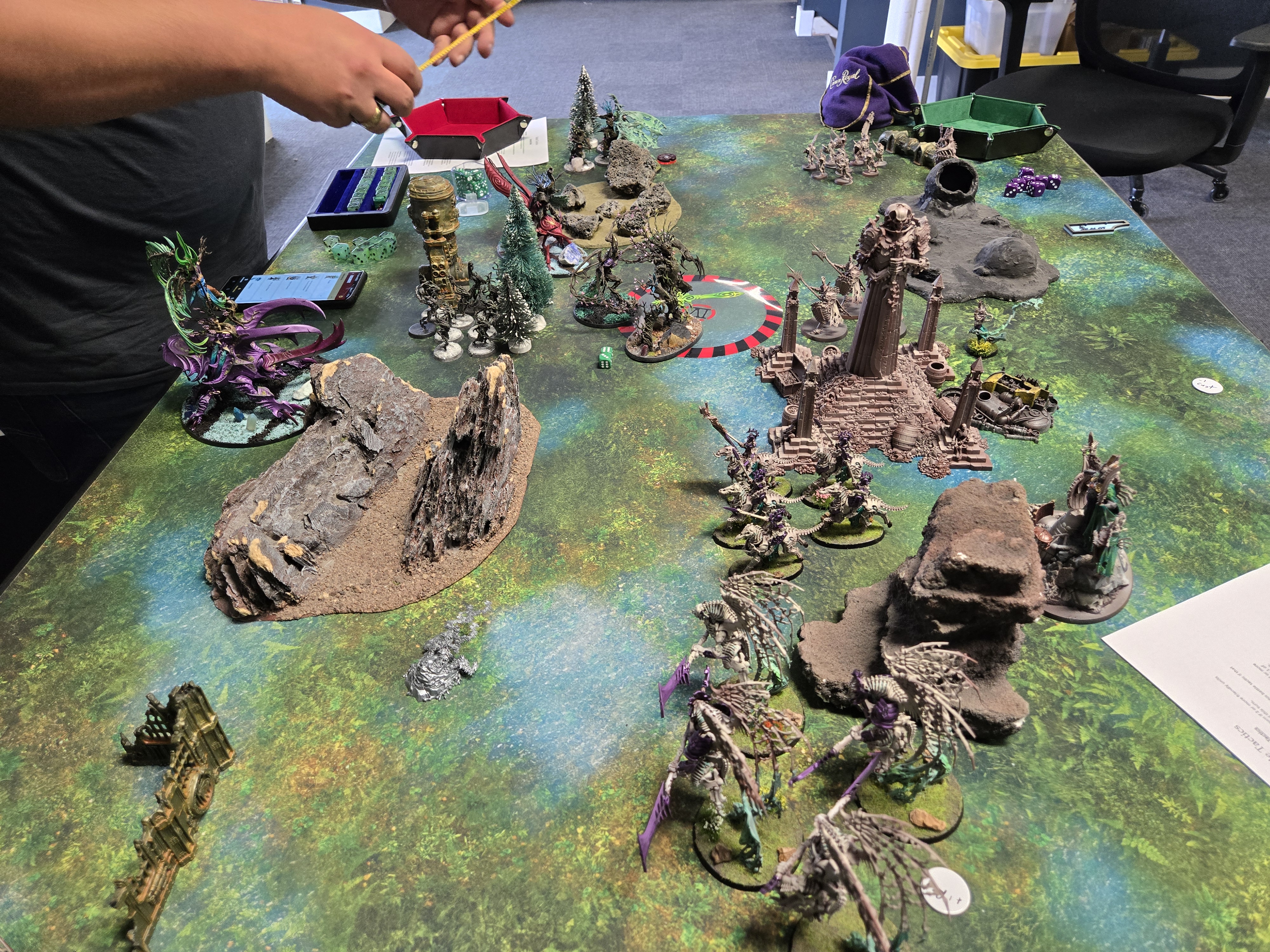
My opponent’s list is as follows. I didn’t take a picture of his full list. Above is how we deployed. I took the second turn.

Alarielle the Everqueen680
Dryads100
Kurnoth Hunters with Greatbows200
Belthanos, First Thorn of Kurnoth350
Dryads100
Spirit of Durthu330
Lady of Vines250

We rolled for our mission, which was to keep the objective in the center until round 3, when it would spawn. Based on my opponent’s deployment, I wasn’t sure what he was going to be able to do. I think he was counting on Durthu and his Dryads to hold in the center. His force didn’t have much damage-dealing ability.

Both forces advanced to the center. My opponent rolled poorly and did not execute any spells.

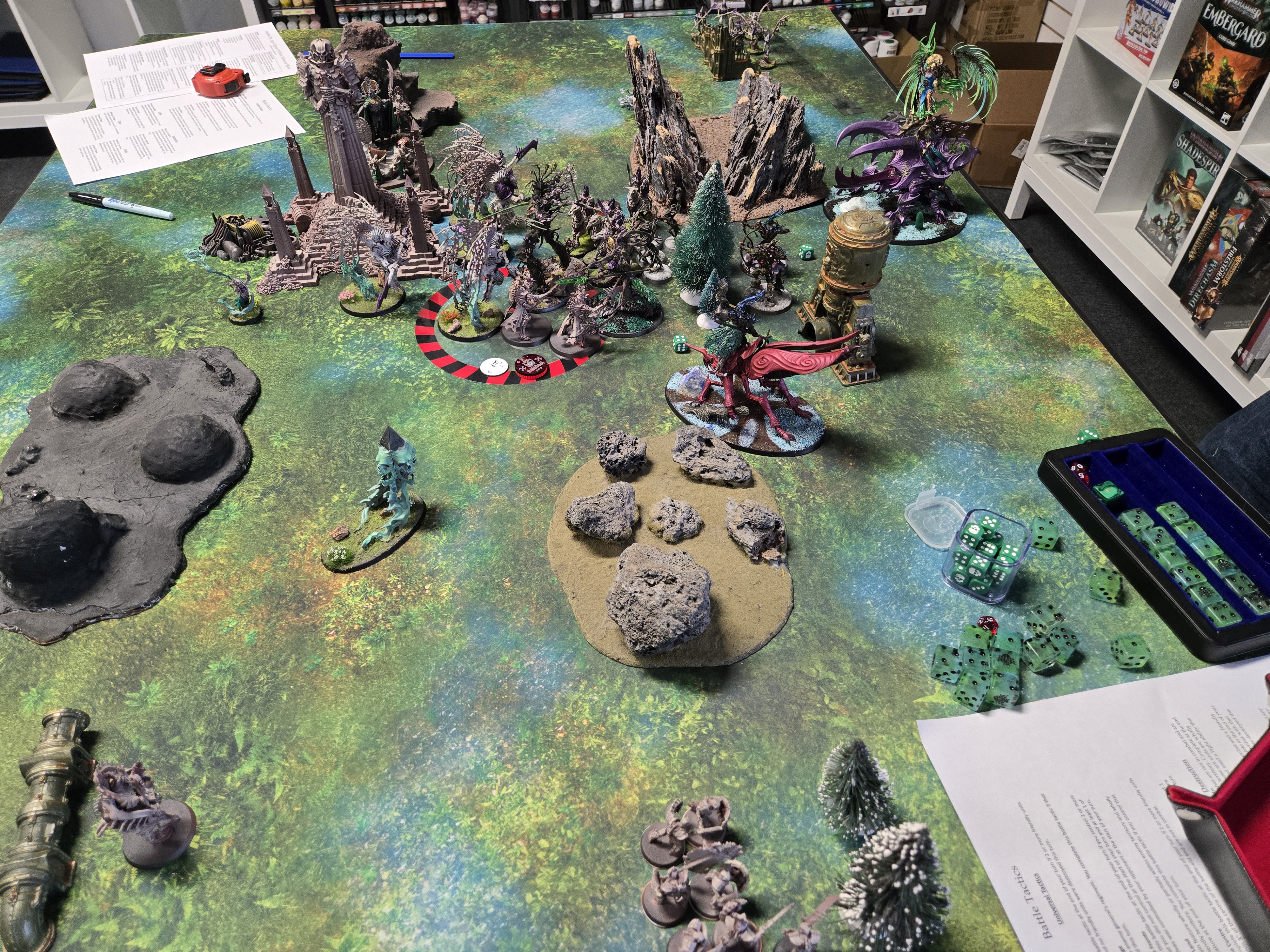
The second turn, he tried to hold, but the morghasts were just too overwhelming. My simple Mortek Guard was able to destroy his greatbows. (He brought them back)

I didn’t take any pictures, but on turn 3, I won the double turn and promptly destroyed everything except his Belthanos. He tried to charge Katakros with Allarielle, and that is just not a matchup he is going to win. My opponent then conceded.

Quick and Dirty Tyranid Terrain Project

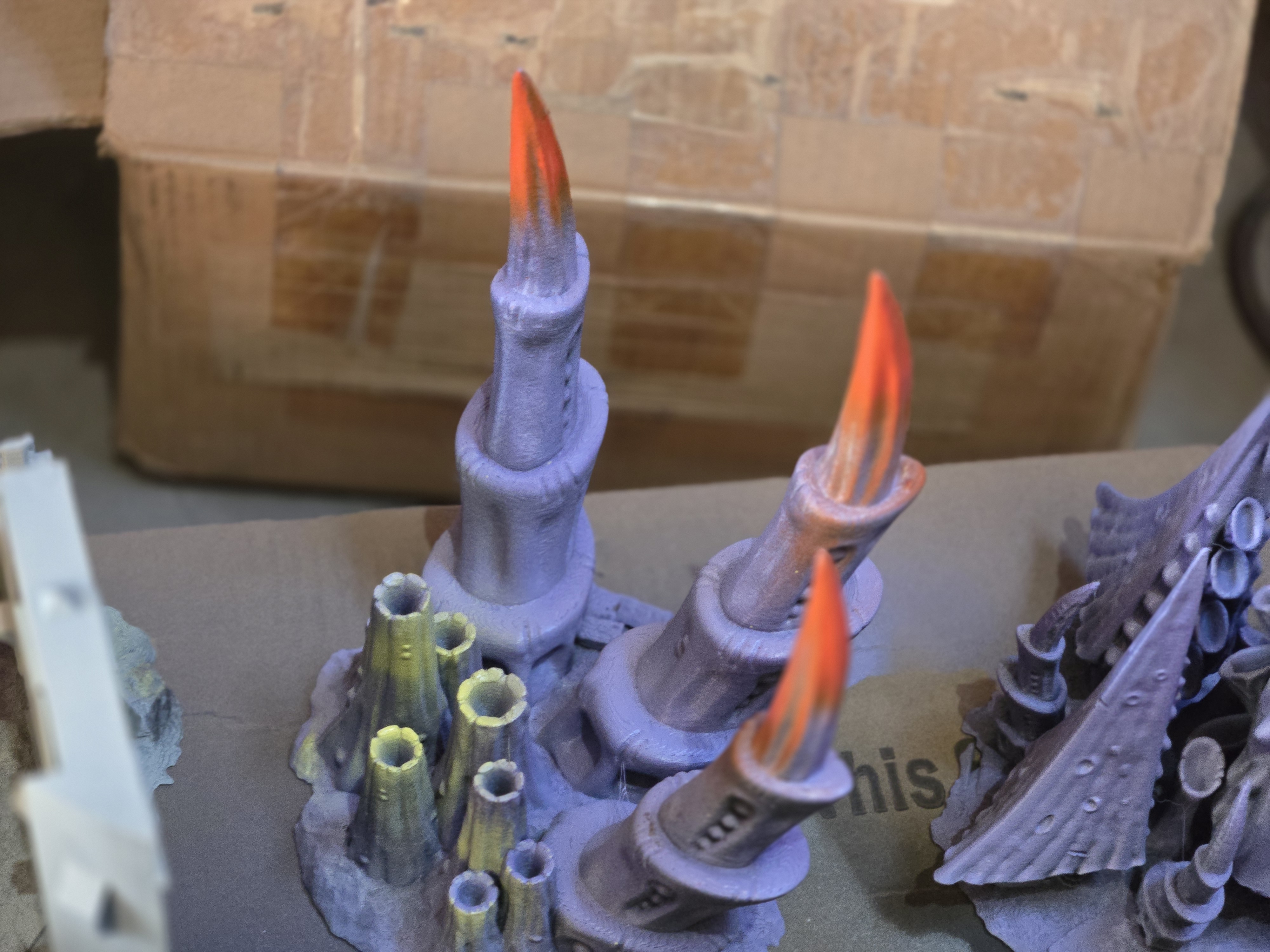
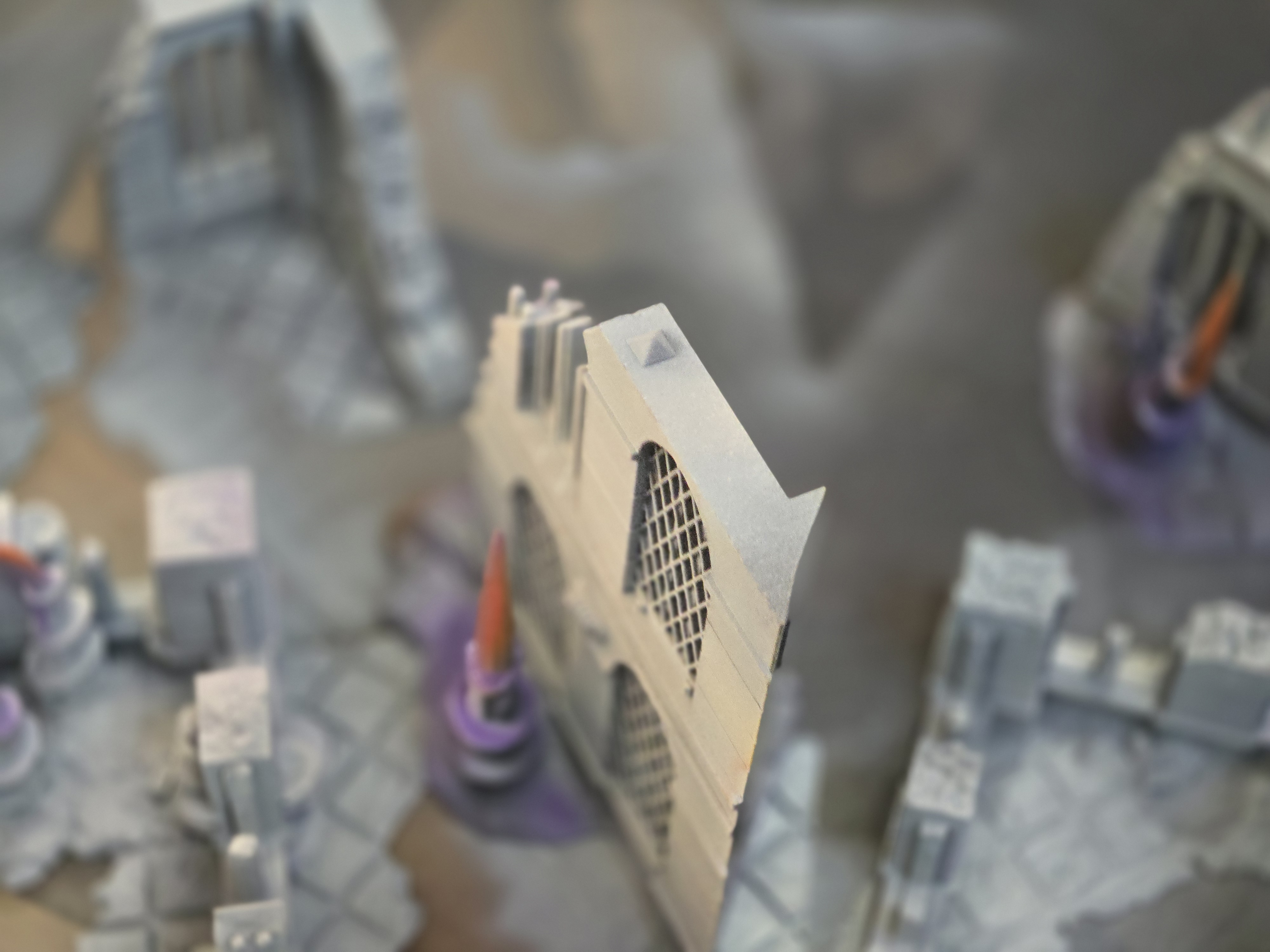
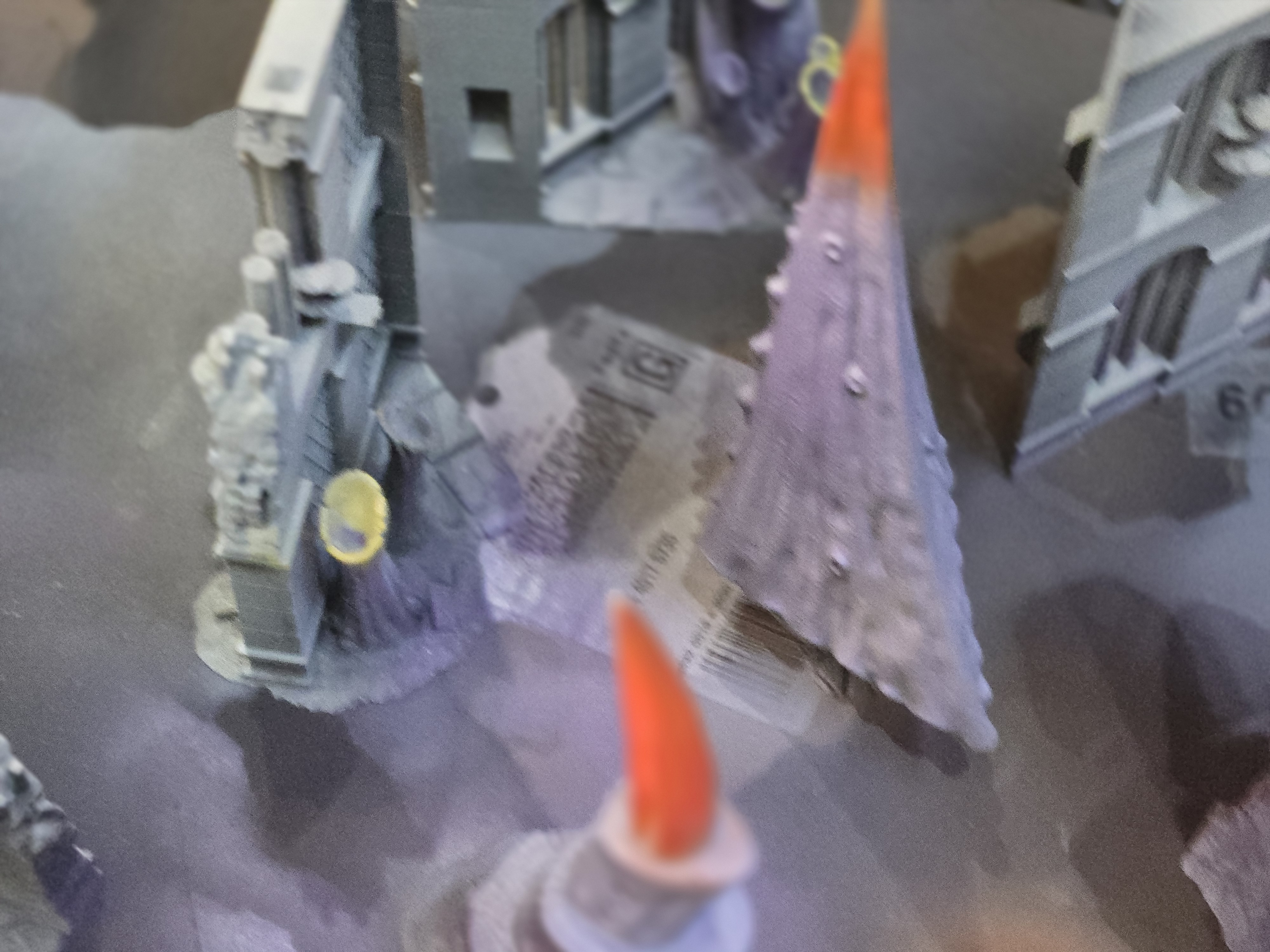
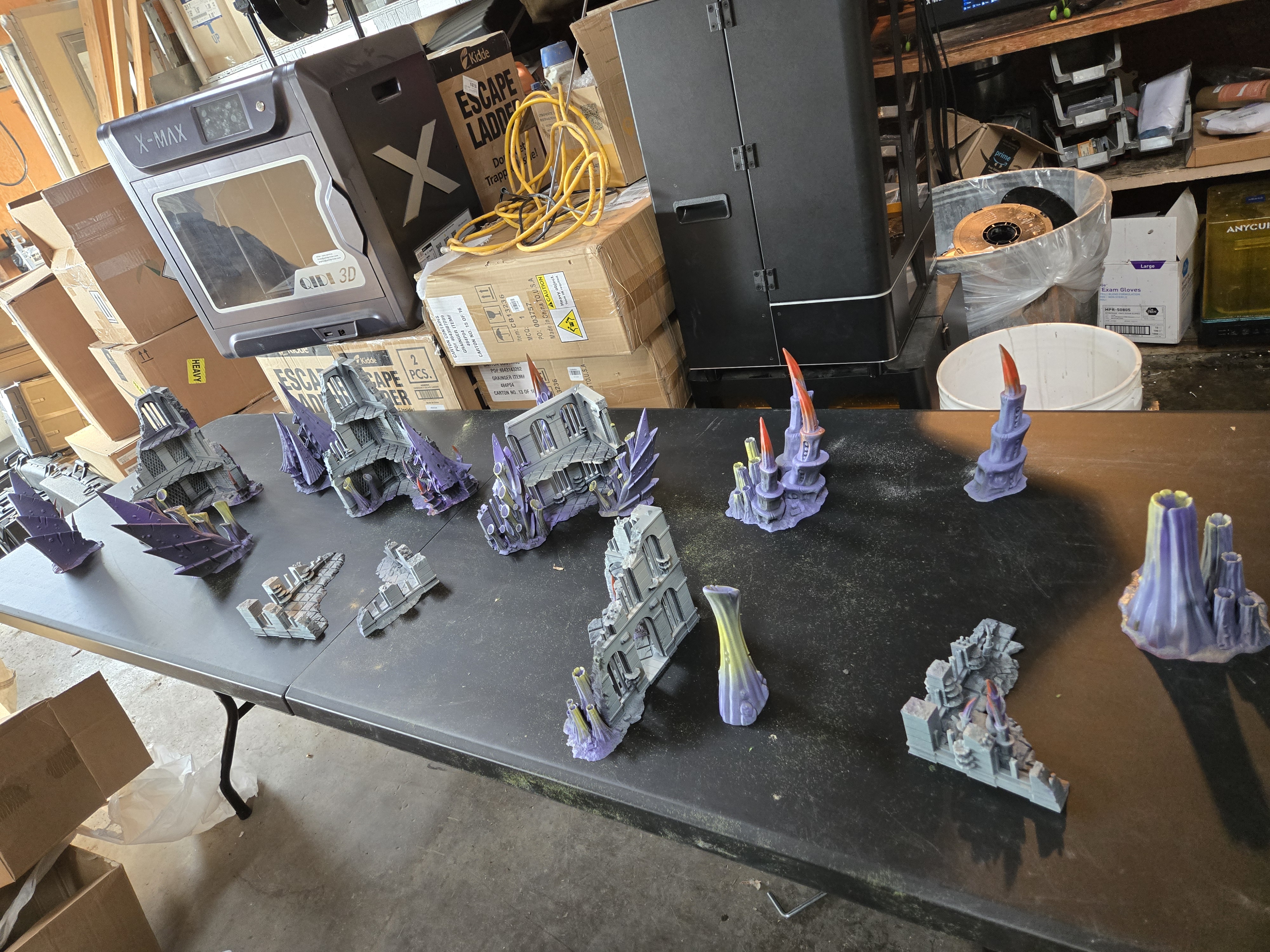
Today, I am sharing some terrain for my Tyranid Escalation League. I purchased a ton of terrain from Etsy and was delighted. It has great details and functions nicely in a game.

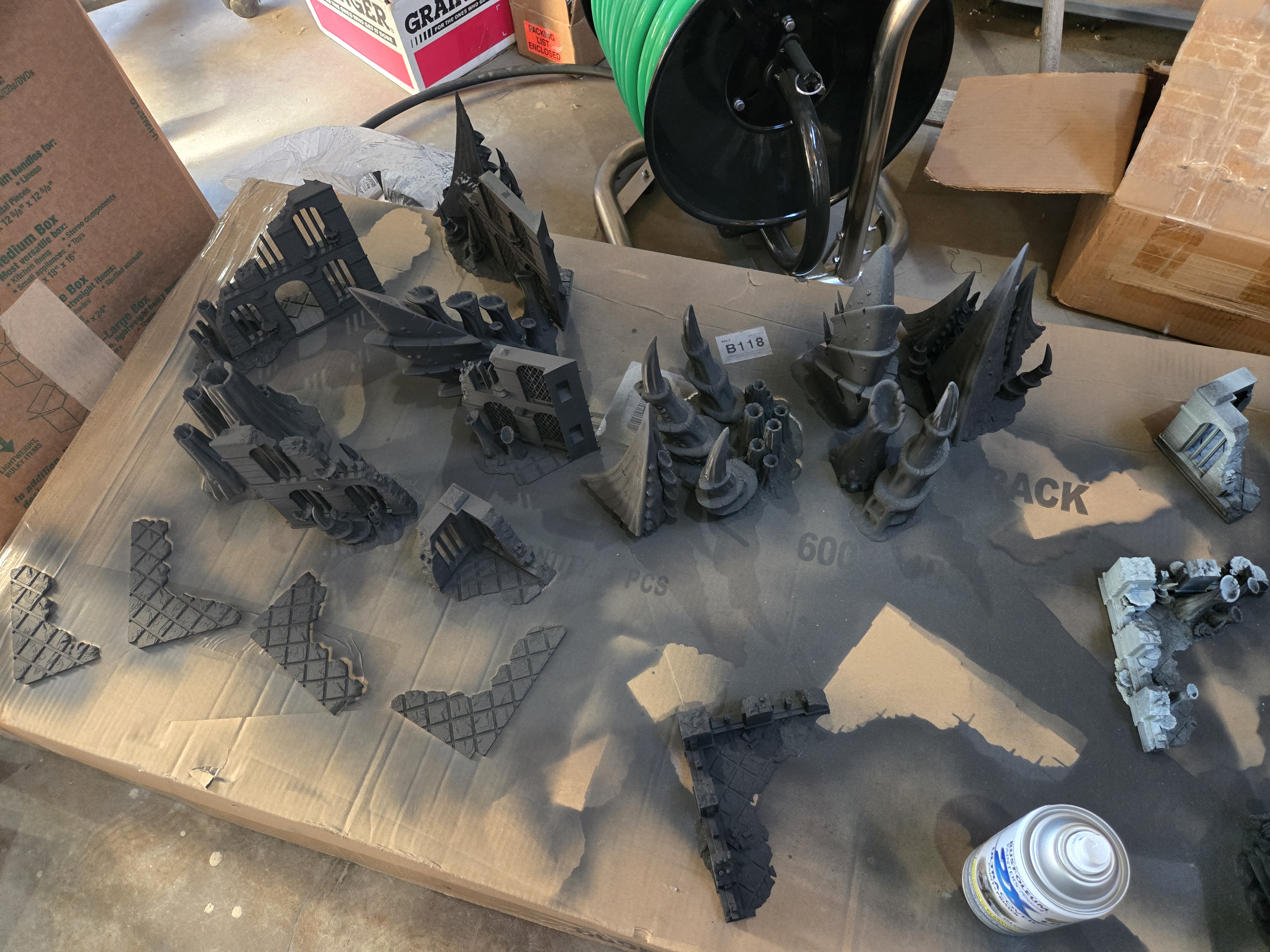
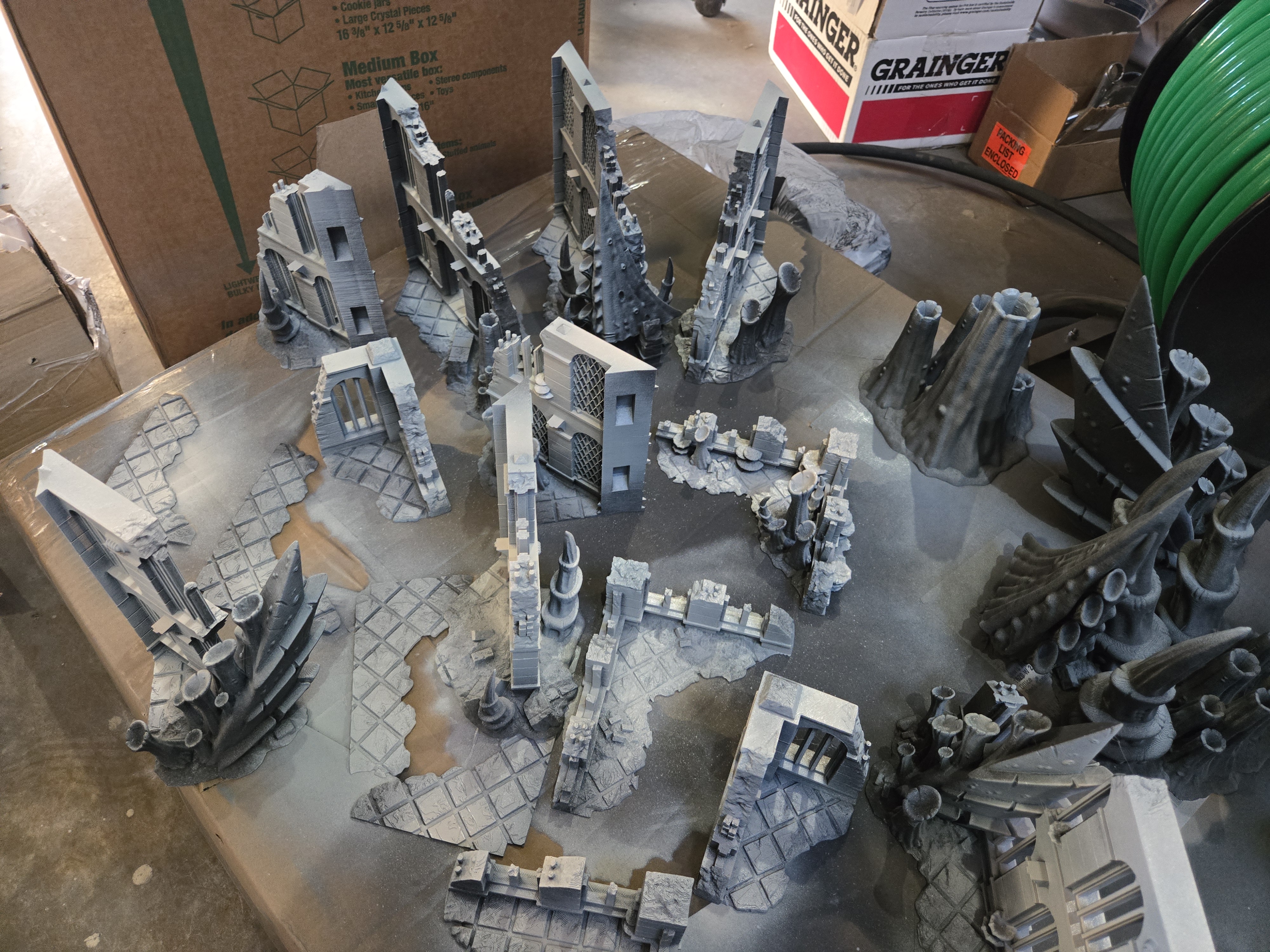
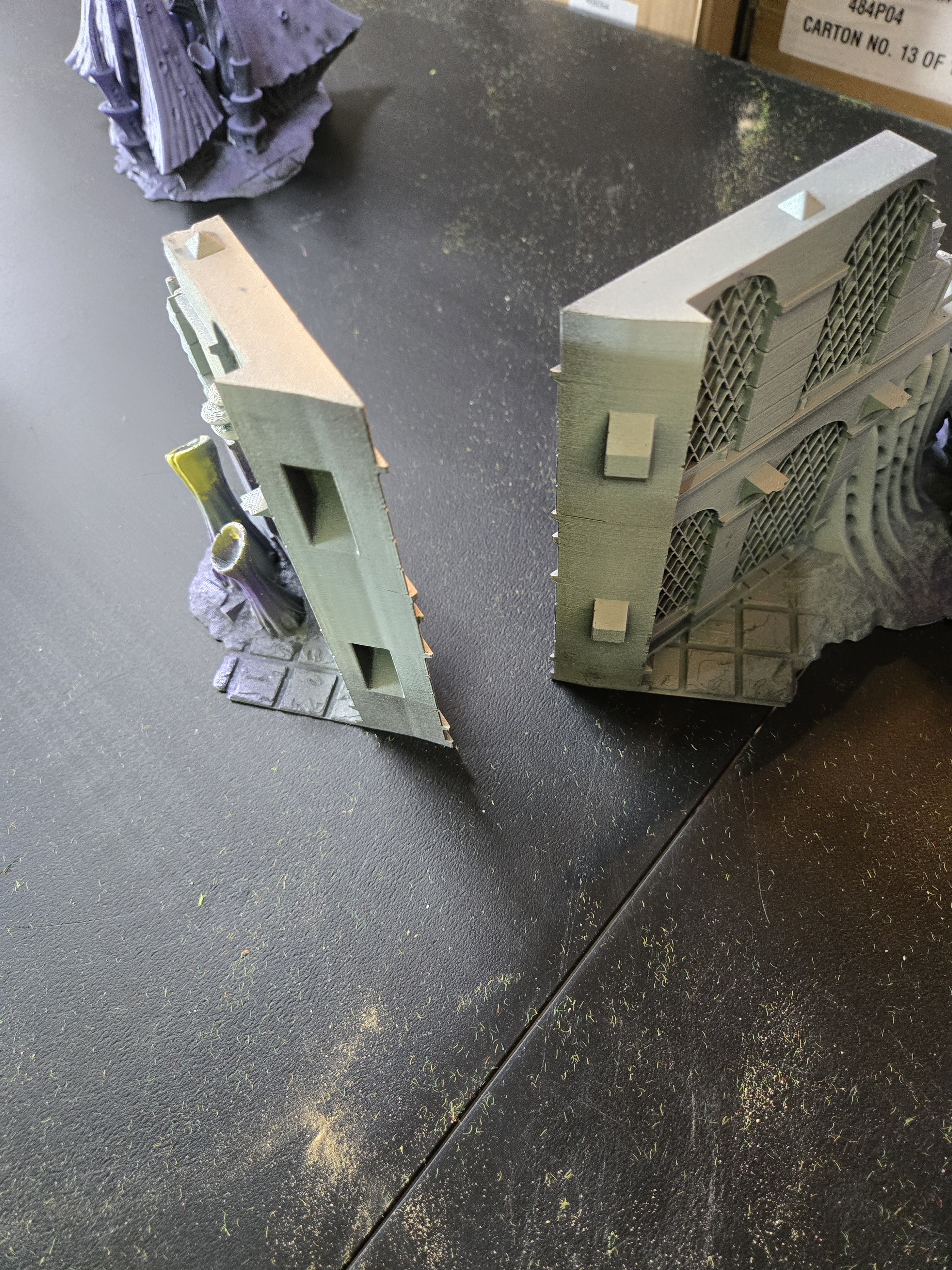
Due to procrastination, I only had about 2 hours of free time where I would be able to get this terrain ready for the tabletop. I decided to just go for it. I fully painted this terrain using rattle cans and nothing else in about 90 minutes.

https://www.etsy.com/listing/1553733003/tyranid-scatter-terrain-scenery-bundle?ref=yr_purchases
https://www.etsy.com/listing/1400349576/the-hive-alien-scenery-terrain-for-war?ref=yr_purchases
https://www.etsy.com/listing/1417470104/alien-infested-ruins-tabletop-terrain?ref=yr_purchases
https://www.etsy.com/listing/1803261885/the-hive-kill-team-set-3d-printed-alien?ref=yr_purchases
https://www.etsy.com/listing/1684087149/tulipa-evolved-infestation-tabletop?ref=yr_purchases
https://www.etsy.com/listing/1669911754/tulipa-the-infested-world-tabletop?ref=yr_purchases
https://www.etsy.com/listing/927375461/alien-hive-army-capillary-spore-stack?ref=yr_purchases
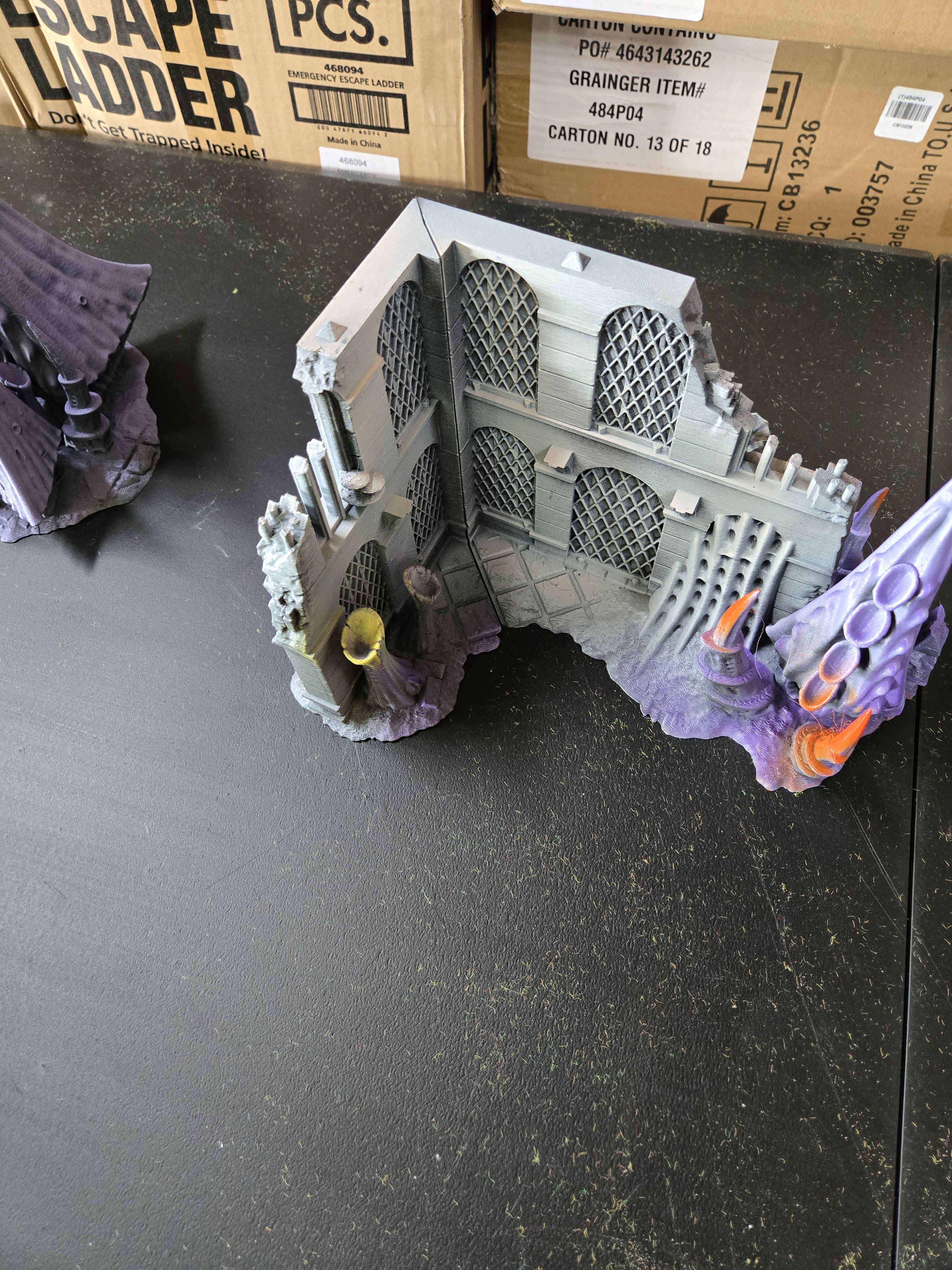
The terrain pictured for the painting is the Alien-infested Ruins and the Tulipa, the Infested World.

The prints are nicely done, and I recommend any of the sellers listed above.

I started with a black primer. I usually splurge for auto-primer when I prep 3D prints. Auto primers fill the gaps made from traditional 3D printing very nicely. All the other paints were simple rattle-can Rustoleum products.

I focused on the buildings first.

The next step was a dusting of winter grey.

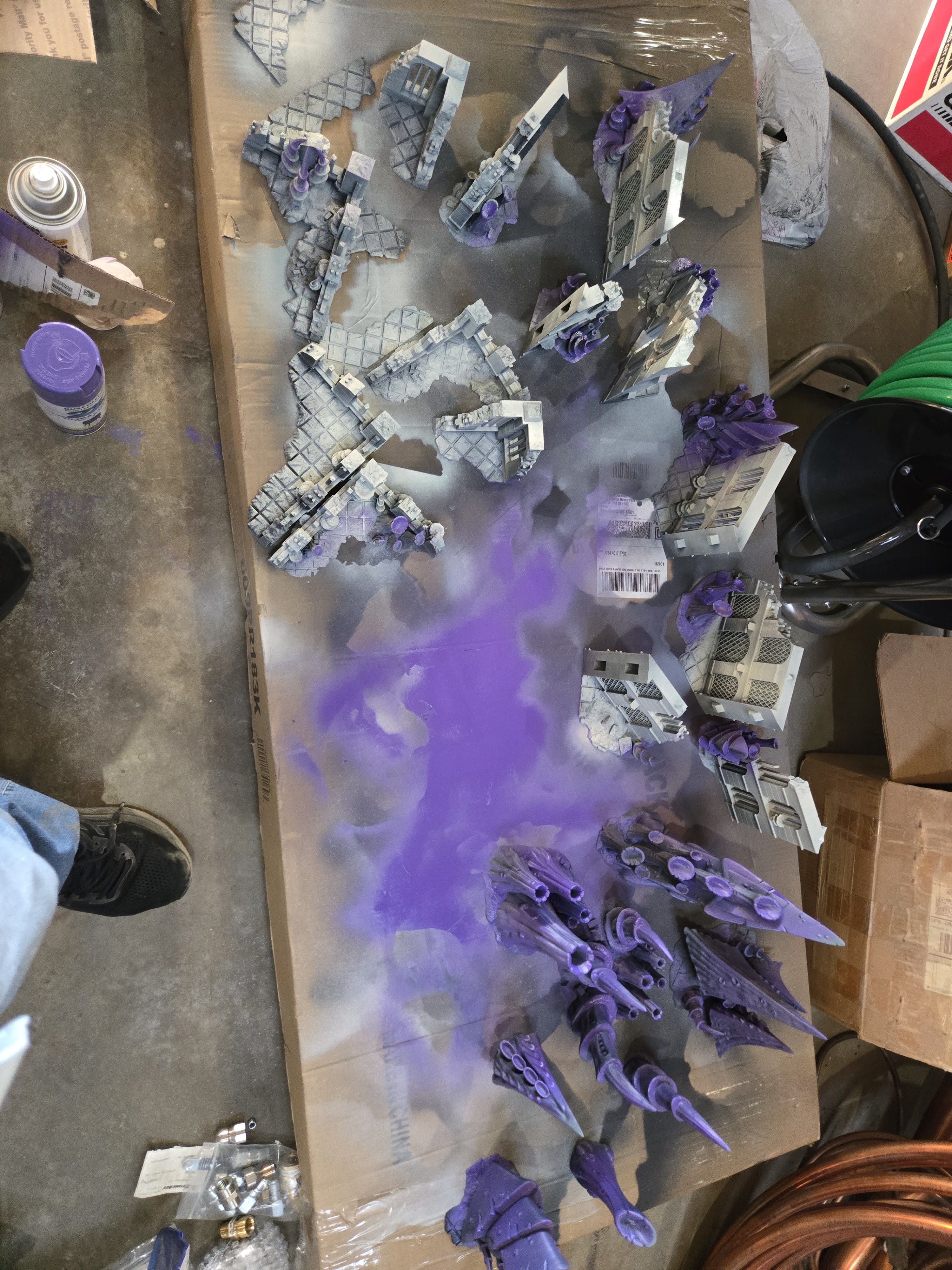
Followed up by a decently large spray of Smokey Beige.

Next, I went to work on the various Tyranid pieces.

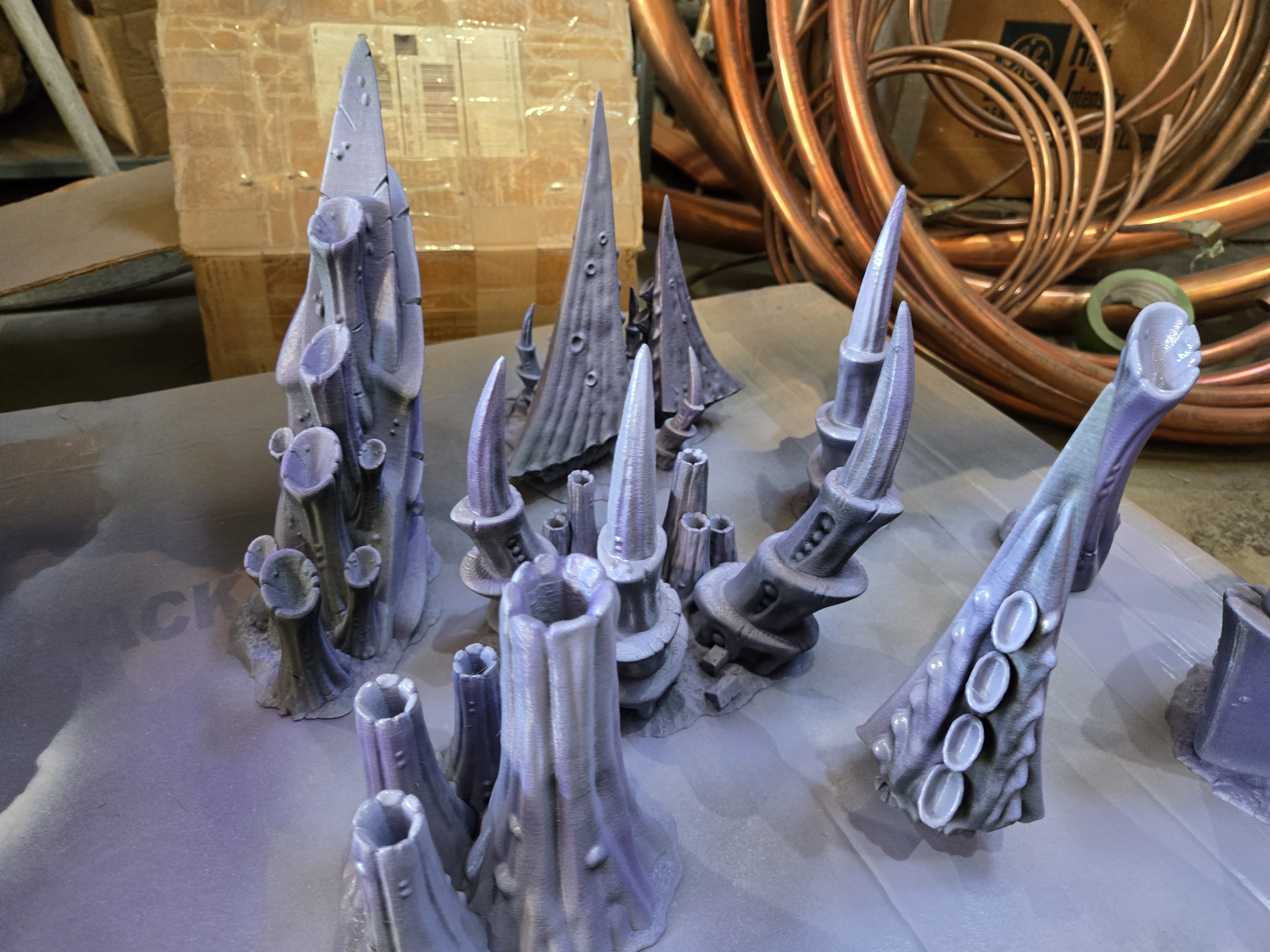
They get a solid coat of Grape and then a dusting of French Lilac.

I finished with a splash of fire orange and sun yellow, just for some pop.

I did the same thing with the Tyranid pieces attached to the buildings.

Here is the finished set on a table. I was really pleased, given how much time I took. I will maybe airbrush some of the windows and floors to break them up and potentially add a bit of weathering grime. It looks better than basic grey, and I hope this lesson shows that terrain does not need to be an hours-long endeavor. The table is 8′ by 30″, and you can see it has decent coverage.

The Big buildings are also modular.

Gargants vs Orruks

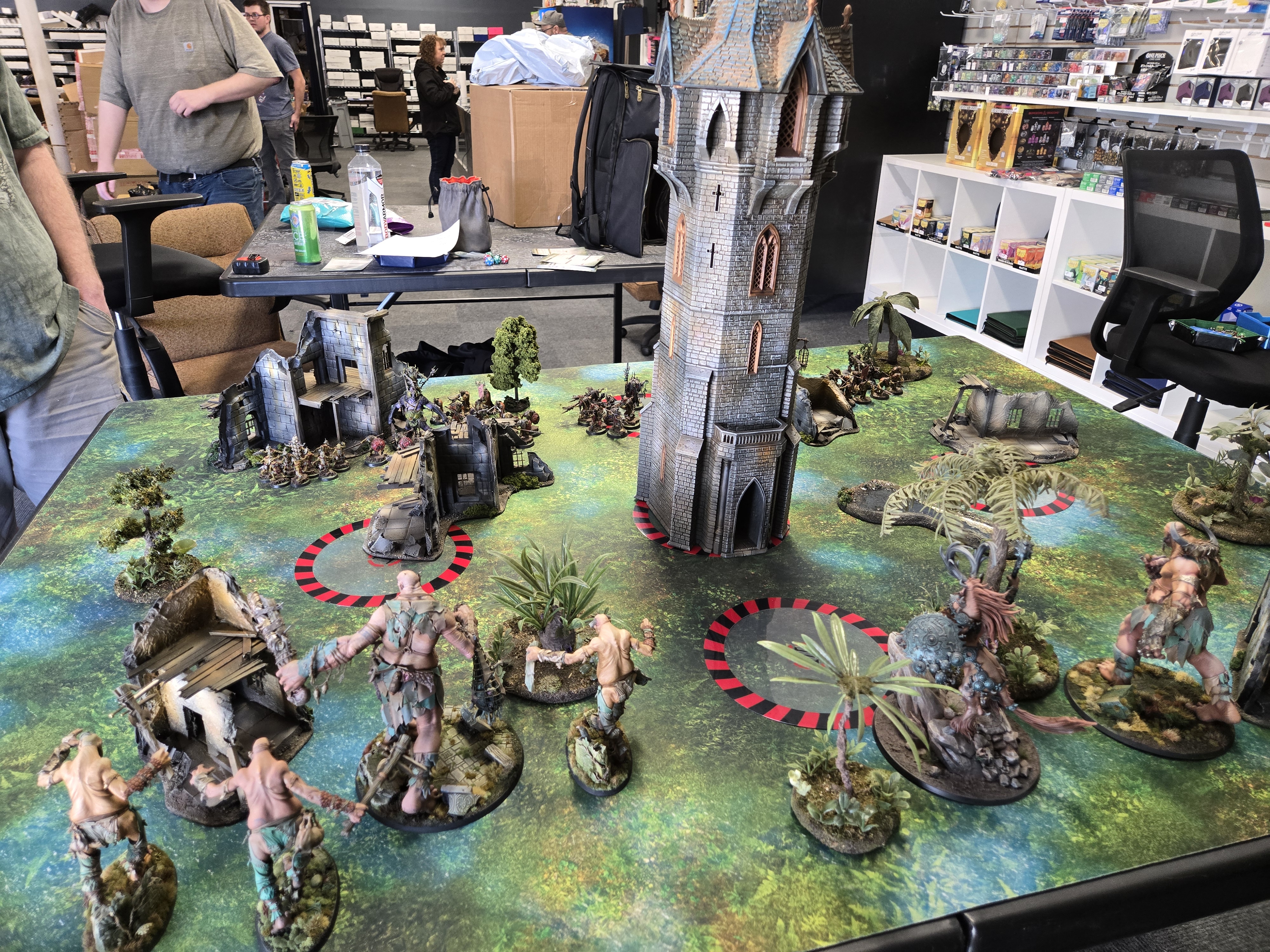
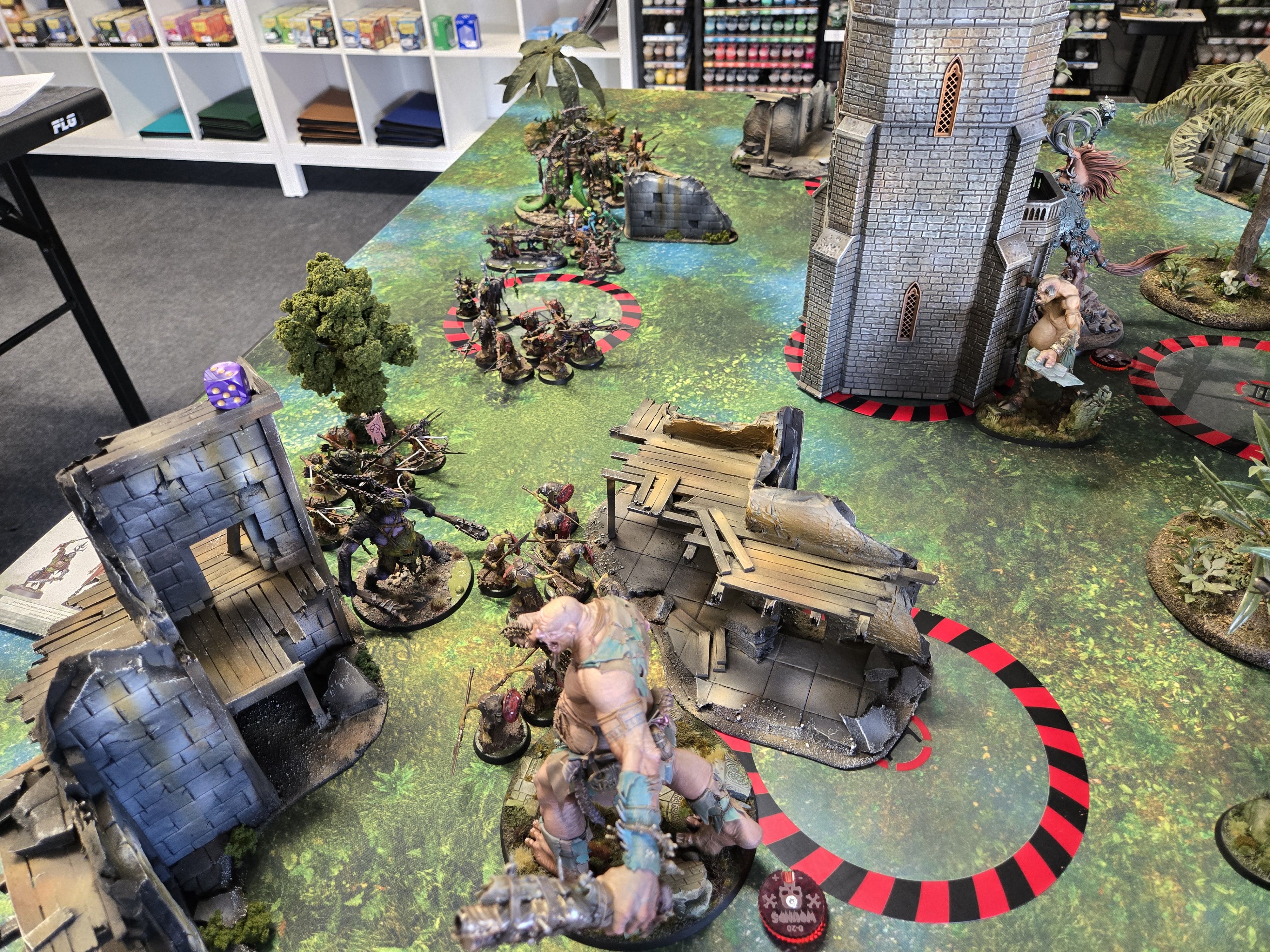
I had a great game with one of my friends this week. He has wonderfully painted Orruk War Klans. I decided to try out my Mega Gargants. My models were all painted by White Metal Studios, and they are absolutely gorgeous. Because I knew how great every model on the table would look, I also brought out some of my Green Leaf Terrain.

Kragnos led the charge, but it was really a great game. I had never actually played with those models before, and my opponent was very experienced with his army, so my butt got utterly destroyed.

Having done no research. I think the key to giants is making sure your entire army hits the opponent line at the same time. Mine kinda came it at different times and it allowed him to put full firepower into an individual unit.

Turn 1 I just pushed up the board.

Turn 2, the game was balanced.

Turn 3, I was skewered.

Bonereapers Painting Project

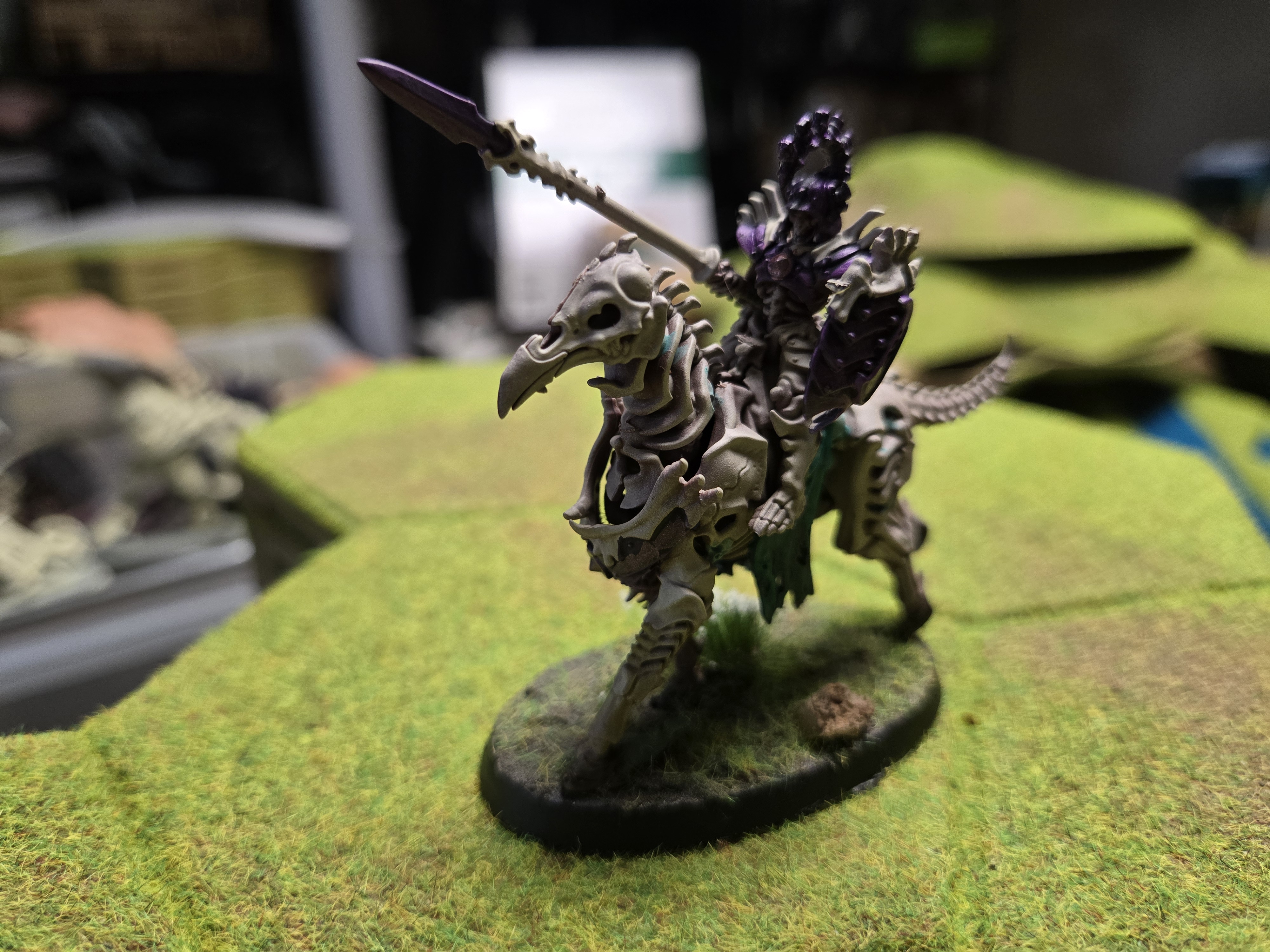
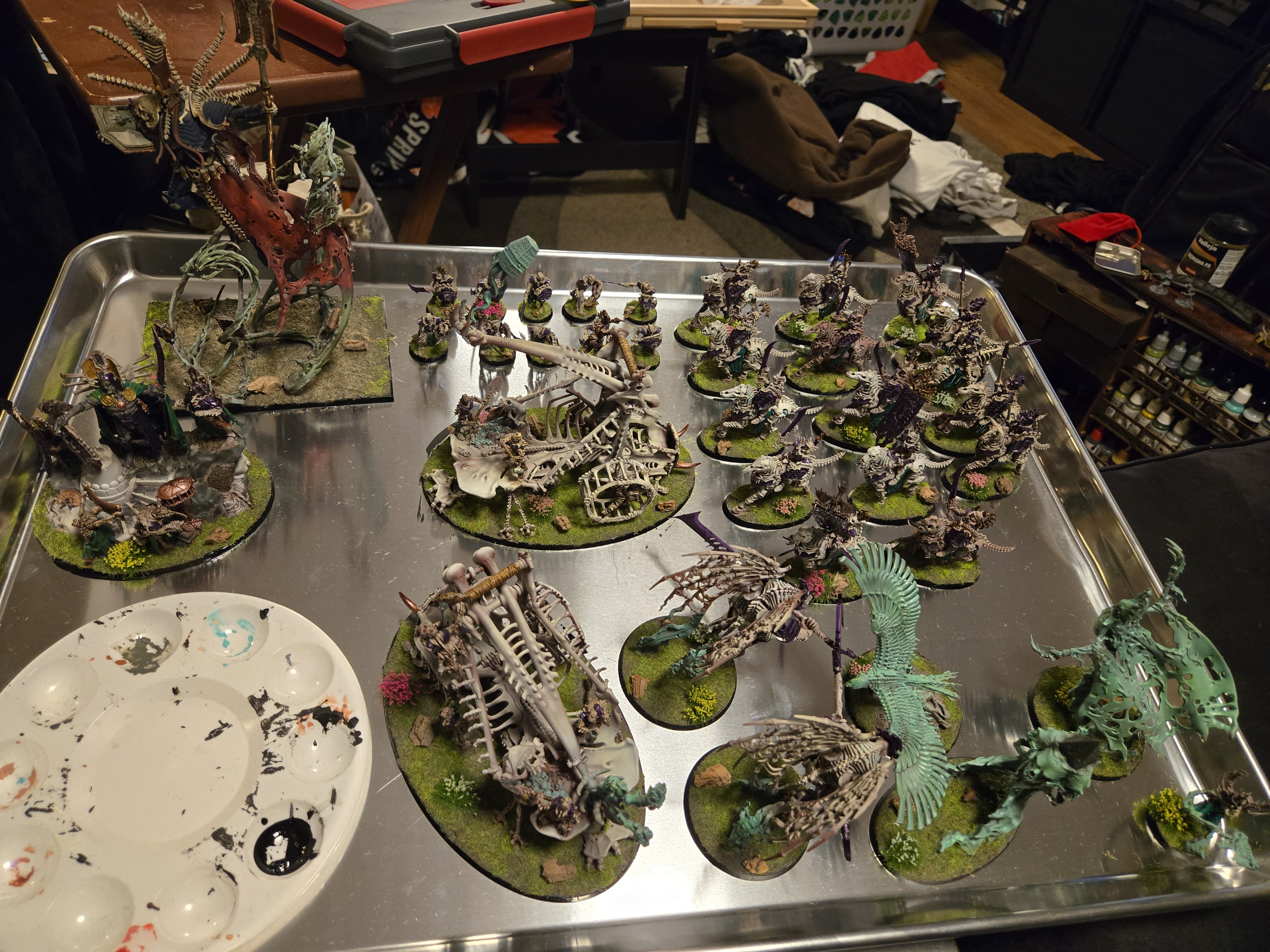
My local gaming store wanted us to do an Age of Sigmar league. One of my goals for the year was to get more Sigmar models on the table and painted. This was a prime opportunity to move on from some of my pile of shame. Many of my armies have 500-1000 points; some even have 2k points. The Bonereapers were 100% grey.

This project has been fun to work on. I plan to bring a different 2k list for each round. Just to give me more opportunity to fill out the model selection.

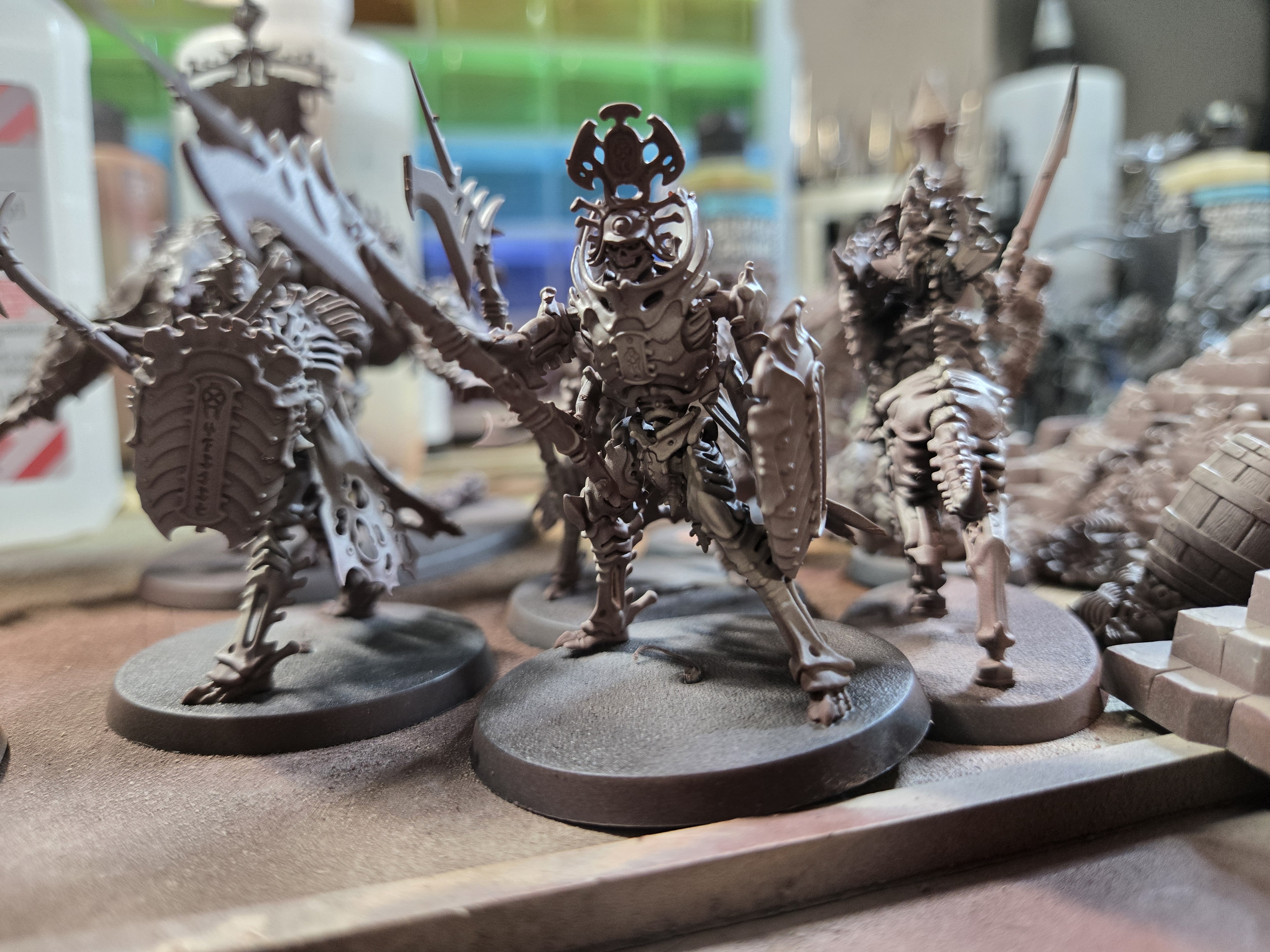
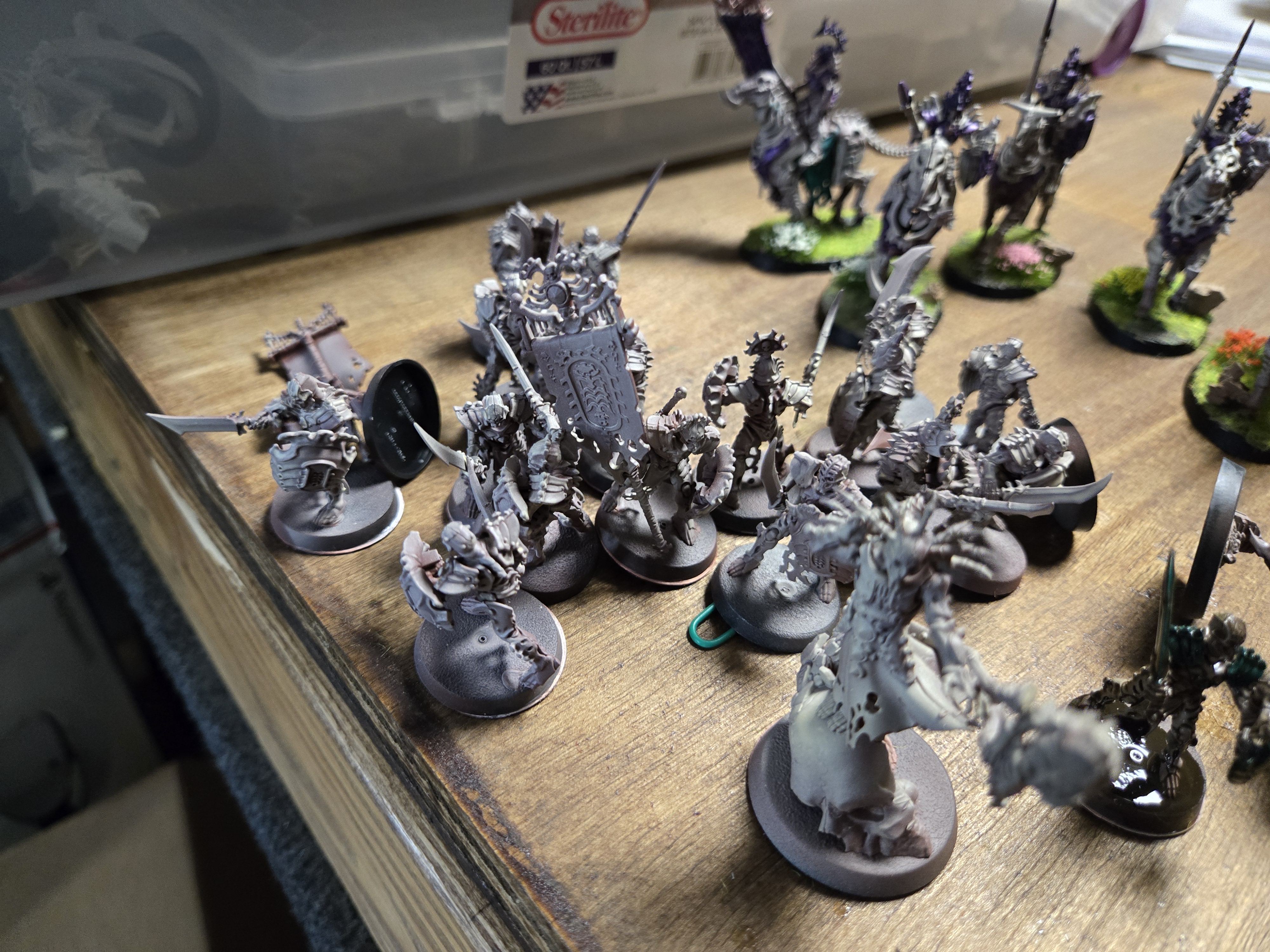
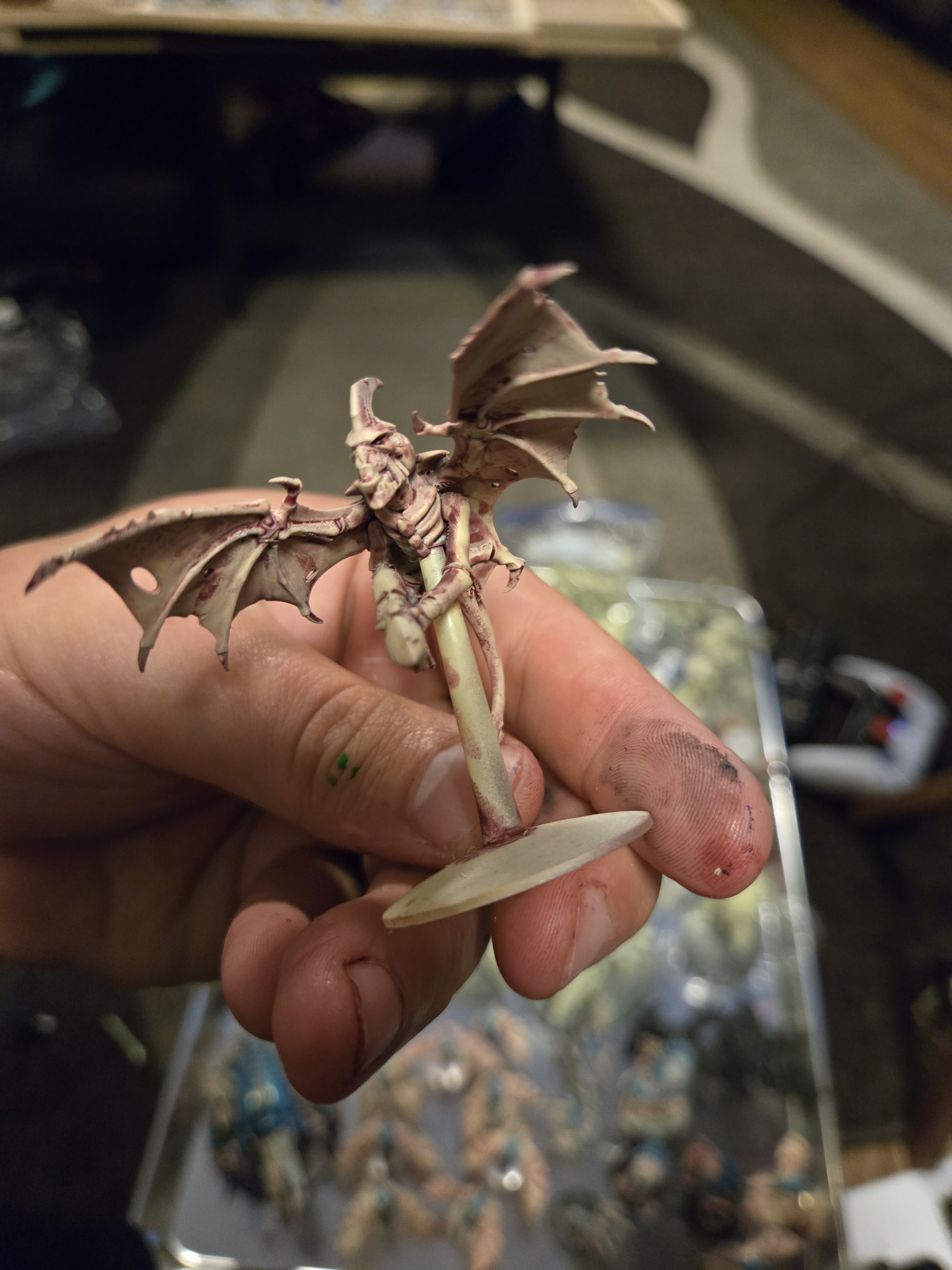
All models started with a prime of Vallejo Primer German Red Brown. I then zenithaled with a desert tan.

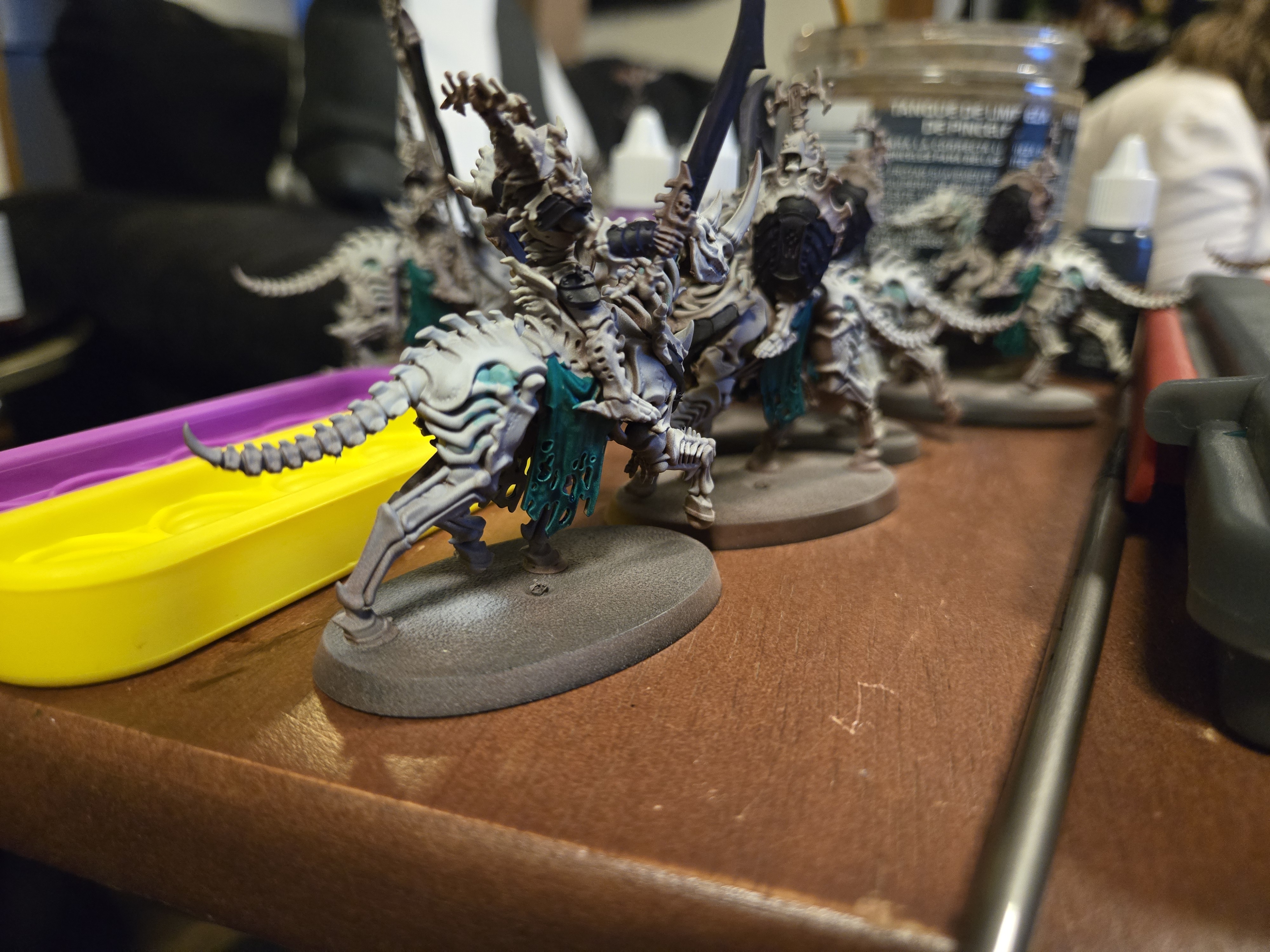
I am happy so far. I wanted to follow Kenny Bouche and take it up to 11 with the airbrush. After one batch of Deathriders, I decided that the bone didn’t pop enough. So, I took all the bone I could and mixed half desert tan and half white to brighten the effect. After that, I just applied a dab of white ink to most of the models from directly above.

You can see a little difference here where I hit the models with the white vs. just leaving them desert tan.

Many of the models have cloth that hangs off the saddle or dangles between their legs. I wanted a contrasting color but didn’t want to spend much time on it, so I used contrast paint Aeldari Emerald with a dry brush of Talisman Green.

Between the bones, I just dabbed a bit of Citadel Nihil Oxide. It’s the same color on my night haunt, and I appreciated the spooky effect.

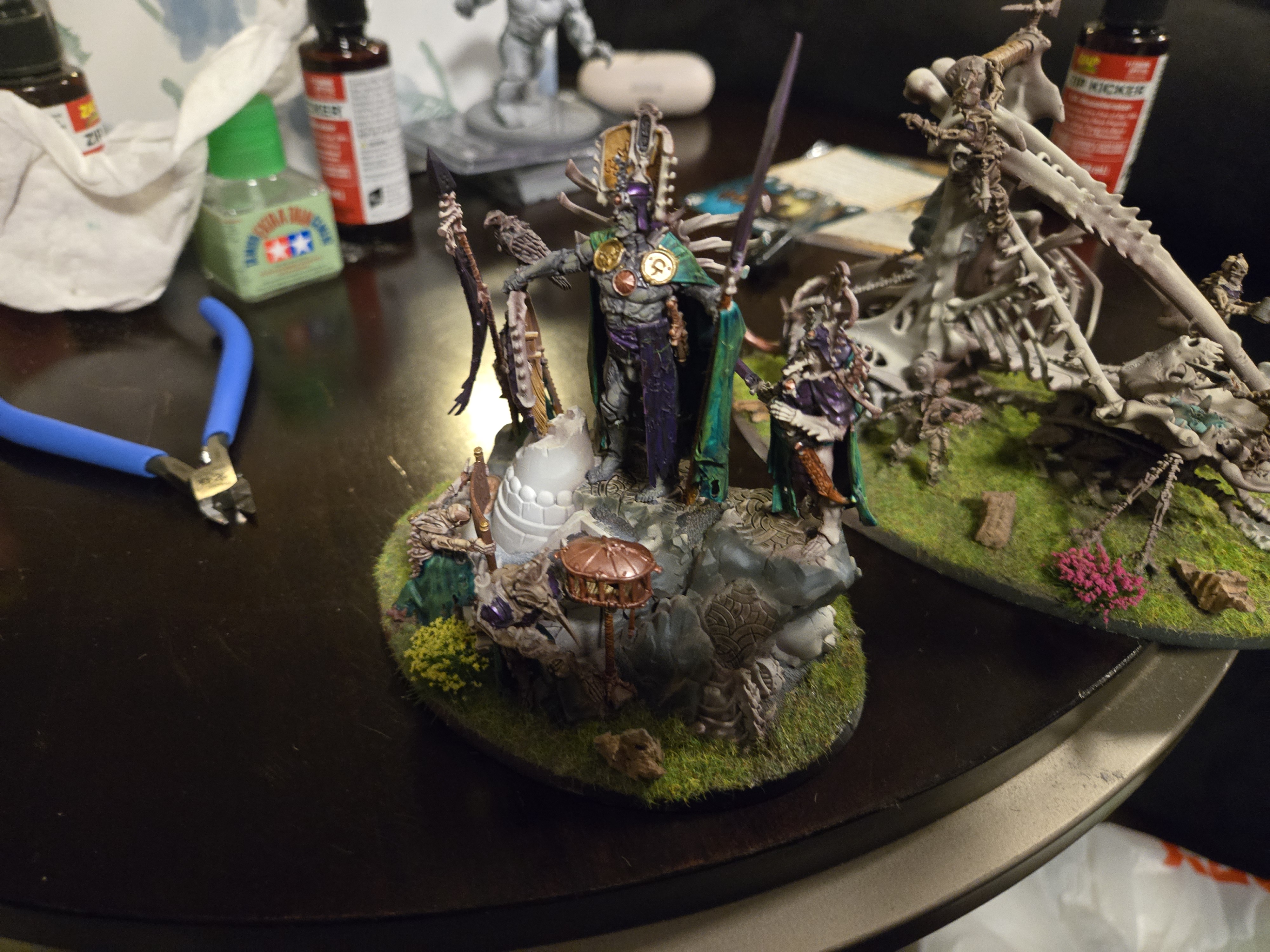
I wanted to take my time on the purple. I haven’t ever enjoyed layering or edge highlighting and these seemed like lovely models to try it on. All purple used the Two Thin Coats. Shadow Von Evil Purple, mid-tones were Emperors Purple and edged using Spectral Purple. The colors gave a nice metallic finish.

For basing I wanted the models to look like they were running through a meadow.

Simple mud texture paste, some flowers and cork rocks and flocked with a strong green grass. The only model I didn’t do this for was Nagash. I took a circle around his model and used a dead flock, and then on the edges of the circle, it was green.

Very happy with Katakros.

This image shows the difference the white highlight made on the bones. Look at the cavalry at the top right.

On the crawlers, I actually washed the skeletons that were manning the catapult just to give them an obviously different color, and help them stand out.

The endless spells were 100% airbrushed. Not sure of the recipe, but absolutely love how they turned out.

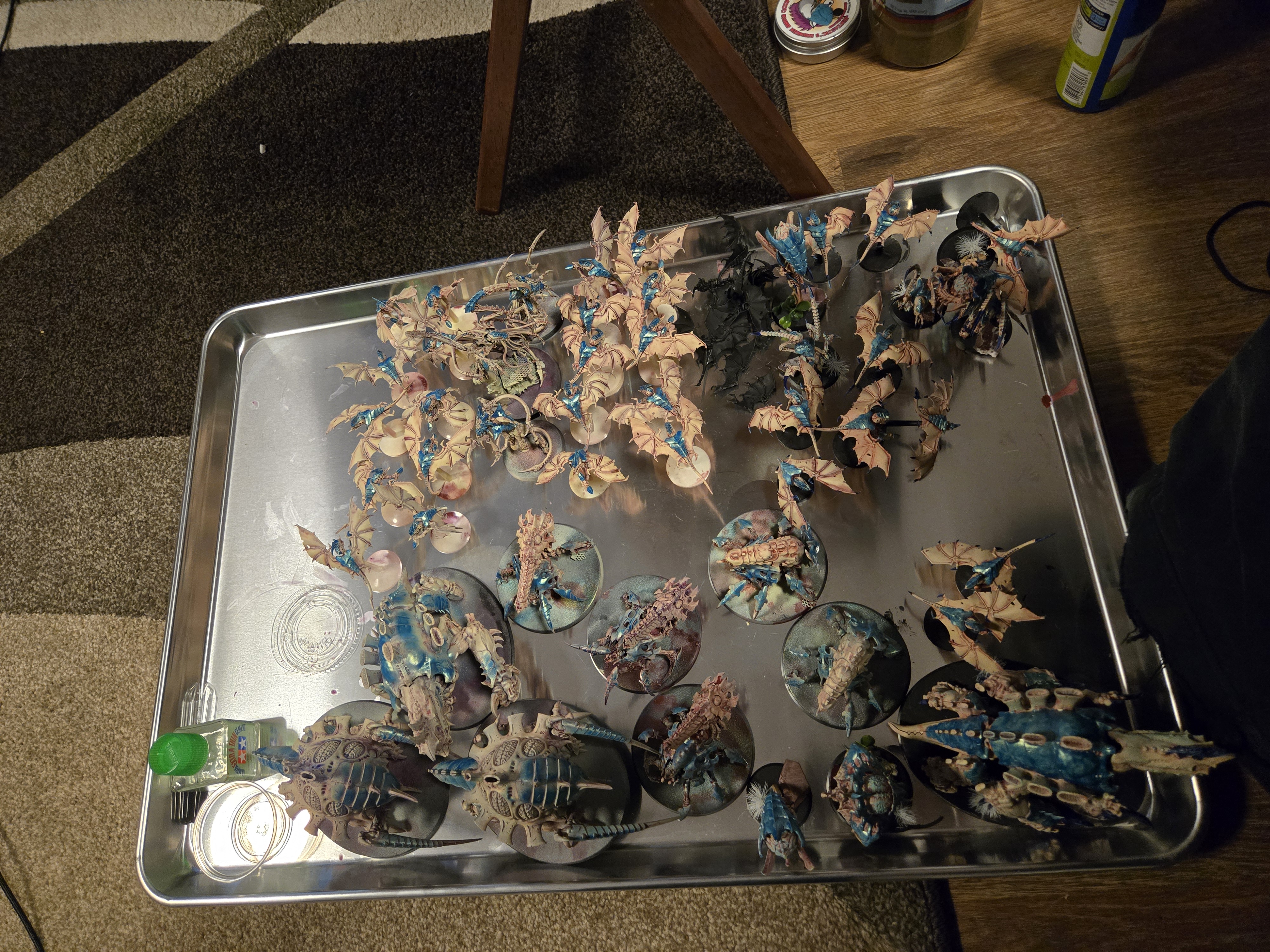
Tyranid Painting Project

In my 40k escalation league, I decided to pick Tyranids. I had a nice collection I had never brought to the tabletop, and it seemed like an enjoyable force to break out. This is an escalation league.

Overall, I am happy with the force and will probably expand. One thing I learned is that just because airbrushing is faster does not mean it is the best way forward.

To start, I primed all the models with Vallejo Primer Desert Tan.

My most time-consuming step was a mostly red oil wash with a drop of blue. I then wiped off using sponges.

I like the alien feel; it brought out most of the details I sought.

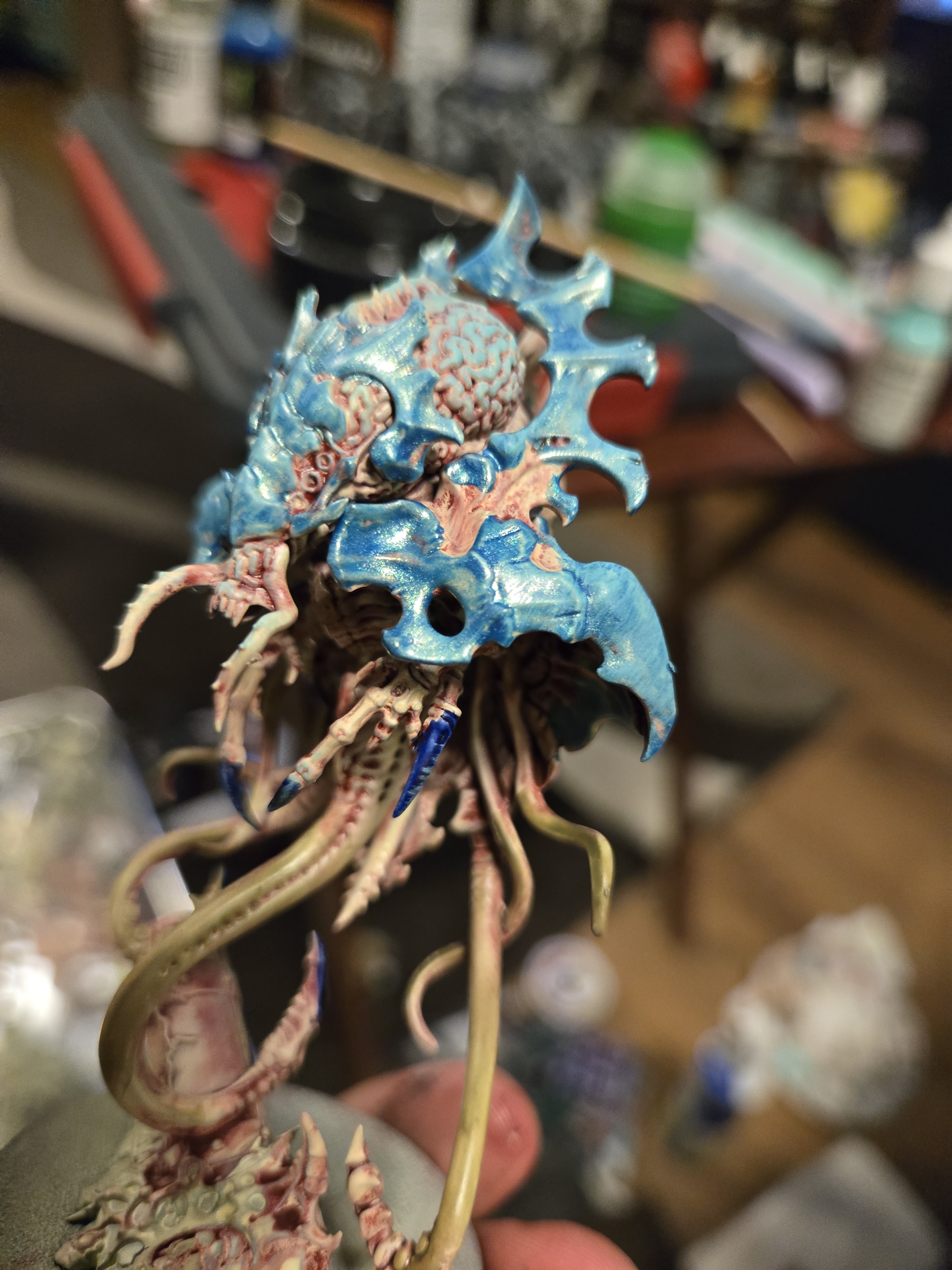
I then painted the caprice armor with Huge Miniatures Green Teal. I was delighted.

If you look closely, I airbrushed the Green Teal on the Exocrine and Maleceptor on the left, compared to the Exocrine and most of the gargoyles that I hand-brushed. I like the hand-painted look more and will forgo airbrushing those pieces in the future.

I painted most of the spikes and nails with Celestium Blue contrast paint. Then, I dry-brushed it with Reaper Mint Green. The tentacles were overbrushed with Vallejo Model Color green-grey.

The look is very alien and nasty, very tyranid-like.

I didn’t take a good picture of the basing, but I wanted it very simple. Volcanic Crackle Paste, Red marble mosaic pieces, snowballs, and clover.

What Warhammer players can learn from Magic the Gathering (opinion). Who’s the beatdown? What’s your archtype?

I always like to explore how one activity relates to another. For example, Basketball and Football seem to be very different games. Round ball, hardwood, vs not round ball, and grass. When you play the game, one key statistic comes to mind. Don’t turn the ball over. In American Football, turnovers indicate how a team performs over a season. A similar stat also shows in basketball.

Magic the Gathering and Warhammer are very different games with very different rules. Their only similarity is knowing and understanding your army’s various phases, strengths, and objectives precisely the same as in a Magic deck.

Magic the Gathering Background
There are two key ways to be a better magic player for newer players attempting to be competitive. 25 years ago, Mike Flores published the following article. https://articles.starcitygames.com/articles/whos-the-beatdown/. I recommend all wargames read the article. The gist of the article is understanding in Magic, two decks are trying to win by doing 20 damage to the opponent. One deck will be more aggressive and attack with creatures and spells than the other deck, no matter what.

This distinction is usually apparent; sometimes, it is less obvious. One key to Magic is that players can use a sideboard after the first game. Think of it as if you can swap out your cavalry for archers if you are facing an army of pikemen. A typical competitive Magic deck has 60 cards and a 15-card sideboard. Understanding what cards to sideboard and your role in the matchup is crucial to giving yourself the best opportunity to win.

The second way of improving at Magic is understanding the archetypes of each Magic deck and how they interact. We will explore this later.

Warhammer Who’s the Beatdown
Many Warhammer players who struggle to win consistently need to understand this concept. When to charge, when to hold back, when to go all in, and when to focus fire are crucial to winning. This relates to the role in the matchup. Word Bearers will most likely always be the beatdown or the aggressor. Their role is to kill the opponent. Could that change in round 4? If you already have objective superiority, it might be better to make the Tau break their gunline and come to you. Understanding each turn in a shell is basic and then applying that shell to the master scheme.

The beatdown role is also list-dependent. Necrons with lots of immortals and doomsday arks operate differently than a Necron list featuring flayers and wraiths. Space Marines would be the classic example of a force that can do either possibly but neither well. It is essential to know when it is your time to attack as a space marine player. A Ravenguard force filled with Assault Marines is most likely the beatdown in most cases vs an Iron Hands player.

A neat trick in magic if you are unsure about who the beatdown is, look who gets the first turn. If you are first turn it is most likely you, if it is your opponent it is not you.

A similar article I found while researching this article was posted in 2018 regarding Age of Sigmar. https://www.tga.community/blogs/entry/1731-4-whos-the-beatdown/

Why does the beatdown matter in Warhammer to winning
There are legit 60 armies in Warhammer between AOS and 40k. The newer gamer can’t understand the intricacies of each. Especially if you don’t play in every army all the time. Understanding what your primary path to victory comes easier when you know if your job is to attack or hold back. This brings us to the next phase.

What is your archetype
Magic decks tend to fall into four categories. Aggro, Mid-Range, Control, and Combo. The archetypes play well together in a rock-paper-scissors style to determine the Magic Metagame. Aggro decks usually beat control decks, mid-range decks usually beat control decks, control decks beat mid-range decks, and combo decks work as a wildcard.

Aggro deck’s job is to do as much damage as quickly as possible with small, fast creatures and damage-dealing spells. Mid-range decks tend to try and deal with the small creatures by killing them, making the opponent discard those cards, or putting a creature that is too big for the aggro decks to kill with their small creatures after the aggro deck runs out of resources, the mid-range deck takes over and goes for the kill. Control decks like to control all facets of the game using counterspells and spells that kill all creatures, but it generally takes until turn four for them to stabilize enough to have control, Aggro decks want to kill the opponent by turn four so it often becomes a race. Combo-decks attempt to win on the spot by assembling a series of two or three cards, casting those cards to create a combo of damage or creature creation that is unbeatable by the opponent.

It is a simplified version of Magic strategy, but it works for our purposes. Part of being the beatdown is understanding what type of deck you are running. This works very similar in Warhammer.

Warhammer Archtypes

Warhammer, as most of us know, also has a series of archetypes. Assault, Counter-Assault, Gunline, Combined Arms, MSU Spread, Glass Cannon, Parking Lot, Bulwark, Horde, Castle. Many of these archtypes can be confusing or overlap. For example to me a Gunline and a Castle function exactly the same with the same goals.

https://www.tacwargaming.com/newplayers/playstyles

Most armies fit nicely into the MTG archetypes, but it depends on the list. Necrons can easily be a horde army with 150 warriors on the board, they can be an elite army with the C’tans, or they can work as an all-purpose.

Armies like Genestealer cults or Leagues of Votaan have a smaller unit roster and aren’t as flexible in the various archetypes. Votaan will almost always be a gunline. Custoedes will always function as an elite army.

Combining Archtypes

I propose that in Warhammer, we consider our archetypes in the same Rock Paper Scissors format as Magic. Many competitive Warhammer players build their list with objectives and army roles in mind. This is the same as Magic when building. A Tau list with three riptides wants to defend said riptides by building a castle, letting them deal out damage while not taking any. I would consider this Tau list to be a control-type list. A control list would also be a different Tau list with crisis suits that want to move quickly around the board working on objectives.

Another example, Drukhari would be classified as a combo army, they want to put multiple buffs and auras on their units to make them more potent than their points suggest. In Magic, you would either counter said spells or discard their cards. In Warhammer, you eliminate the units, boost them or make them commit units elsewhere.

A new Warhammer player would better serve by understanding the archtypes in the game. If you think of your army as aggressive, you know your role is to kill as much of the enemy as possible. While mathematically, you would be best served to charge your orc boyz into a smaller unit of Termagants. If a Hive Tyrant is also within charge range and is buffing several units around it, the Tyrant is a better target, even if you don’t get the kill. To come to this decision, you, A, must understand that the Ork player is the beatdown, and B, the Tyranid player, is a combo player, and you must eliminate the combo pieces. The rest of the army crumbles once the Combo enabler is removed from play.

Facing the Same archetype

What happens when two forces have similar builds or archtypes? This is where, in Magic, you make your money as a pro. When two control decks face-off, one must be the beatdown.

In Warhammer, how do you decide? If two gun lines are facing off, unless the two armies are identical, one will be better at shooting than the other. Know if that’s you or not. You don’t want to be the player sitting back and shooting at your opponent when they are better at it than you are.

2025 Resolutions

My last post looked at how I did in 2024. Now, what can I do in 2025?

For one thing, I want my goals to be more direct.

Projects that will be done this year
The following projects are with various painters or will be with them.

  1. Lumineth Realm Lords
  2. French Bolt Action
  3. Death Korps of Kreig

Building Goals

  1. Eliminate all the piles of shame. I did most of this last year, but getting rid of it would be huge.


Army Goals
1. Paint AOS Ossiarch Bonereapers (I own every AOS faction; less than half have paint)
2. Paint a 40k army. (Potentially more Tyrnaids, leagues of Votaan, and dark Eldar are also options for 3,500 points)
3. Paint a 15mm Byzantine force. (my next campaign idea is Wars of Justinian following Belisarius)
4. 5 Small groups (Harry Potter, MCP, Kill Team, Warcry, Necromunda, Malifauxe, Bloodbowl)
5. Paint a Fantasy Army (leaning towards high elves, could do Skaven 3,500 points)
6. Paint a Battlefleet Gothic Fleet. (ad mech most likely 5,000 points)
7. Paint a Middle Earth army 1k points

Terrain Goals
1. Inventory Terrain
2. Properly Store Kallistra
3. Paint my Industrial Complex Terrain

Game Goals
1. 26 games throughout the year, battle report worthy. These can be home games or public games
2. Pick up a new game system, One Page Rules seems likely, so does Mortem et Glorium

Skill Goals
1. Paint brighter colors
2. Try new paint techniques, went blending in particular
3. Inventory some forces (an entire game system first would be good)
4. Complete and publish a ruleset or campaign.

2024 Year in Review

Wow, has it really been 2 months since I posted last. I have not been idle. Just lazy on the writing front. Sometimes, I think I get anxious about not doing what I am supposed to have done, and then I fall further behind. I will make several posts showcasing my accomplishments over the last two months. A half a dozen games and a fully painted Tyrranid list.

My resolutions for 2024 were;

  1. Complete Horus Heresey Word Bearers Army
  2.  Complete through scenario 15 of the Stalingrad campaign
  3.  Complete a Warhammer Fantasy Army, either high elves or Beastmen
  4.  Inventory my terrain
  5.  Spend less money and focus more on 3d printing
  6.  Paint 6 Skirmish forces, either Warcry, Necromunda, Carnivale, Malifauxe, Kill Team, etc. 6 of them.
  7.  100 Blog Posts

I completed the Word Bearers Army with 3500+ points. I still have quite a bit of work to do. I need two more Terminator squads, another couple of dreadnaughts, and new tanks.

I did not even get close to scenario 15. In fact, I only got to 5. I gave up on this as, quite frankly, I just got bored with it. As a plus, I painted 2k points of Soviets and 1500 points of Germans.

I completed a fantasy army, which consisted of the dwarves rather than the high elves, but it was completed.

My terrain was inventoried, kinda, no, not really, I did look at what I have.

However, I did spend less money; I did not do more 3d printing. This year should be better for 3d printing. I am getting much better at it, and the new printer is fantastic. I need to do a review.

I painted 4 skirmish forces. One Blood Bowl Team, One Marvel Crisis Protocol Group, 10ish Harry Potter Figures, and One Warcry Warband.

100 Blog Posts, 33%, are not good but not bad. Considering there were 4 months with zero posts. It seems a weekly post would be more effective.

Other Things
Complete the Black Seas ships (thank you, Kevin Bush)
Completed armies for the 100 Years war
Completed Mancrusher Gargants

How to improve;

I was actually more successful than I thought I would be. The thought this weekend of completing the review was it would be abysmal. Instead, I was a little encouraged.

Review My Goals
It seems like I tend to get bored quickly with a project. The Stalingrad project, for example, was exciting for a few weeks, then a chore for a few more weeks, then a burden. Hobbying should never be a burden. If I had looked at the list of hobby goals, I would have grabbed a Kill-Team, Warband, or other item and given myself a break.

Understanding Limits
I just don’t get enough hobbying done in a week to get enough content for two posts. I may do one battle every two weeks and complete one or two units every two weeks. People don’t care much about my thoughts, but I could review more products. This year, 50 posts seem more reasonable.

Also, to understand my limits, I must understand my attention span. I have three rulesets I have been working on for various games and a dozen campaign and army ideas; traversing from one to another will be necessary.

Have Fun

This hobby should not be a chore or a burden. If I am not having fun, do something enjoyable.

Until 2025.