A Comprehensive Guide to Wargaming Terrain Part 4.

Next, we must discuss mats, trees, hills, and other landscape terrain.

Mats

Mats are used to cover the tabletop. There are literally thousands of designs and hundreds of manufacturers. I consider a good mat to be essential for building miniature battlefields.

The best mats are neoprene with a non-slip rubber backing. They are very similar to mousepads. They are durable, can pack in a ton of detail, and don’t slide around the tabletop. I recommend Frontline Gaming. I think I own 30 of their mats.
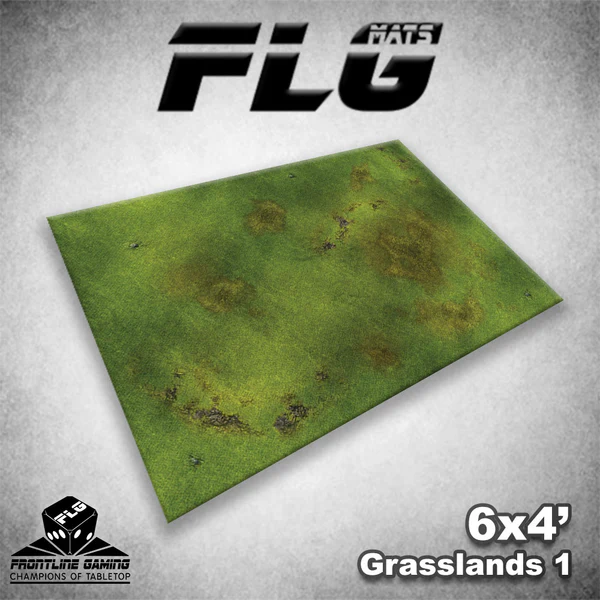
There are several considerations for buying a game mat.

Material Type: As I said before, look for a neoprene mat. 95% of all games will look fine. The only exception would be if you want one of the long grass mats for historical wargaming. These have a very nice texture, but they make a mess, and spiders like to hide in the grass. I try to stay away from cloth mats. They have a better texture than neoprene but are very hard to lay flat, the same with dry-erase plastic and other similar materials.
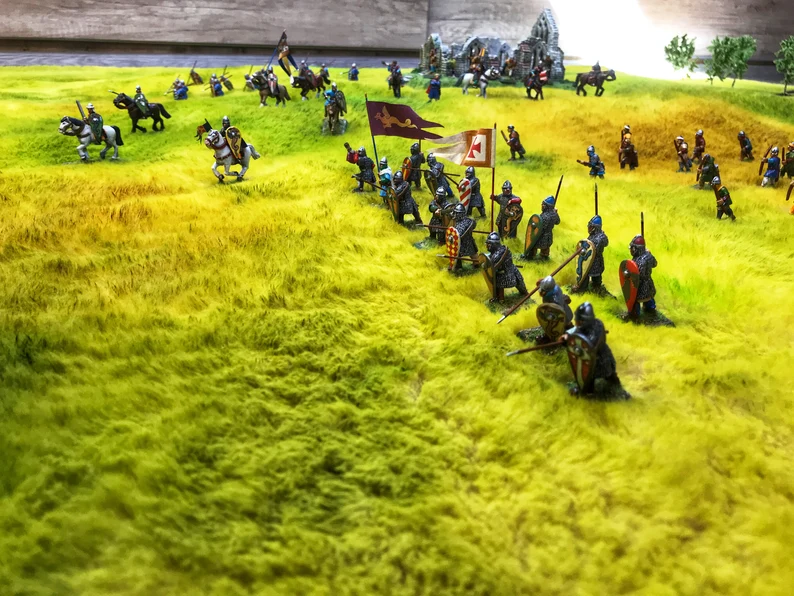
Table size: Don’t buy a mat that is too big for your table. When shopping, the manufacturer will list the mat size; you can typically get the same pattern in multiple sizes. A 6×4 mat should be in the $100 range, but you can often find these on sale.

Game: Know what size your game needs. Star Wars Legion is 6ft. x 3ft., and 40k is 44in. x 60in. For a standard game. I have found a 6ft x 4ft mat works for almost all games, as long as it fits your table. I typically opt for 8×4 mats as that is my table size, and I can always make the battlefield smaller with things like walls, fences, and rivers.

Terrain: My biggest kicker. I don’t want jungle ruins on a moon terrain map. This is one thing that irks me about terrain. You spend tons of money and time making nice terrain, so don’t pick up a mat that matches.

Storage: If you buy a mat or seven, ensure you have a good place to store them. If mats aren’t stored correctly, they will crease. I store my mats in a Christmas wrapping paper bin.

Trees

Trees are very useful in building a wargame table. Many game systems use trees as cover, breaking the line of sight, rugged terrain, and they just look nice.

The options for trees are vast. I recommend that your first tree purchase be a Christmas village tree. These are generally cost-effective, scale well, and look fine on the tabletop. They are also quite durable.

Model railway trees are also an option. They are less durable than the Christmas variety but more detailed and typically cost slightly more.
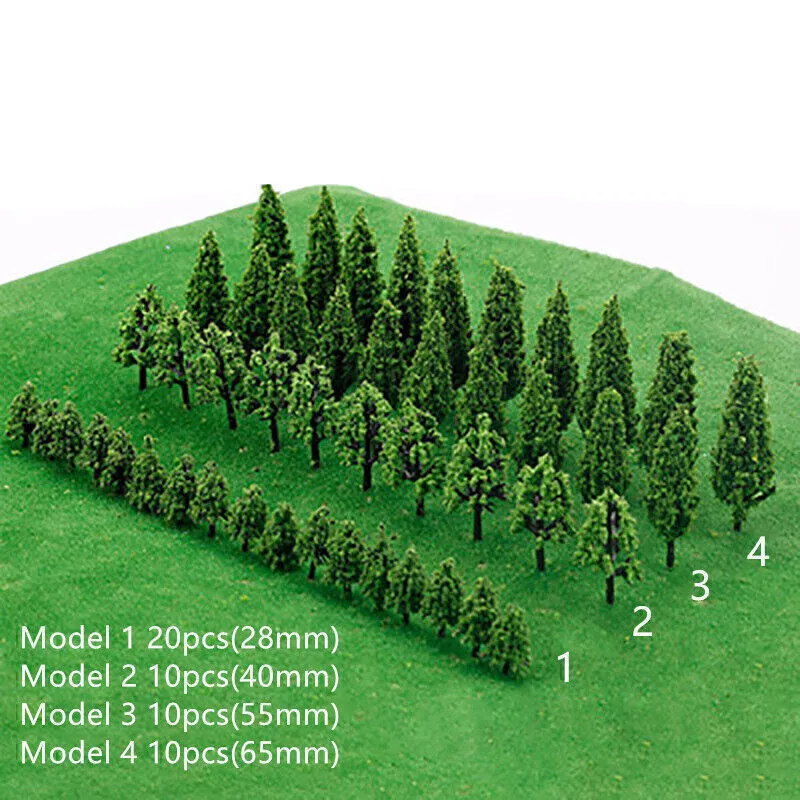
My final recommendation is to search Etsy and see what you can find. If you are crafty, you can make your own. This is one area of crafting where I have never really been successful.

Hills

Ah, the lowly, simple hill. In our hobby, hills are far more challenging than you would think. Miniatures tend to slide down sloped hills. There is rarely a place large enough for a unit of models to stand on.

When you can find a hill that works, it dominates the tabletop. To start wargaming, I would actually stay away from hills altogether. It helps keep your game simple, and most games are designed to be played on a flat field.

If you really want to get into hills with some of your historic games, I recommend flat-topped hills.
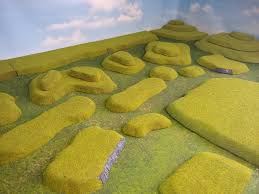
You can place an entire unit on the crest, and they have a good table feel. I would avoid gently sloping hills like the ones I own from Hexeton Hills. They are just too cumbersome on the table.

Other Landscape Features

There is no limit to how much you can put on a table. As someone who plays various games and periods, I lean towards universal terrain and avoid particular items. I try to keep the basics around: rough ground, fields, roads, rivers, ponds, hedges, fences, etc. Most of these have minimal impact on gameplay other than you move 1 inch less, you can’t cross this, and it provides cover. I have found that the more I scatter about the table, the more complex a game can be. They look absolutely incredible, and if that is what you are going for, by all means, make your table as detailed as possible for the best gaming experience. I would skip most of these small terrain items.

Until next time.

A Comprehensive Guide to Wargame Terrain Part 3

Now that you have played a few games, are tired of stacks of books and hardboard cutouts, and want to take the next step, I still don’t recommend breaking the bank; let’s look at budget starter terrain.

Most of this terrain will come pre-painted, limiting your upfront time and money investment. This gives you more time for gaming.

My #1 recommendation will always be aquarium terrain.

Rocks, ruins, castles, and plants—all for less than you will spend on two or three paint bottles. Ten or so good pieces will give a very nice-looking 6×4 table with interesting and varied terrain. The biggest con is that aquarium terrain is rarely thematic or scales with the models on the table. (table cost $140)

My following recommendation is to go take a walk. Find some public property along a riverbank or in the woods, grab 10 or 12 interesting rocks/pinecones/logs, and place them on a table. This terrain setup can actually be very thematic and fit your table. (table cost $0)

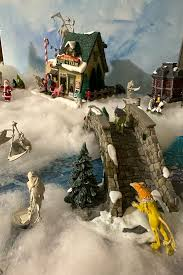
Another budget item is to visit thrift shops and church stores and look for Christmas village items. This is a great way to get a handful of buildings, perhaps a bridge, and some trees.

The terrain tends to look okay. Your battles can be pretty interesting, and you can even do fun missions, such as escorting Rudolph to the flying sleigh. The biggest downside to Christmas terrain is that it is primarily sealed, and your troops cannot occupy the buildings. (table cost $30-$200)

Trees for Christmas villages could be a category of their own. Often, these are the only trees I use. They look far better than I can make, and they fit the scale wonderfully.

My final recommendation would be to buy model railroad building kits.

Many buildings can be had for $15 or less. You can paint them however you like. They are very accurate to scale if you buy the correct scale. There are endless possibilities. My most significant downside to model railway items is there is a time investment and a hobby side. Most buildings require assembly and painting. The other con is durability. The model railway is for building models that sit and look pretty, not for gaming with frequent movement and other forms of abuse. (table cost $200-$400)

That is just a quick look at the options for terrain on a budget, for a burgeoning wargame. Tune in next time for information on gaming mats and other 2d terrain.

Flames of War Fortress Europe Soviets vs Germans

I am starting a string of 3 matches of the same game. I keep my interest longer with smaller match strings to see what happens.

I brought a decently large Soviet Force against a relatively elite late-war German Force. The Germans, as a whole, were unable to do enough damage to stem the tide of Soviet tanks and thus lost the engagement. I did misplay a little and did not dig in with the 88s. Could have made a difference, we will never know. The Soviets literally brought 21 tanks to the fight. I maybe could have positioned the 88s better to avoid so much damage the first turn, but I don’t think it would have mattered.

The mission was counterattack and the lists are below.

SovietsGermans
KVs Heavy Tank Regiment HQ4Tiger Tank HQ12
4 KV1’s Guard Tanks16Tiger Tanks x336
4 KV1’s Guard Tanks16Tiger Tanks x224
Hero T34 Tank Battalion HQ58.8 Tank Hunter Platoon 4x 8.8 CM Guns18
4 Hereo T34 Tank Company12Luchs Scout Troop 3x Luchs5
4 Hereo T34 Tank Company128.8 CM Heavy AA Platoon 2x 8.8 cm AA Guns6
3 Hereo T70 Tank Company3
Recon Company HQ2
Armored Recon Platoon6
Heavy Tank Killer Company 4x 76mm10
4x 122mm Howitzers8

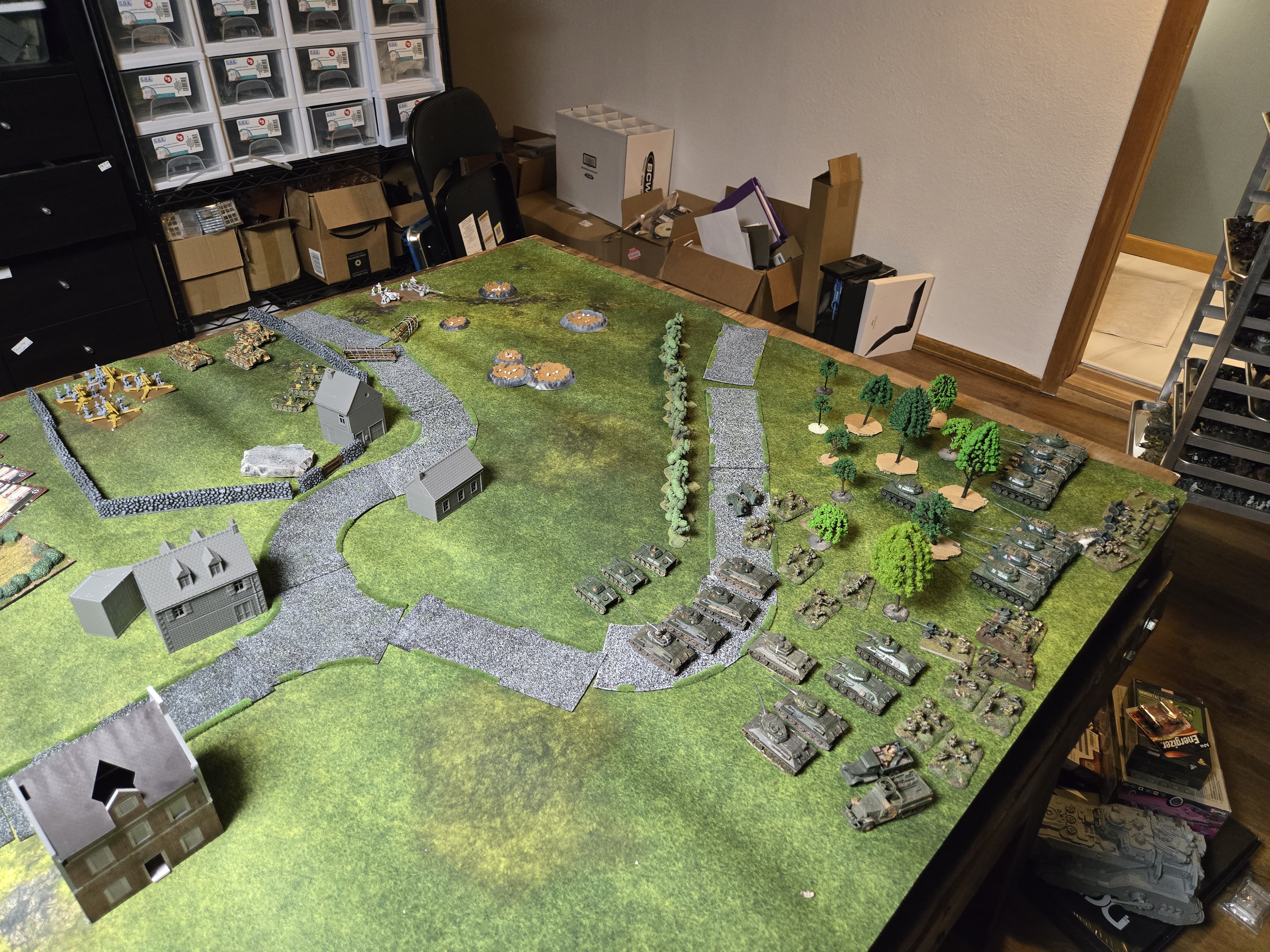
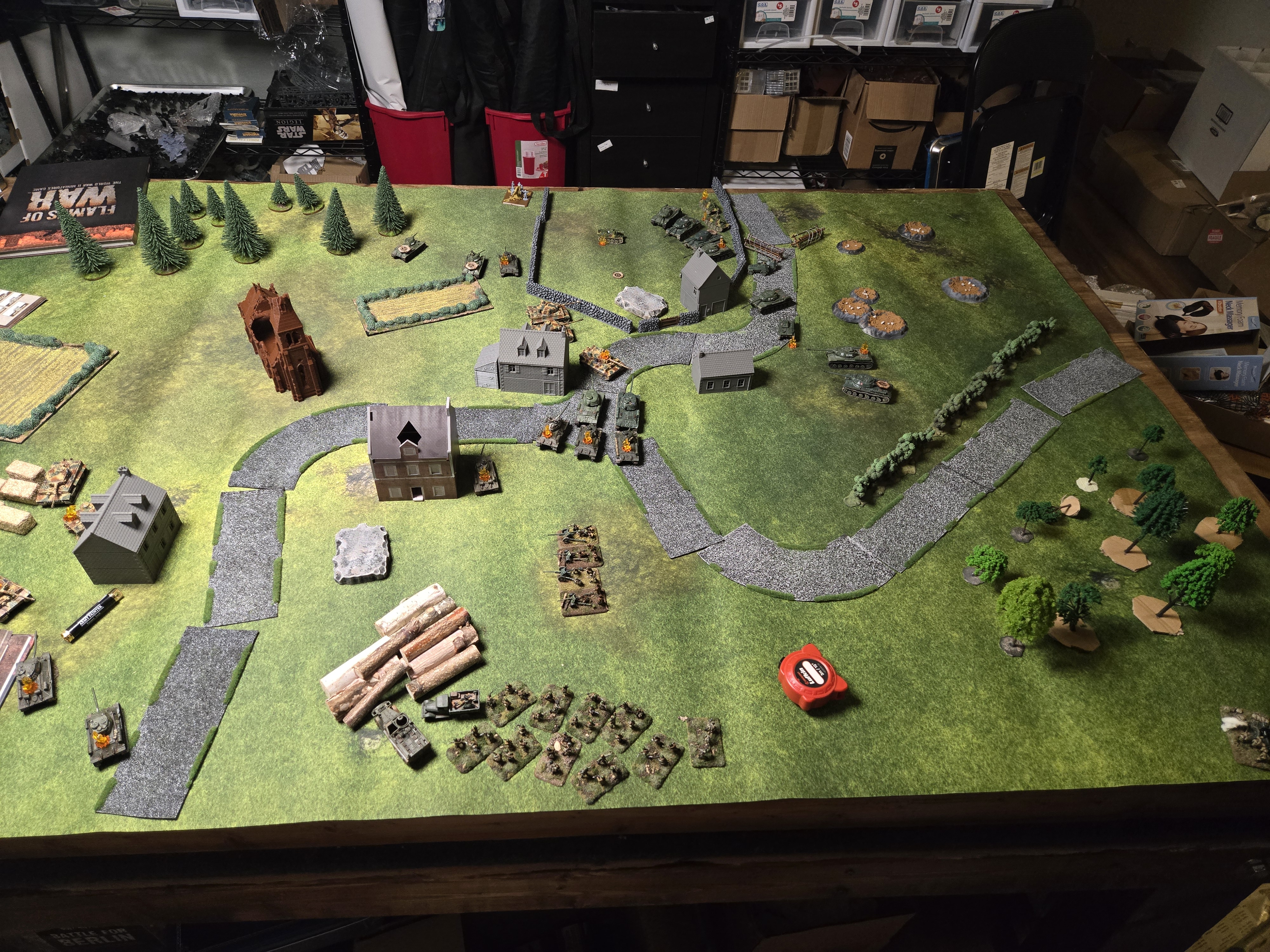
The primary deployment is below. The Germans have three Tiger Tanks in reserve; they will enter the game from the bottom left.

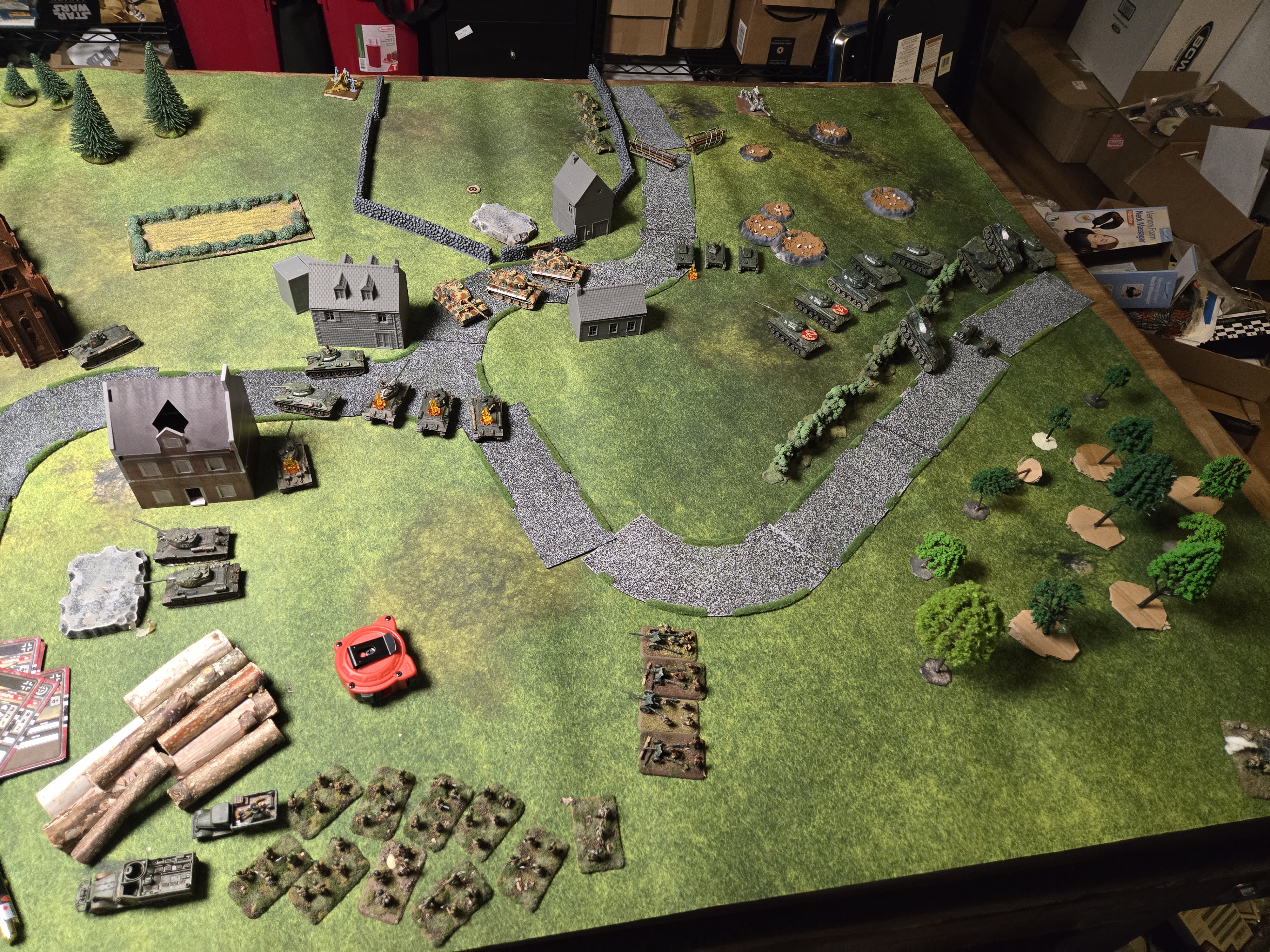
One turn in, and you can see that the German reserves have entered the fray. A very successful Soviet artillery strike estimated the leading German 88 group, killing 3 of the 4 guns. The German tanks completely desecrated the T-34s, pushing up the middle of the field while the KV1s pushed the right flank. The Germans planned to use their infantry to hold the objective. The Soviet scout droop did a great job ranging in the artillery.

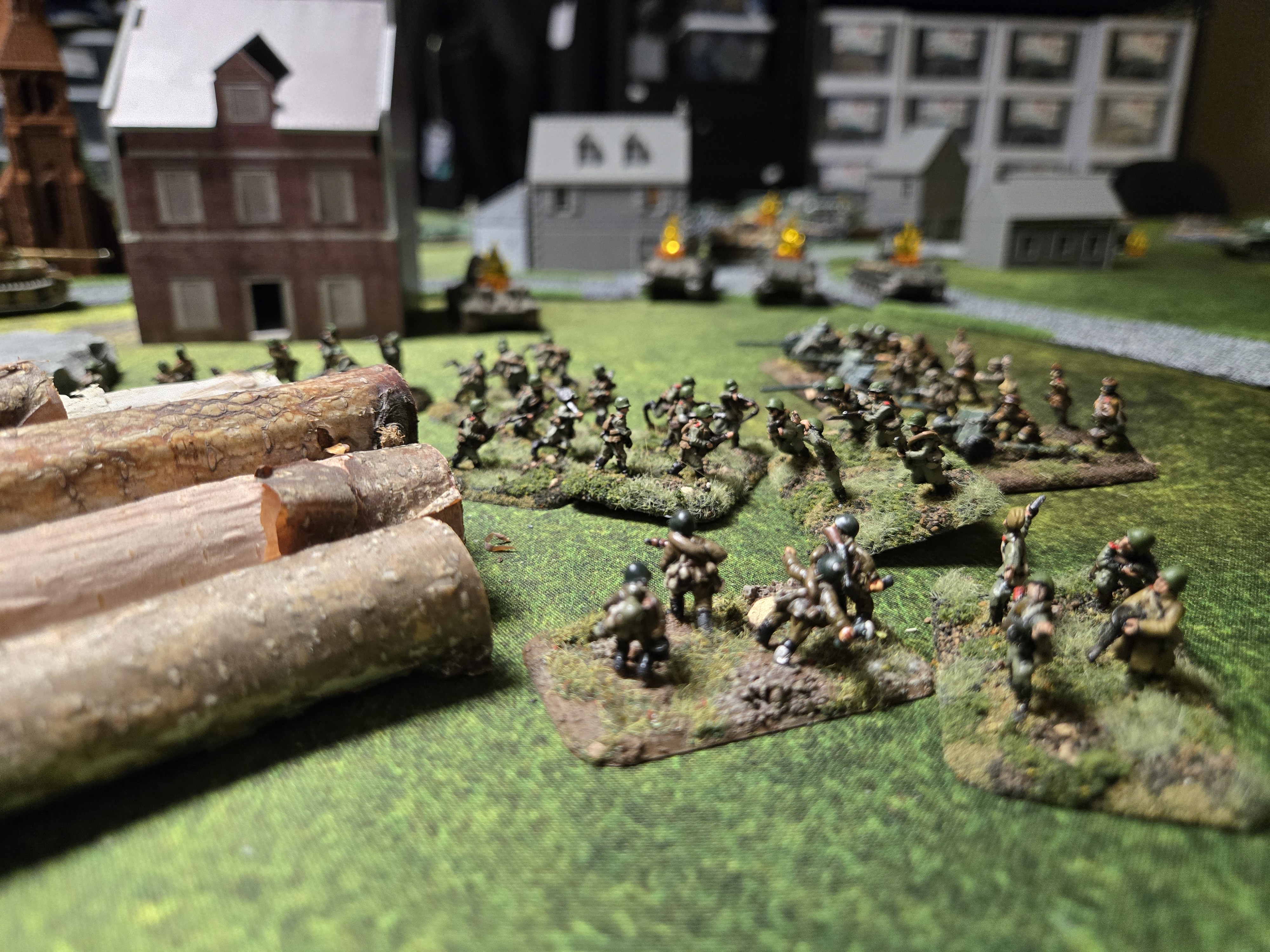
Turn 2 was much of the same, with more destroyed and bailed-out Soviet tanks. The German guns are safe for now. You can see the Soviet Tank hunters and infantry at the bottom of the table taking up positions.

Turn 3. Apparently, 4 tank hunter teams (side armor), and an artillery strike can destroy a Tiger Tank. I didn’t take many good pictures on the bottom of the board, but one of the up-gunned T34s also destroyed a Tiger. At this point, I didn’t have a plan for the Germans to win. Instead they just destroyed as much as possible and try not to lose.

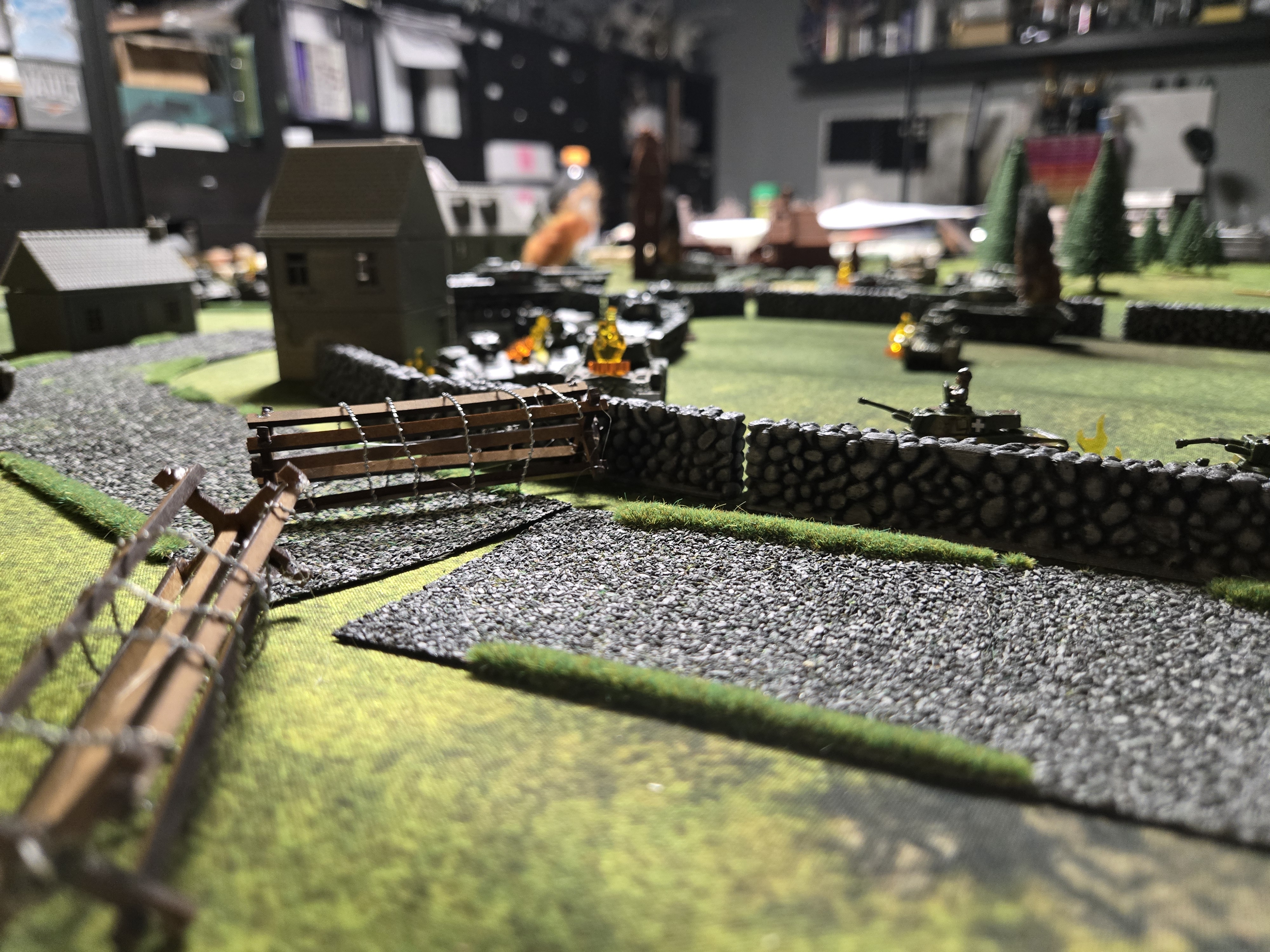
Turn 4, a brave group of T-34s tried to surround the German Tigers. They were annihilated. The lone Tiger on the bottom side was maneuvering to help his two brothers in the middle. The KV1s are pushing to completely surround the Tigers.

Turn 5: The Germans lost another Tiger and are in full pullback mode to try and salvage what they can. The Soviets are firmly rooted with 4 tanks on the objective and stand to win at the end of the following turn.

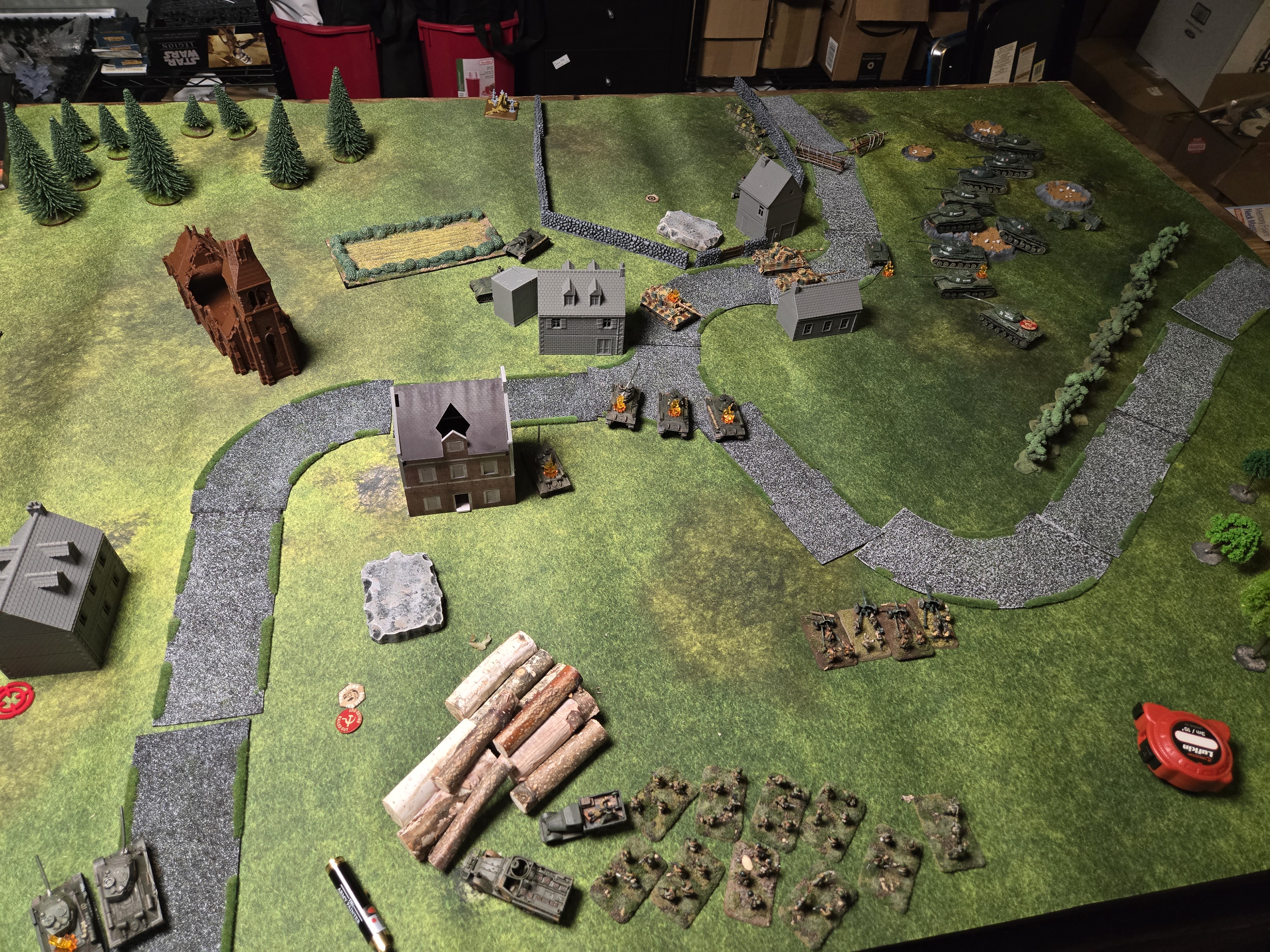
Turn 6, and you can see how it ended. The Germans were just unable to do enough damage to win the round.

A Comprehensive Guide to Wargame Terrain Part 2

You have played a few games, enjoy the hobby, and want to improve your tables.

Hooray. Terrain, as I will say, 100 times makes the game better. It is not required, but it sure is fun.

At this stage, I will avoid discussing 3D printing. I know what is out there and how amazing it is, but we are beginning hobbyists.

A Note on Scale

Wargames can use a variety of scales. Scale is determined by the height of a figure from the bottom of its feet to eye level. Warhammer models are about 32mm, so they are 32mm scale. Bolt Action is closer to 28 mm, while Marvel Crisis Protocol is 40mm. (aka Captain America is 40mm from his feet to his eye)

Scale matters when it comes to terrain. If a standard rifleman can stand, look over a building, and shoot, it detracts from the immersion. Consider this if you make or buy your own terrain. The type of game you are playing also matters. Epic Battles from Warlord games is about 10mm scale, designed for large, medieval conflicts with a couple thousand figures on the table. Narrow streets and cramped buildings wouldn’t be fun to play on.

The same can be said for Bolt Action, a 28mm WW2 game. The average army has about 30 figures and a vehicle. This game plays much better with more terrain, buildings of different heights, etc. It does not play well on an open plain with a small river.

If purchased for Epic Battles, the same river might be the width of a battalion, 150 or so yards across. In Bolt action, that same battalion is shorter than a typical Tiger Tank and little more than a stream.

It’s just something to think about. Most players I know won’t care if the house is about the same size as a Landraider or if their noble knight is just a little bigger than the door he is guarding.

What Terrain do I need?

This entirely depends on what game you are playing. Rivers don’t make sense if you play Battlefleet Gothic, a game in outer space. Like Grimdark Gothic ruins don’t make sense in the Wild West.

I always recommend starting with the basics. Roads are universal, and scale doesn’t matter much. You can buy some fabric from a local store and cut them out yourself (the cheapest option). You can paint and use cardboard, buy the neoprene roads from Amazon (my top choice), or even look at premium custom-made or 3D-printed options.

The entire above paragraph can also be said about rivers. Add a bridge, and you can have an exciting engagement. Most games allow faster travel along roads, and rivers are always an effective barrier or defensive structure.

Next time, I will add some vegetation; hedgerows and trees are universal among the wargames I played. Star Wars Legion, Flames of War, and Napoleonic all need some vegetation. Adding cover and breaking the line of sight always looks good. I have some expensive custom-crafted trees. I prefer trees for your Christmas village or the bulk boxes of fake trees you can buy on Amazon.

Hedges have always seemed a little trickier. These matter for scale, as a soldier shouldn’t be able to see over one, but a vehicle or mounted knight should. They are also a little harder to find. My favorites are plastic and 3D printing, but you can also find premade ones on Etsy. If you want to try making your own, a few YouTube videos and a trip to a craft store should yield good results.

I also think stone walls are reasonably universal. I use mine in dozens of games; they never go to waste. I buy mine on Etsy, but Amazon and 3d print shops also yield good results.

More Specific Terrain

At last count, I have armies for 47 different miniature wargames. I strive to make my terrain as universal as possible. I don’t add Soviet propaganda to my 15 mm buildings because I also used them in the Napoleonic and Ancient periods. If you’re just starting out, I recommend building one table first.

When building a table, look below at the types of games and terrain needed. Don’t worry about walls, fences, or many buildings if you are playing 15 mm Napoleonics with 400 figures on the table. Instead, focus on hills, fields, and forests. If you bought a kill team and want to expand into an entire 40k army, a grimdark ruin (3d print please) with several floors and bits of scatter is more thematic.

As always, buildings and vegetation are unnecessary if you are playing a space game like Billion Suns or a water game like Black Seas.

Types of Games

I classify boots-on-the-ground Wargames into four categories: Squad Actions (10-14 Figures), Skirmishes (20-50 Figures), Army Actions (100 figures plus), and ranked soldiers. There are other categories for naval, space, and airplanes, but that’s how I do it for boots-on-the-ground.

I know you may balk at this, but think: A squad of 10 men may fight over a house, a platoon of 60 men may fight over a compound, large structure, hill, or bridge, and an army will fight over a town or range of hills.

In squad actions, scatter terrain is vital. Broken furniture, light poles, crates, rubble, craters, computer terminals, and market stalls. When you only have 10 figures on the table, you can take your time to enhance some of the details. It generally leads to much more interesting games.

In skirmish games (think Age of Sigmar), you have a force of units on the table and generally move a few models around as a unit. No one would consider your 40-man army a full invasion force, but they look great on the table and strike a nice balance of hobby and playtime. Scatter is less critical here than elevation and line of sight. It rarely comes into play and is often just inconvenient.

In my book, army actions are typically reserved for historical events. I rarely consider using figures larger than 15mm in an army action game. This is when actual land features start to play: hills that hold entire battalions and dozens of cannons. A single fence or wall is inconsequential; the layout is more important. A forest that hides 3,000 troops, a river you can’t just walk across. A hill is several hundred feet high that overlooks a large camp. These are the types of terrain you should be working on. Unfortunately, most of these need to be crafted.

Finally, there are rank-and-file games: Warhammer Fantasy Battles, A Song of Ice and Fire, Kings of War, and Conquest. They want to act like army games, have the model counts of skirmish games, and are exceptionally difficult to move around. I treat them like army games, but I also push for utterly flat terrain. It doesn’t look as nice, but functionality is most important for the game’s playing.

Conclusion

Hopefully, this guide will help. Stay tuned for part 3.

40k League Match 5 Tyranids vs Astra Militarum

Another game, this time a devastating loss.

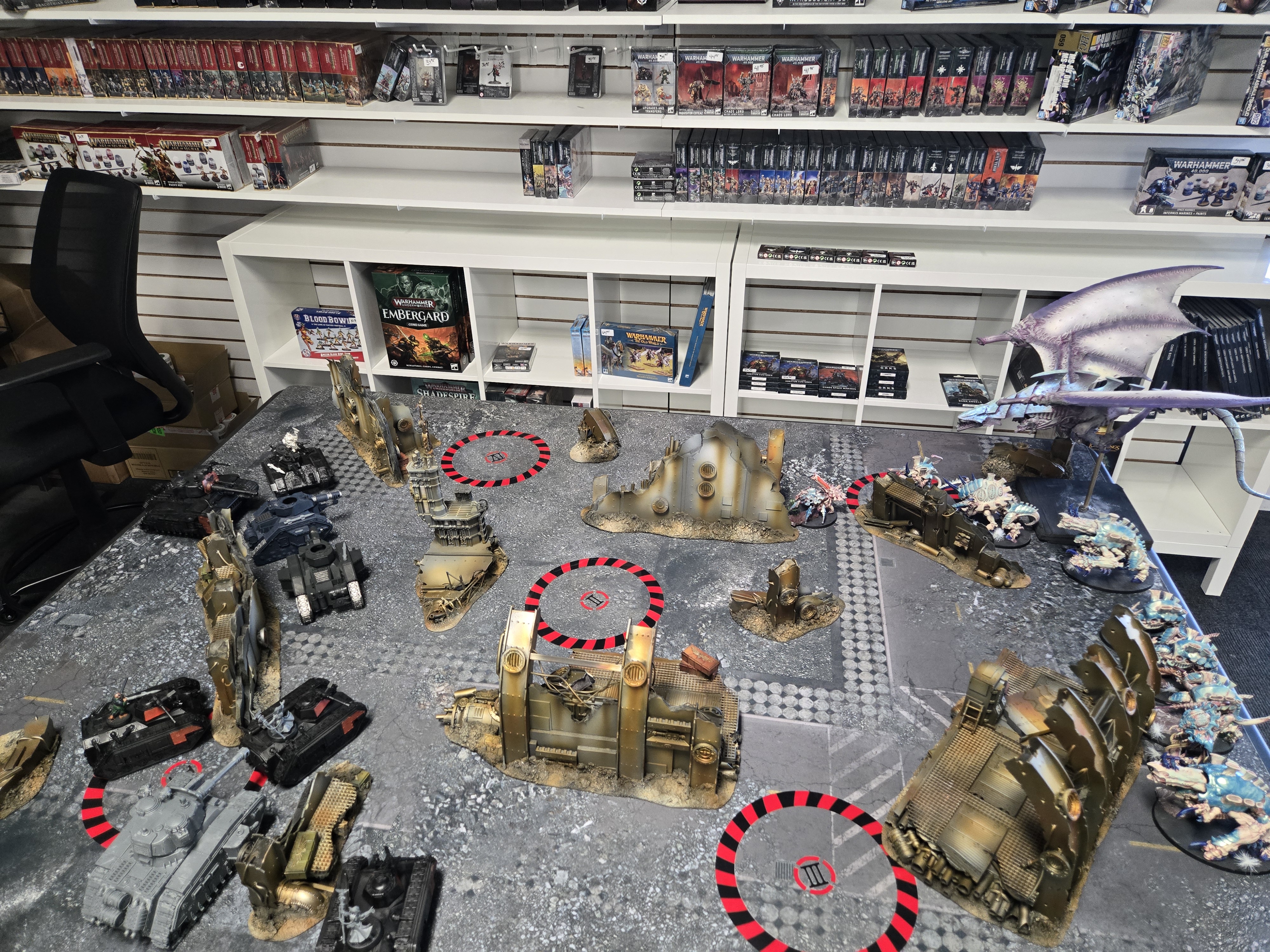
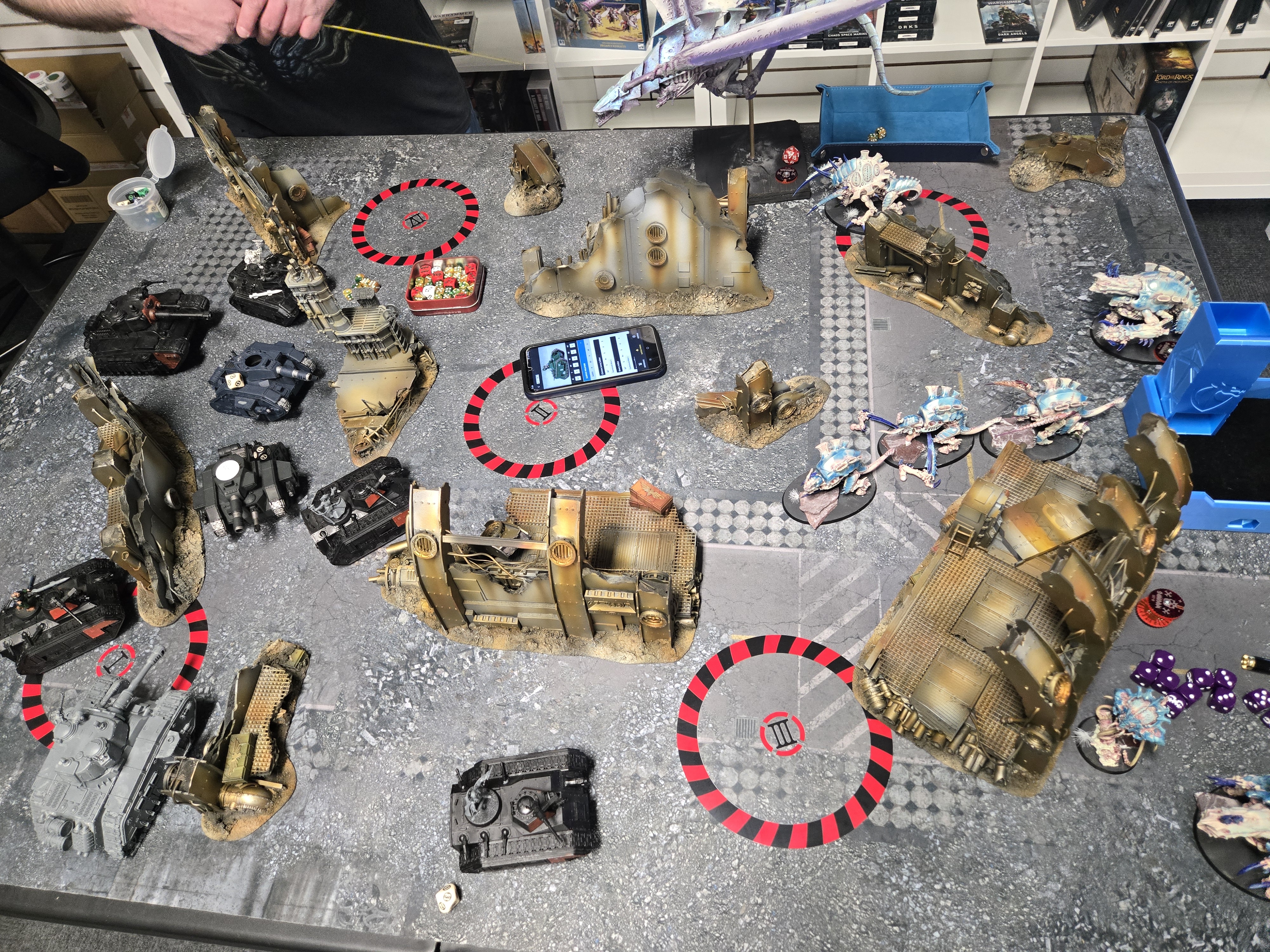
I had a tough time facing down 7 Lemon Russ, 2 Regal Dorns, and 4 Chimeras. My anti-tank just wasn’t practical, and it didn’t help. Instead of 3 maliceptors and 3 exocrines, I brought a Harridan.

I will see this game I did play well, just didn’t have the firepower.

Hive Tyrant (general) Synaptic Lynchpin255
Neurotyrant105
Old One Eye150
Gargoyles x2170
Carnifexes230
Exocrine x2270
Harridan610
Maleceptor170
Pyrovores40

Round 1

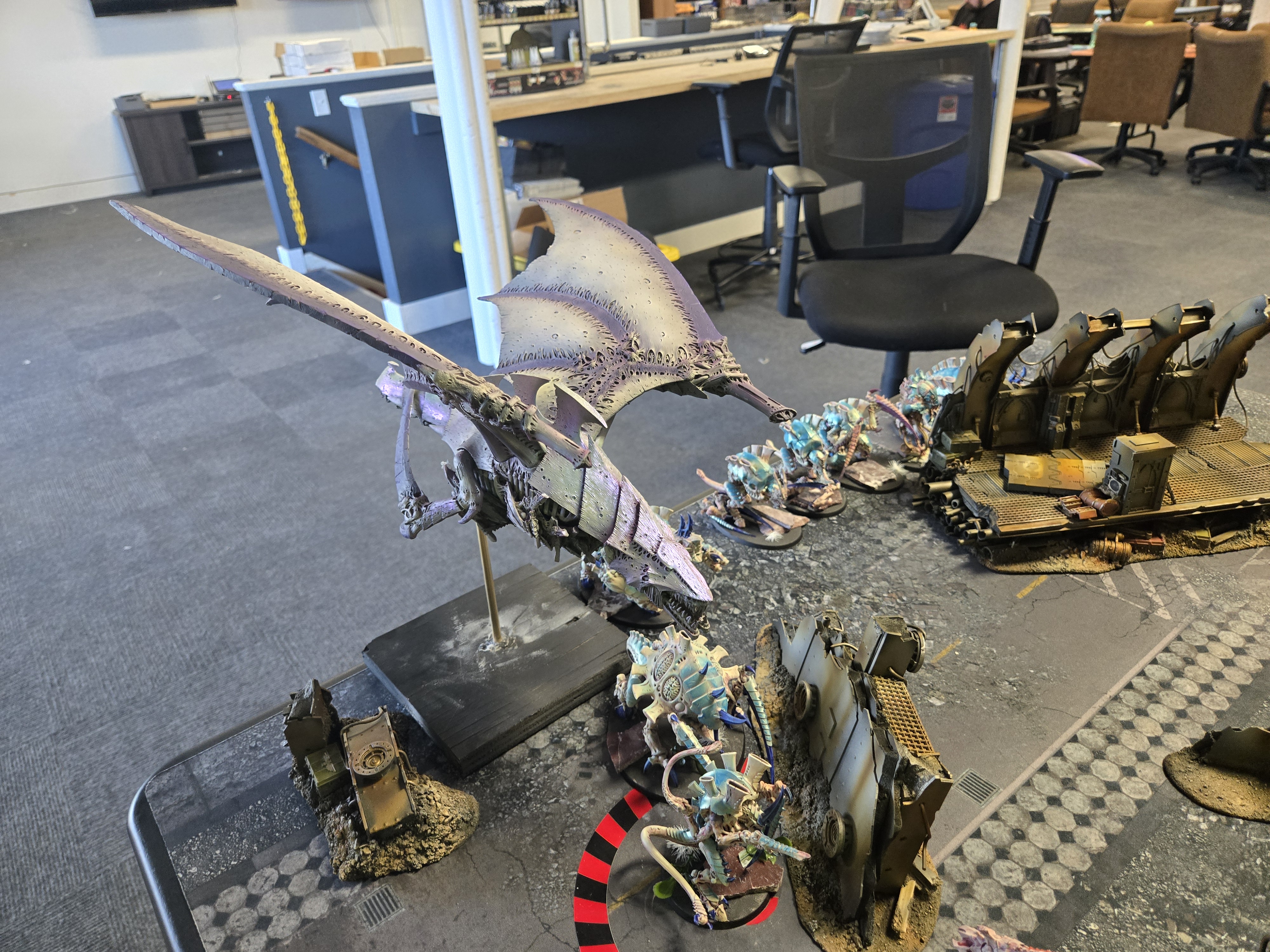
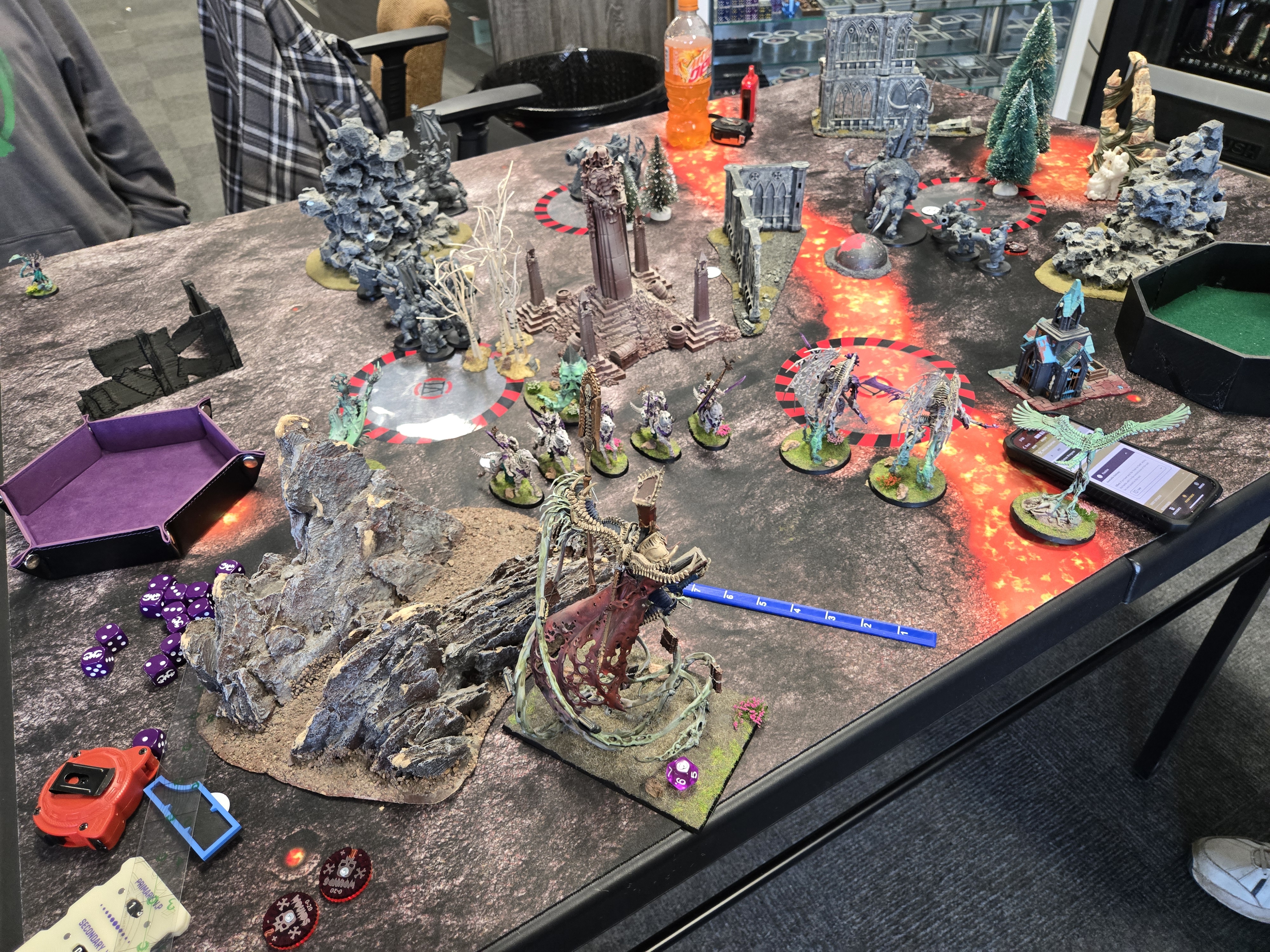
Nice shot of the Harridan overlooking his troops. His size and scale are compared to the Hive Tyrant and Maleceptor below.

Our initial setup looked something like this. After looking at my opponent’s list, I knew I was going to have a tough time.
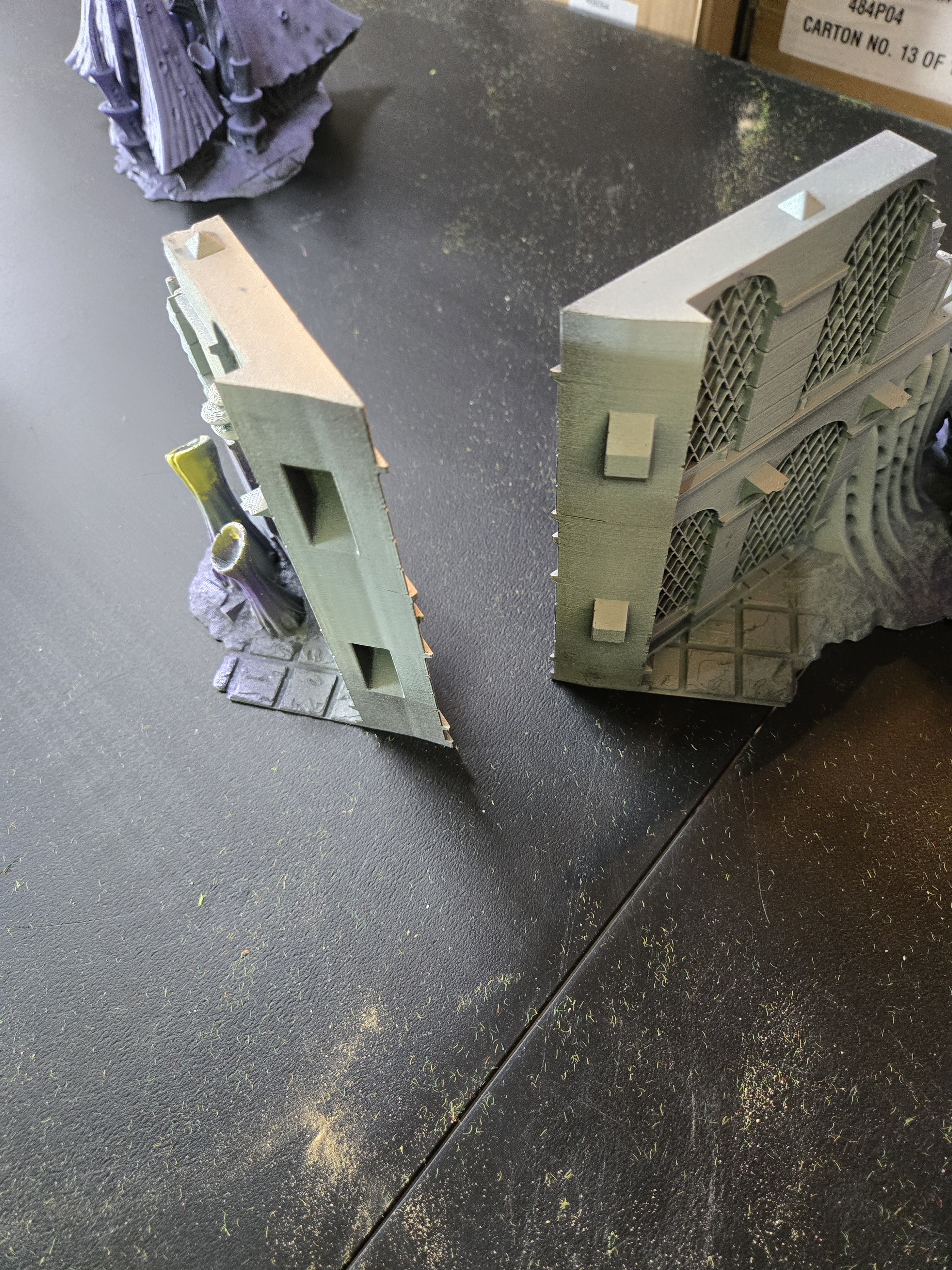
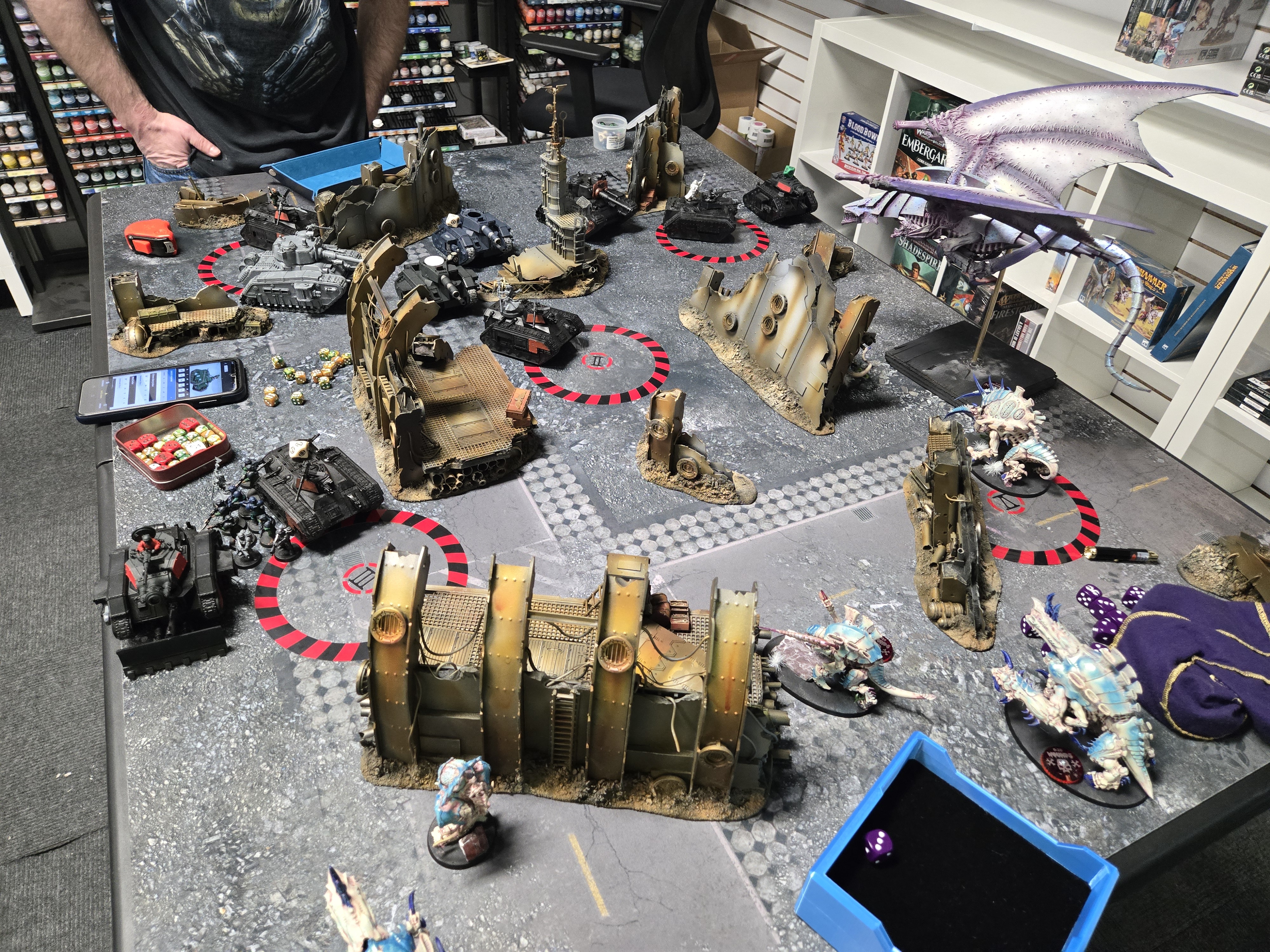
I pushed up with my melee units while he held firing lines with his tanks. This was very standard. I probably should have screened my carnify with gargoyles on the advance.

He didn’t shoot particularly well. I didn’t either, and after the first round, absolutely zero units were destroyed.

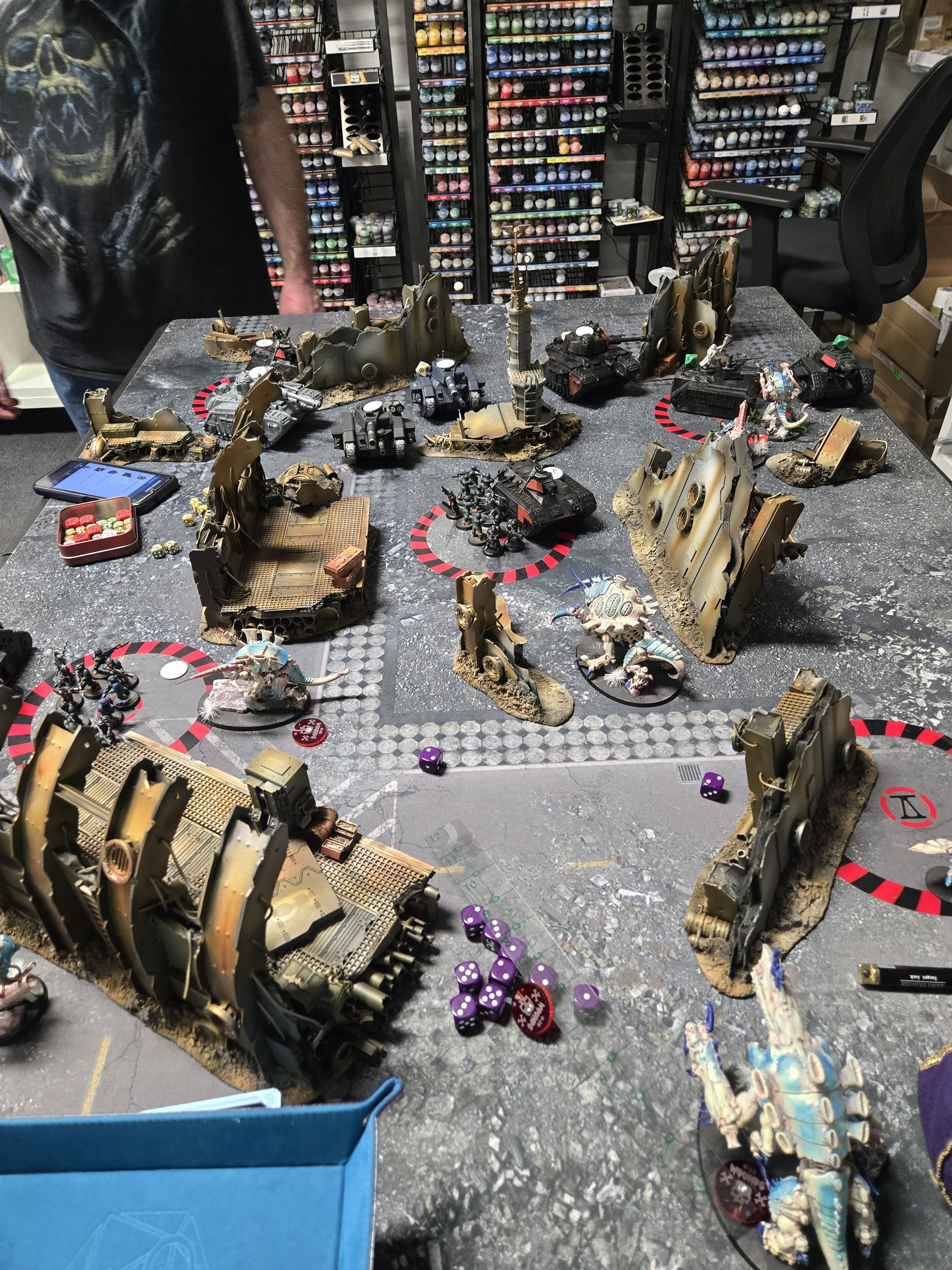
After round 2, I lost my carnify and still have not destroyed a tank. Plus, he was able to bring on two more from deepstrike. The game was over at this point. Both exocrines had less than 3 wounds remaining.

This was the end of round 3, as you can see, with minimal firepower. He would get to shoot again to start round 4. I let him try to table me, then conceded.

A Comprehensive Guide to Wargame Terrain

Greetings, new (or seasoned) wargamers, and welcome to my guide on wargame terrain. I want this guide to be very in-depth but spread over multiple parts. I love the terrain. It is wargaming, more so than the models themselves. I have spent fortunes on terrain that I am proud to have on the table. Click here for the rest of the series.

What is Terrain

In Wargaming, terrain is simply something we use to avoid battles on flat surfaces. Looking back through historic battles, terrain plays a starring role in how the battle shapes out: Germanic tribes ambushing Roman legions in dense forests, fierce fighting in Stalingrad over a grain elevator, and even the shallows at the Battle of the Nile.

When we play wargames, depending on the game, the terrain will change how our models move about the battlefield. There are games where terrain is a significant part. Rules for elevation, river crossings, and trenches all factor into our generalship. Hours are spent discussing target priority, strategic usage, and ideal lists, but using terrain is even more critical.

Getting Started

There are levels upon levels of terrain available for purchase. You can make it yourself, 3d print it, buy 3d prints, complete terrain kits, fully painted items, use non-traditional items, get fully custom-made-to-order commissions, purchase modular build kits, and endless other options.

But let’s say you bought a starter set, and you are tired of your miniatures shooting at each other across empty space. Maybe you have watched a video online about how to play your newest game, and they have these handcrafted realistic buildings, luscious grass, LED lights, flowing rivers, and jungle canopies. You look on Etsy and see this terrain set for $1,000. You put your miniatures away in a box, ending your wargame experience.

You don’t have to have beautiful terrain to wargame. If you are so overwhelmed by your first games by the sheer amount of options and all the shit you have to buy, it’s impossible to love the hobby.

In fact, if you are curious about wargaming, I would advise printing out paper models and paper terrain and getting a game started for $20 and an hour of work rather than $2,000 and 100 hours. Most games have a free ruleset available as a PDF for starters. See if you enjoy the game part. Then maybe visit a local game store. (My town of 7,000 has one; I’m confident the internet can help you.) Most stores have terrain you can use and tables to play.

Your First Terrain Set-Up

More people play casually at their kitchen table with their kids and friends than in a store with dozens of others. Stores are intimidating. You don’t want to ask for help or feel clueless. Gamers will walk in with backpacks filled with the latest and most fantastic devices and commission-painted armies, and you have a mound of grey plastic. It’s ok.

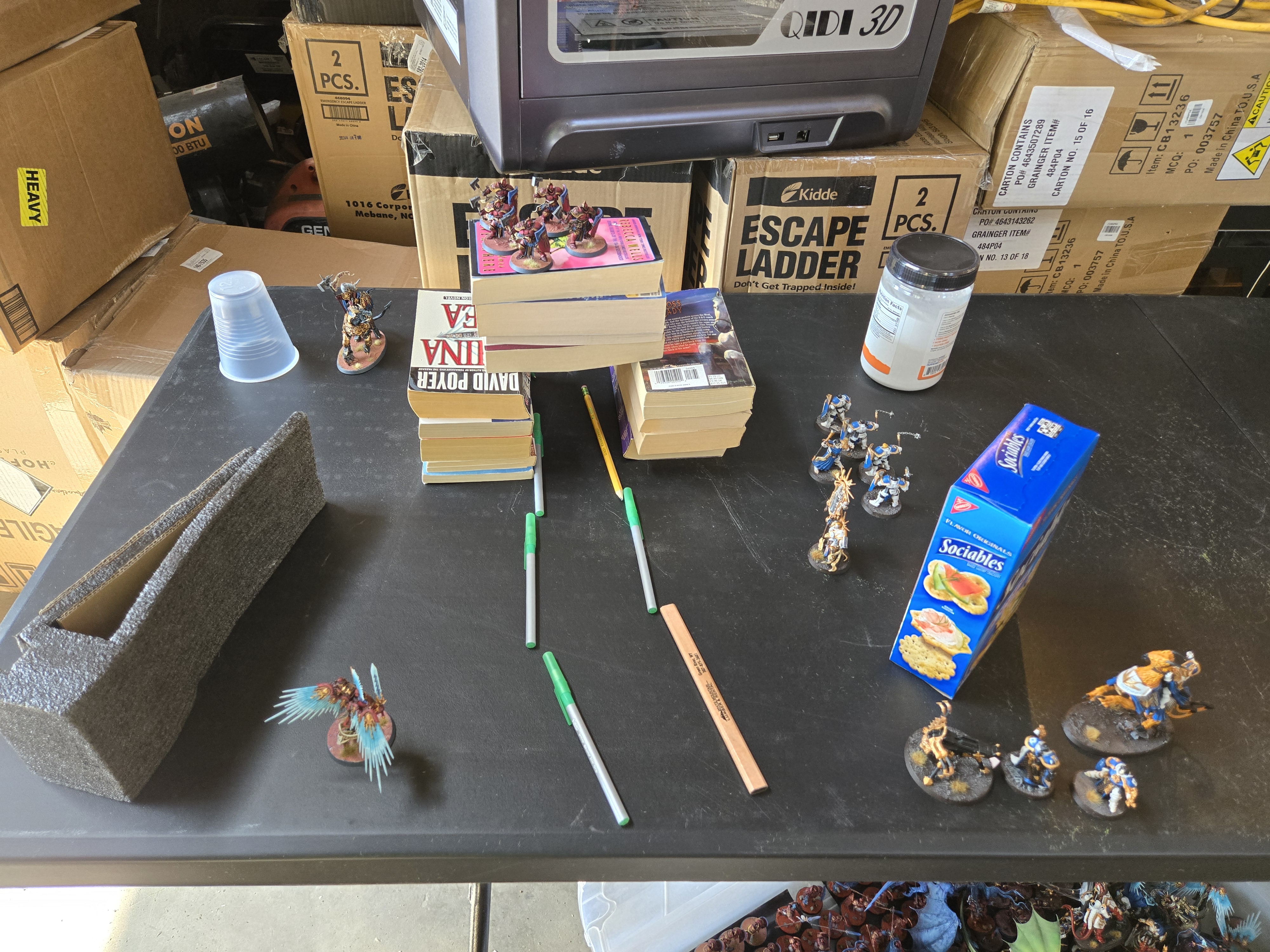
Feel free to use books, pots and pans, CD cases, cups, and mugs when playing at home. Break out a piece of paper and draw a river. It will serve its use, and honestly, books as buildings and hills are far more functional than most wargame terrain you may buy.

You want your terrain to be varied but balanced, not giving one side an advantage. One side has a stack of books overlooking the entire battlefield; the other should also. One side has a mousepad minefield, and maybe the other has a blue dinner plate used as a lake to restrict movement. You want your space between terrain to be large enough for the most prominent units to pass through most areas. You want a few areas with long sightlines so your snipers and other shooty units can shine. You want others with tight corridors so melee units can charge and have a go.

The models with the most significant footprint tend to be the most important. It wouldn’t be a fun game if your shiny new tank couldn’t drive anywhere. Below is a setup I did while writing this article in my shop with stuff from my desk.

It looks just fine and is more functional than many of the fancy boards I have played on.

A Table

Warhammer, Marvel Crisis Protocol, Bolt Action, all have a recommended table size. Here is the kicker; it’s not required. Any coffee table, kitchen counter, or floor is acceptable. The most critical piece is to play the game and have fun. If we are not enjoying ourselves, then why waste our time.
If you really, really, really, want to buy a table, to start, buy the 30″ by 30″ folding card table for $15 at Walmart. It’s functional, large enough to play 750 points on, and if you decide against gaming long-term, you can use it for something else.

I prefer a table you can sit at. Also, this is just me. Having alternate surfaces to store dice trays, rulebooks, army boxes, and other items that we wargamers seem to think we need to successfully eliminate the enemy.

AOS Leage Match 3 Bonereapers vs Ogors

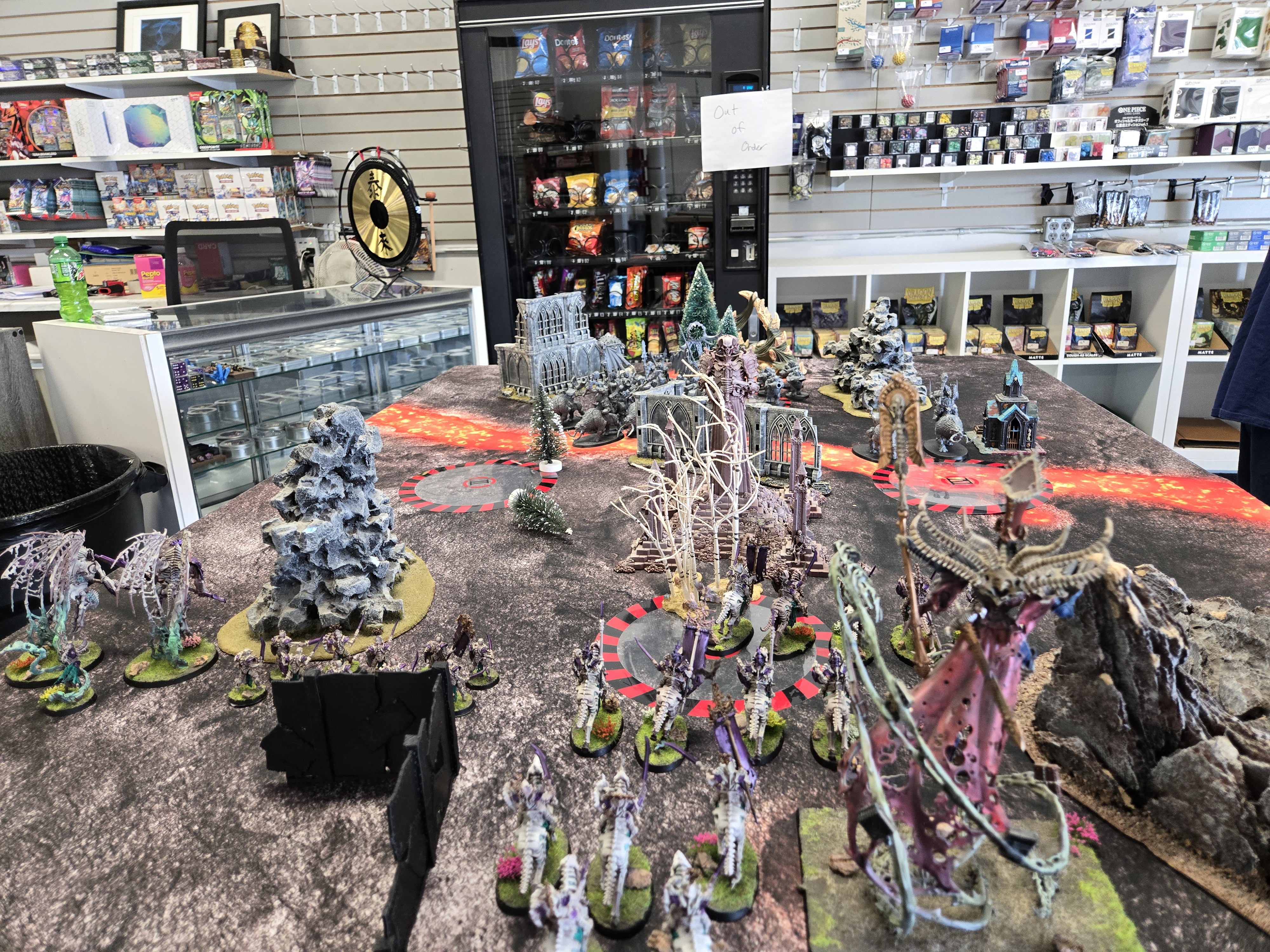
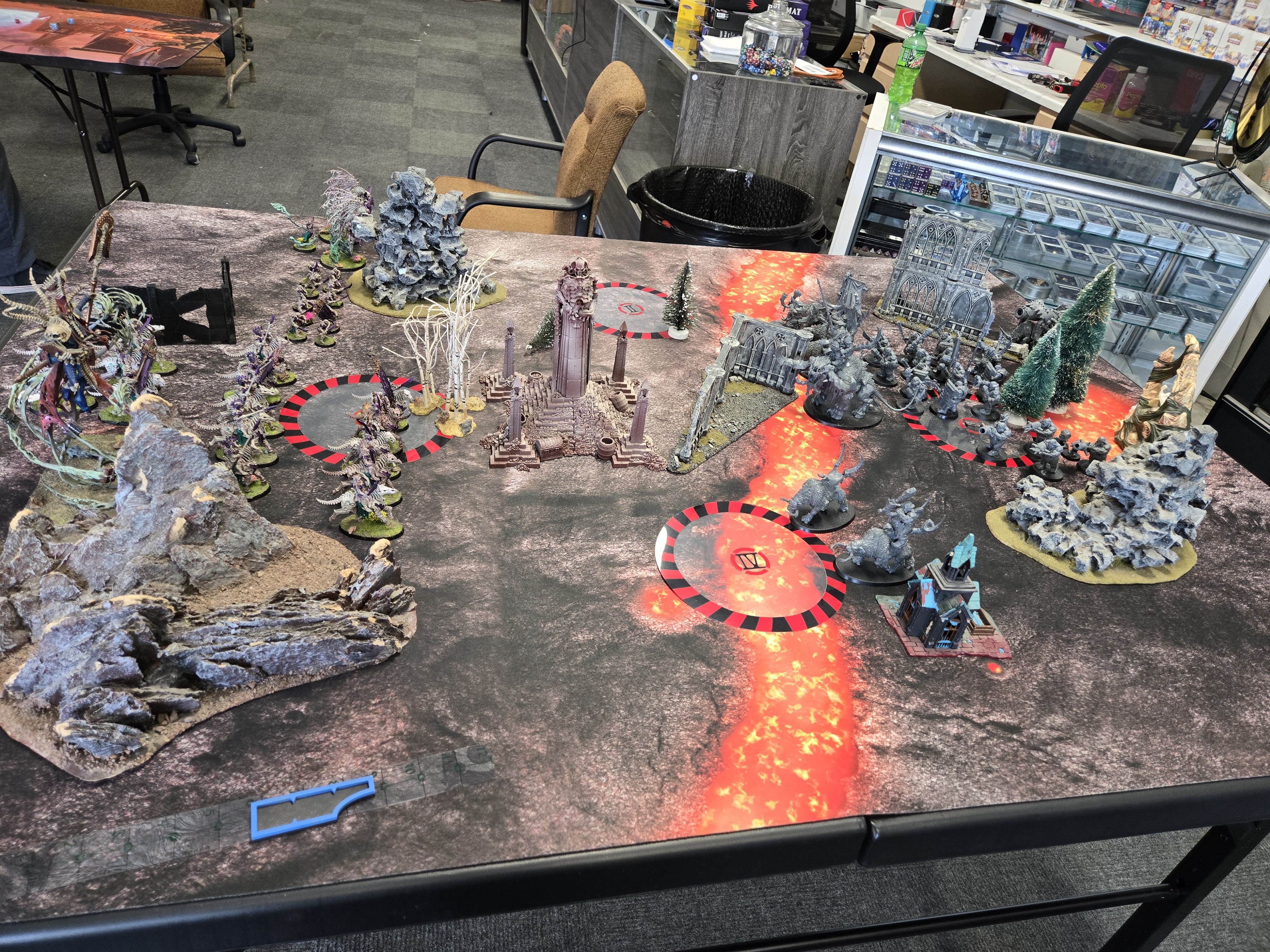
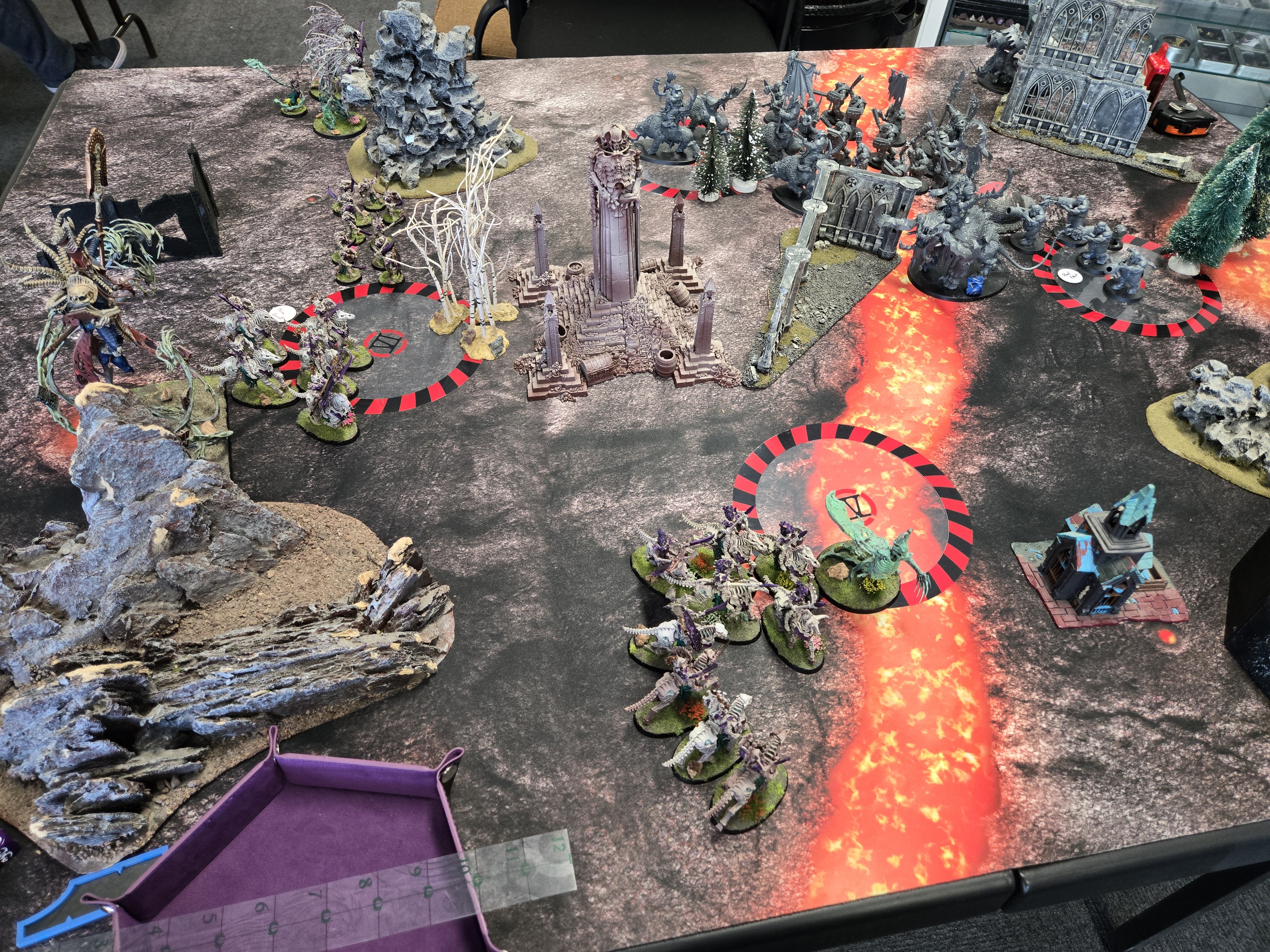
This weekend, I played my 3rd league match using the Ossiarch Bonereapers. I lost miserably.

Conclusions
– Like any game, a tuned list generally performs better than a list full of things
– If you want to be competitive, you need board control
– Running and hiding is acceptable
– Knowing thy enemy is important

Our lists are as follows.

BonereapersOgors
Nagash900Tyrant160
Deathriders x3600Leadbelchers150
Mortisan Ossifactor110Gluttons Reinforced480
Morghast Archai270Butcher150
Mortek Guard120Ironblaster200
Frostlord on Stonehorn320
Mounfang Pack (reinforced)
360
Mounrfang Pack180

My opponent was very aggressive and recklessly rushed forth with a small mournfang pack to take one of our neutral objectives.

I quickly destroyed this unit and thought that the lower side of the board would be clear. I underestimated the swiftness of his units. I also thought my morghasts and more guard would be able to hold a stronger line than they actually did.

Turn 2 I pulled back a little to stay out of charge range while pushing my cavalry up the other side. Nagash was shooting off his 9 spells every turn.

Turn 3 is where I lost the game. Nagash had to make a 5-inch charge against my opponent’s Stonehorn, and I missed. I also allowed him to charge my morghasts and mortek guard, destroying them. Really just all-around lousy play. I missed several abilities, such as Nagash being able to heal units. I poorly charged my cavalry and morghasts allowing his stonehorn to countercharge, damage the morghasts, and still not be in combat.

At the start of turn 4, I did plan on conceding. I had a chance, maybe with a double turn, but the double turn did not happen. He killed every unit except Nagash. There was just zero chance of me catching up. Nagash was only in charge range of his lead belchers and gluttons, and there was no way I was doing 40 damage there.

AOS Leage Match 2 Bonereapers vs Sylvaneth

This week, I brought out a freshly painted batch of Ossiarch Bonereapers. I faced Jason and his band, Sylvaneth.

Overall, I was impressed with how much damage my force could do. I thought this would be a good matchup for me since he went big, but my bigs are bigger and better. I loved Katakros. There is a reason he is staple number 1 in the army.

As far as AOS 4.0 goes, them game is balanced. I hope we have more missions soon.

My army list is below.

Generals Regiment Kavalos Lance2,000
Katakros Mortarch of the Necropolis520
Kavalos Deathriders200
Morghast Archai Reinforced540
Regiment 1
Mortisan Ossifector 110
Immortis Guard200
Regiment 2
Mortisan Soulmason160
Mortek Guard 120
Teratic Cohort150

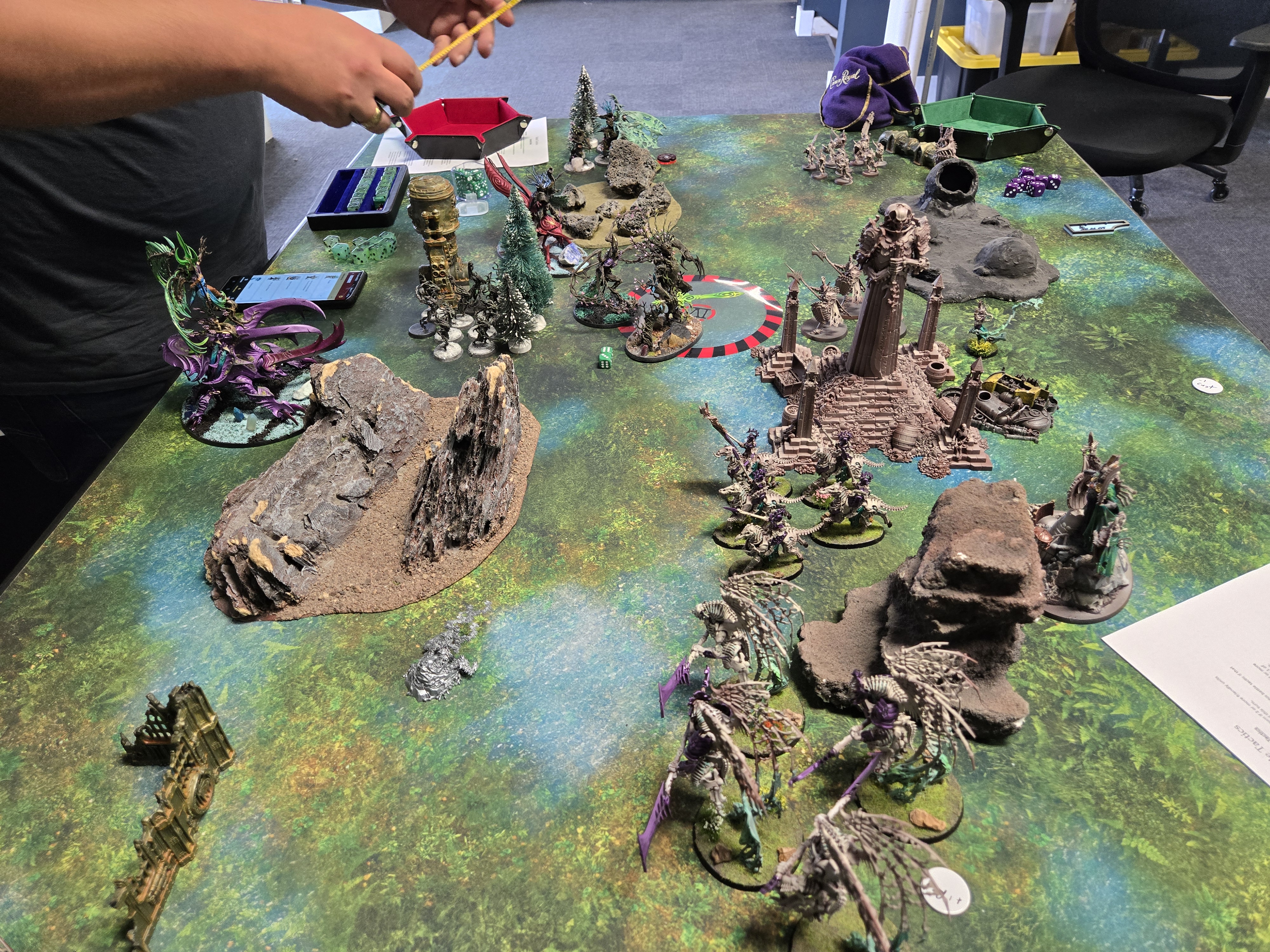
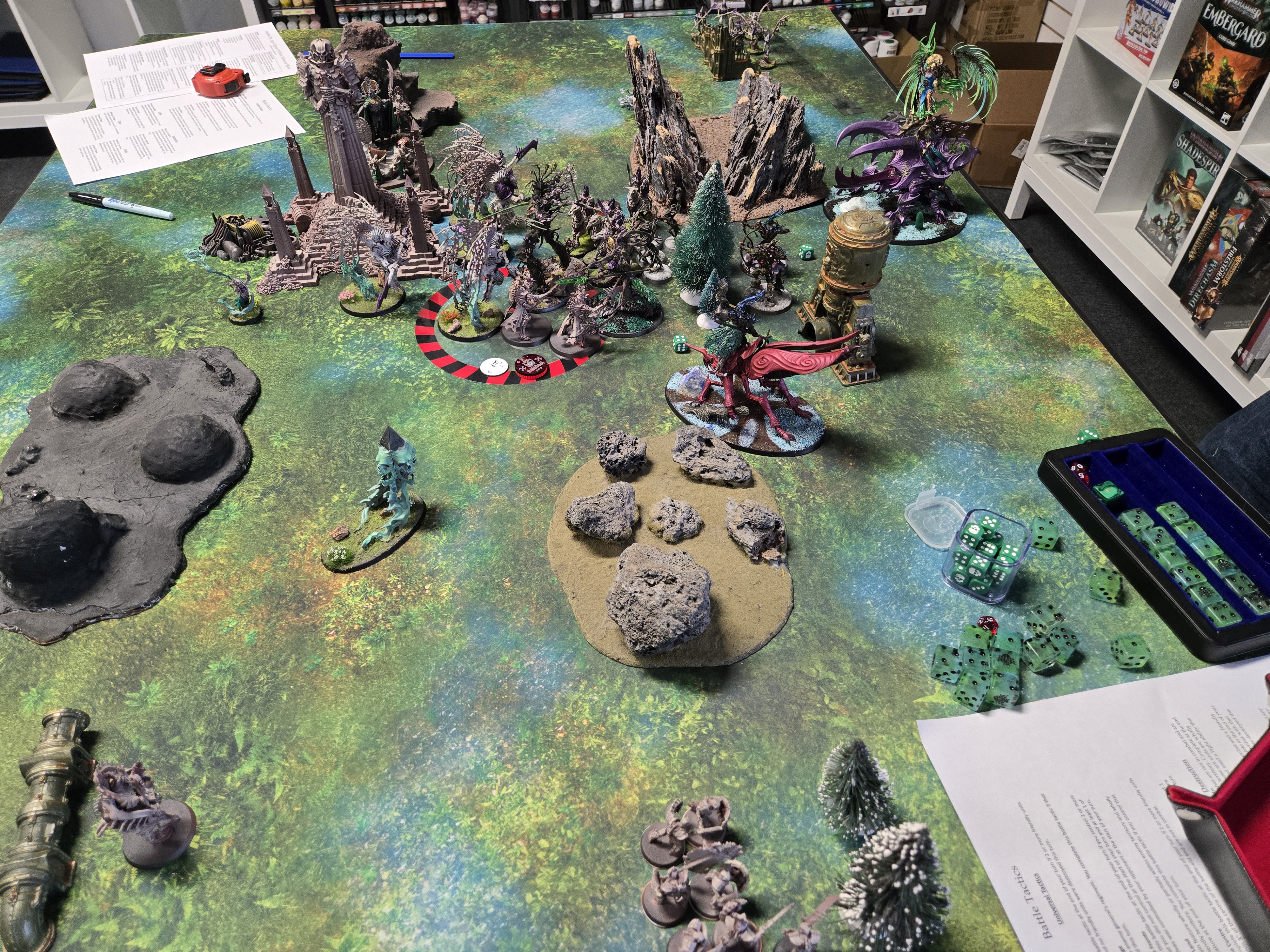
My opponent’s list is as follows. I didn’t take a picture of his full list. Above is how we deployed. I took the second turn.

Alarielle the Everqueen680
Dryads100
Kurnoth Hunters with Greatbows200
Belthanos, First Thorn of Kurnoth350
Dryads100
Spirit of Durthu330
Lady of Vines250

We rolled for our mission, which was to keep the objective in the center until round 3, when it would spawn. Based on my opponent’s deployment, I wasn’t sure what he was going to be able to do. I think he was counting on Durthu and his Dryads to hold in the center. His force didn’t have much damage-dealing ability.

Both forces advanced to the center. My opponent rolled poorly and did not execute any spells.

The second turn, he tried to hold, but the morghasts were just too overwhelming. My simple Mortek Guard was able to destroy his greatbows. (He brought them back)

I didn’t take any pictures, but on turn 3, I won the double turn and promptly destroyed everything except his Belthanos. He tried to charge Katakros with Allarielle, and that is just not a matchup he is going to win. My opponent then conceded.

Quick and Dirty Tyranid Terrain Project

Today, I am sharing some terrain for my Tyranid Escalation League. I purchased a ton of terrain from Etsy and was delighted. It has great details and functions nicely in a game.

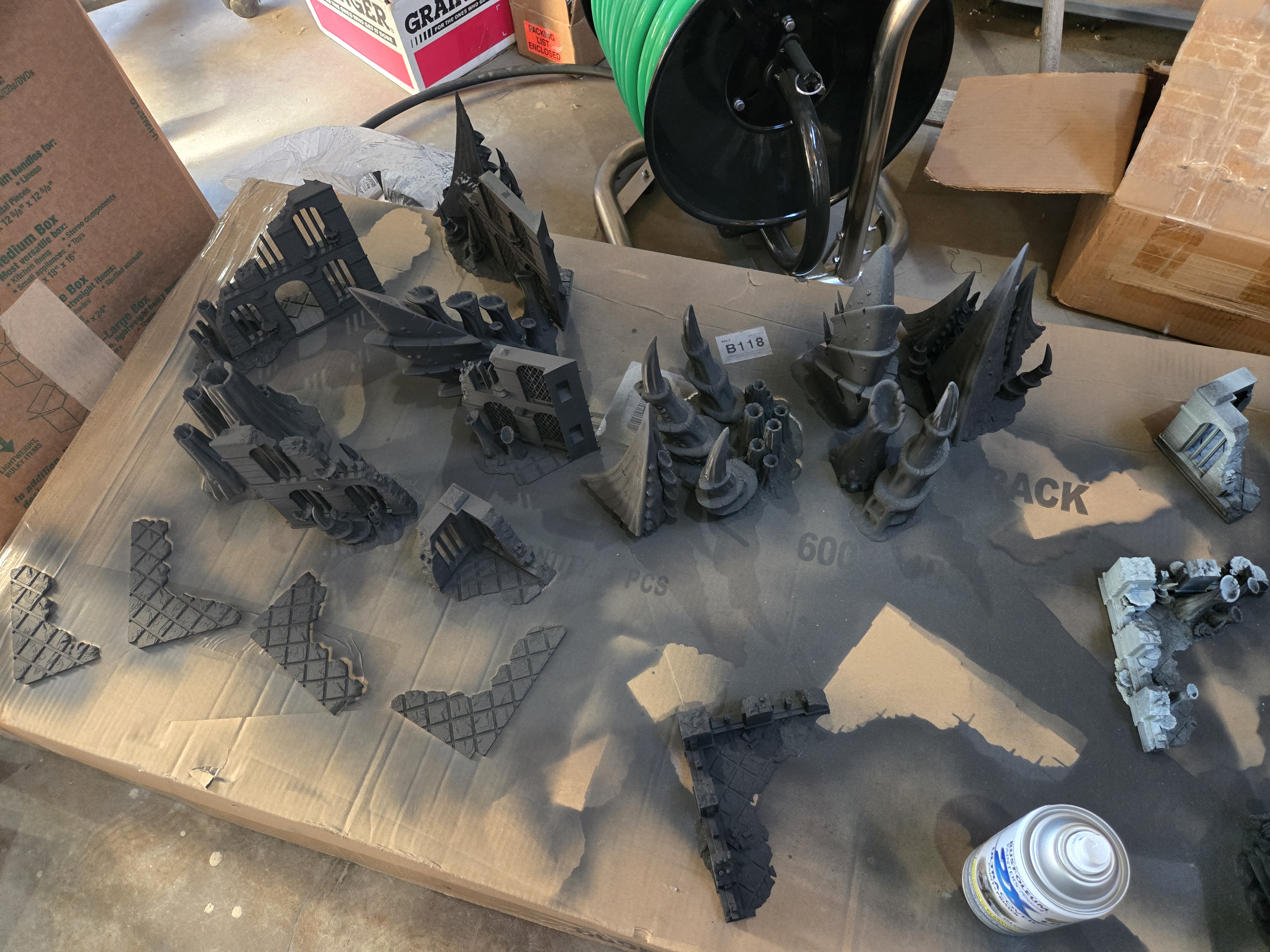
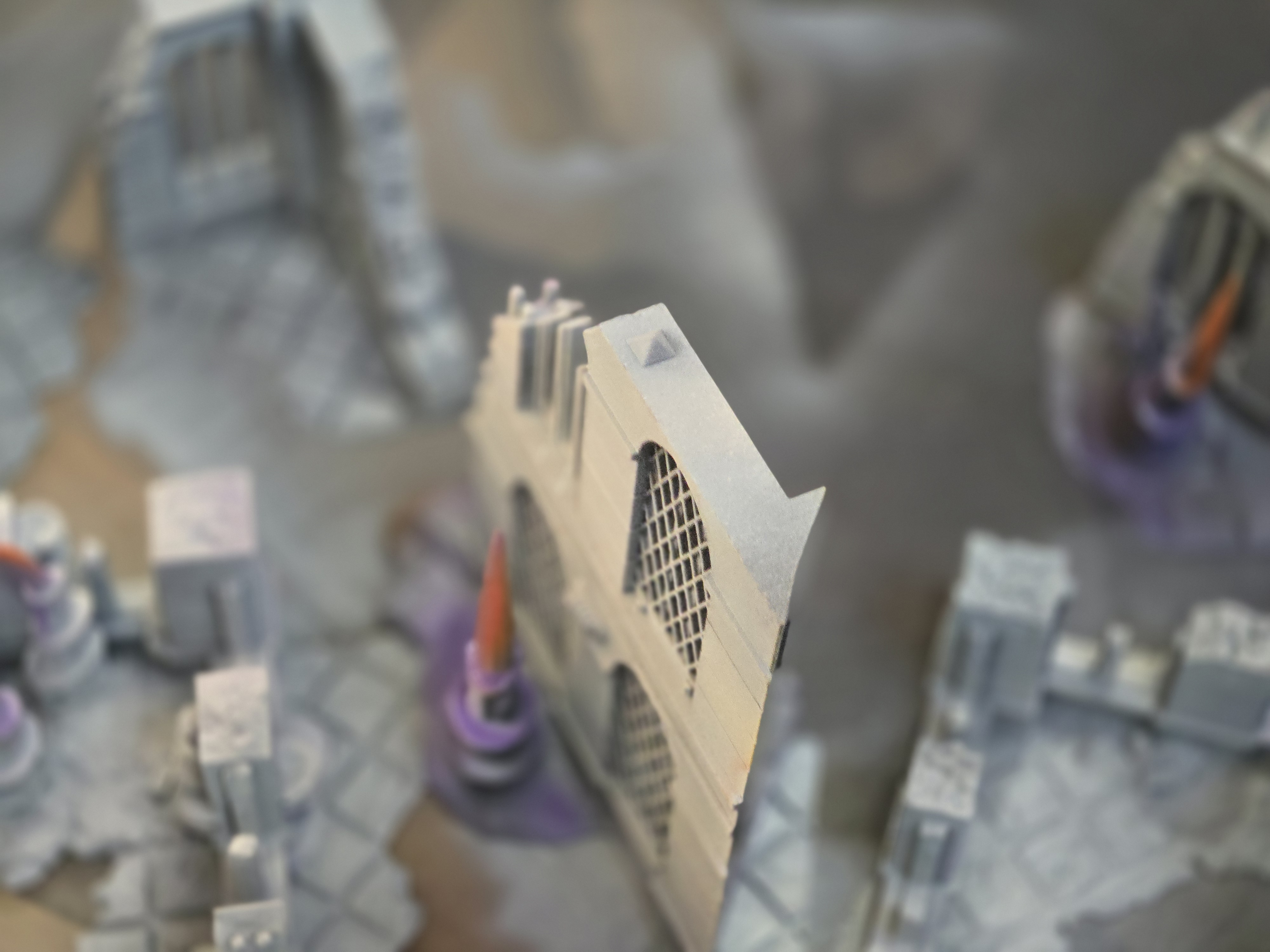
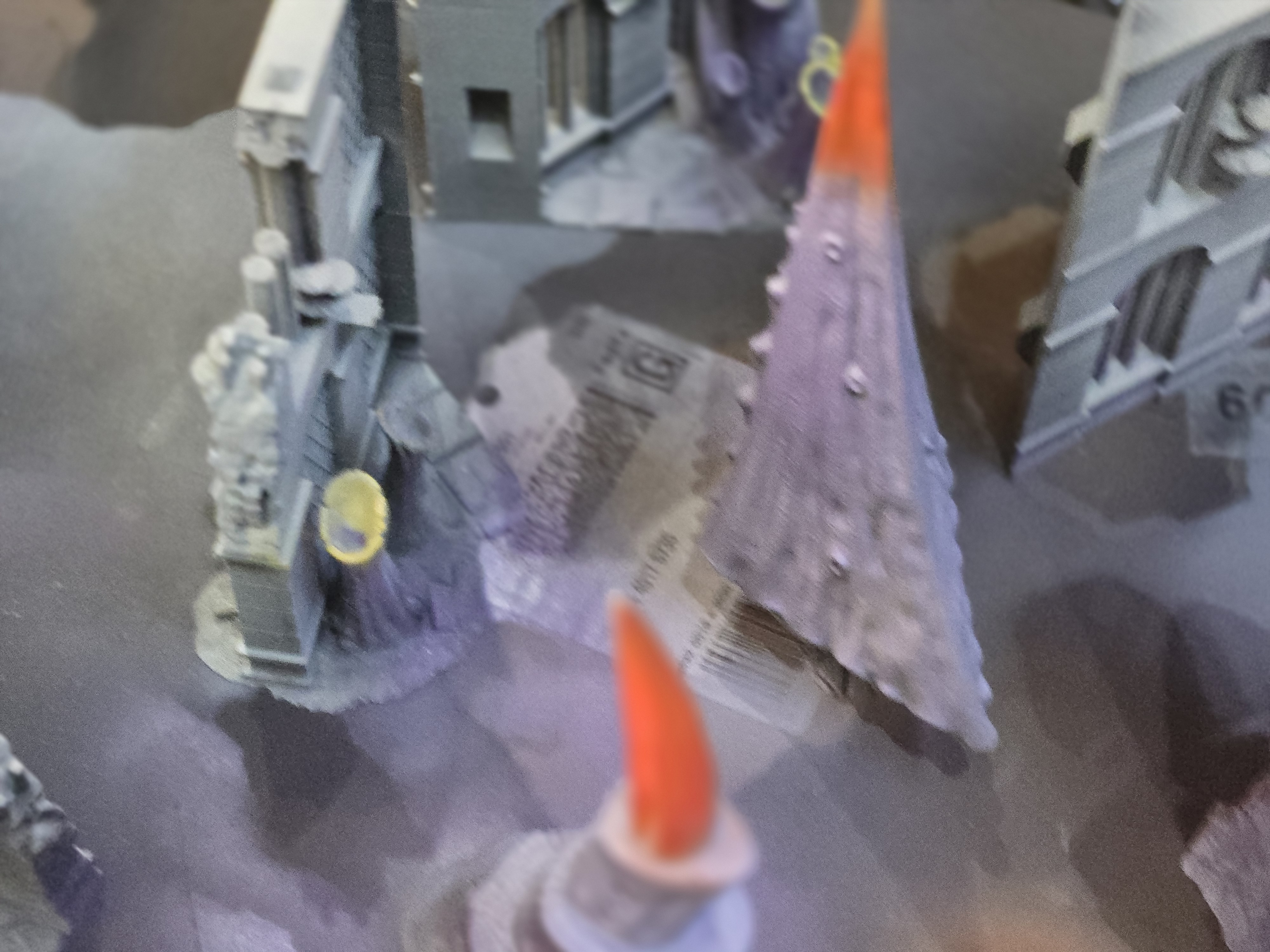
Due to procrastination, I only had about 2 hours of free time where I would be able to get this terrain ready for the tabletop. I decided to just go for it. I fully painted this terrain using rattle cans and nothing else in about 90 minutes.

https://www.etsy.com/listing/1553733003/tyranid-scatter-terrain-scenery-bundle?ref=yr_purchases
https://www.etsy.com/listing/1400349576/the-hive-alien-scenery-terrain-for-war?ref=yr_purchases
https://www.etsy.com/listing/1417470104/alien-infested-ruins-tabletop-terrain?ref=yr_purchases
https://www.etsy.com/listing/1803261885/the-hive-kill-team-set-3d-printed-alien?ref=yr_purchases
https://www.etsy.com/listing/1684087149/tulipa-evolved-infestation-tabletop?ref=yr_purchases
https://www.etsy.com/listing/1669911754/tulipa-the-infested-world-tabletop?ref=yr_purchases
https://www.etsy.com/listing/927375461/alien-hive-army-capillary-spore-stack?ref=yr_purchases
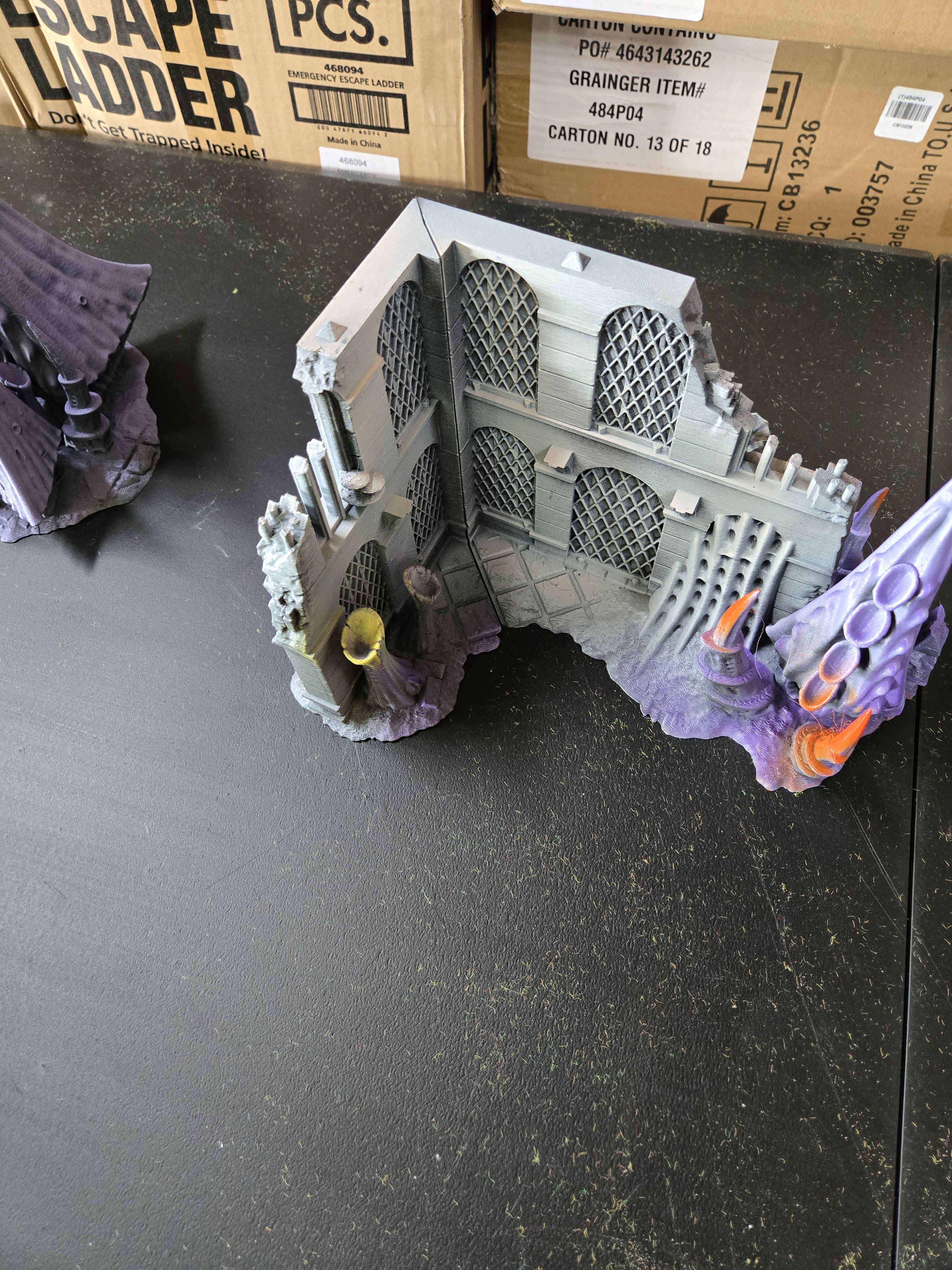
The terrain pictured for the painting is the Alien-infested Ruins and the Tulipa, the Infested World.

The prints are nicely done, and I recommend any of the sellers listed above.

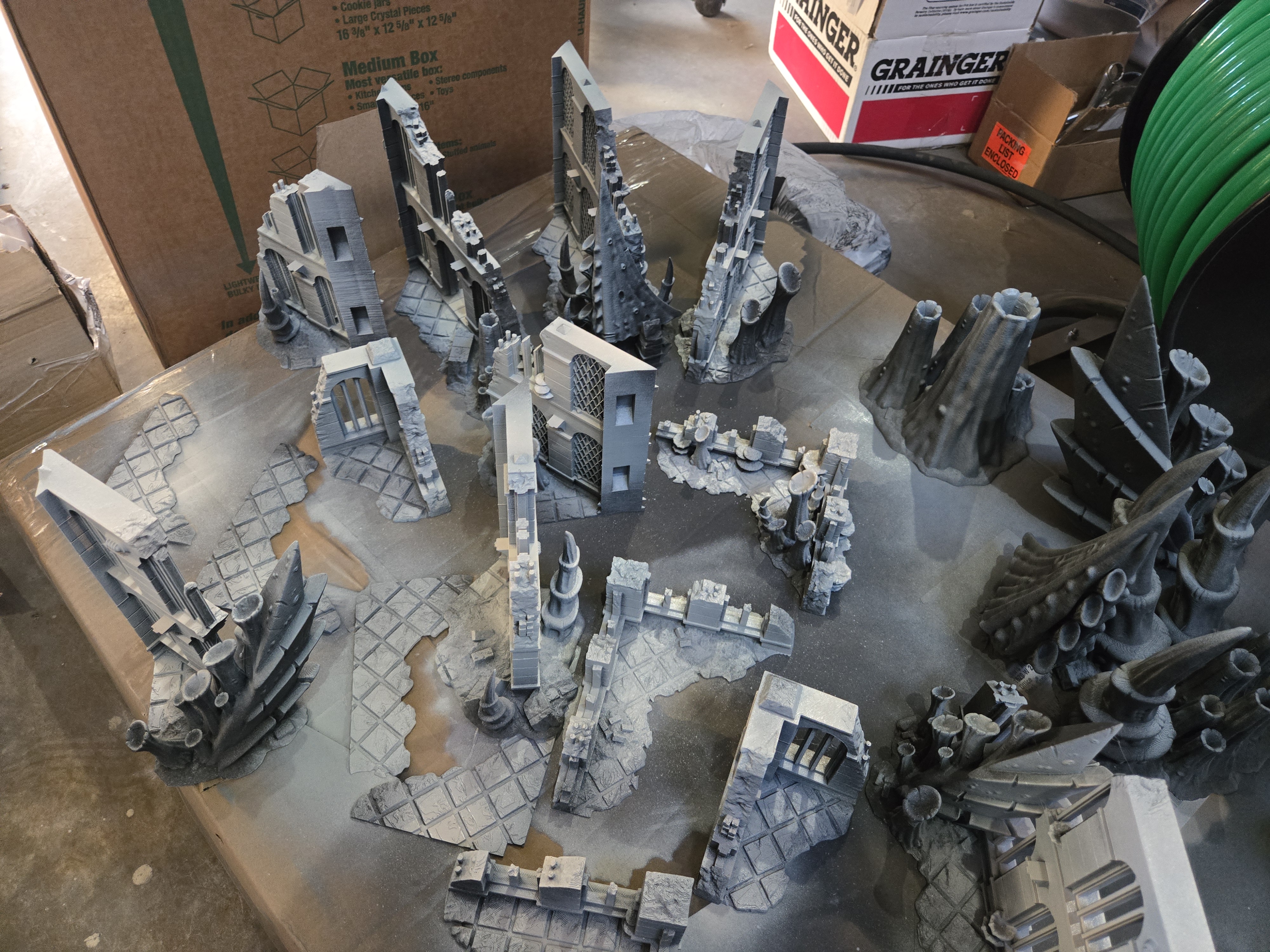
I started with a black primer. I usually splurge for auto-primer when I prep 3D prints. Auto primers fill the gaps made from traditional 3D printing very nicely. All the other paints were simple rattle-can Rustoleum products.

I focused on the buildings first.

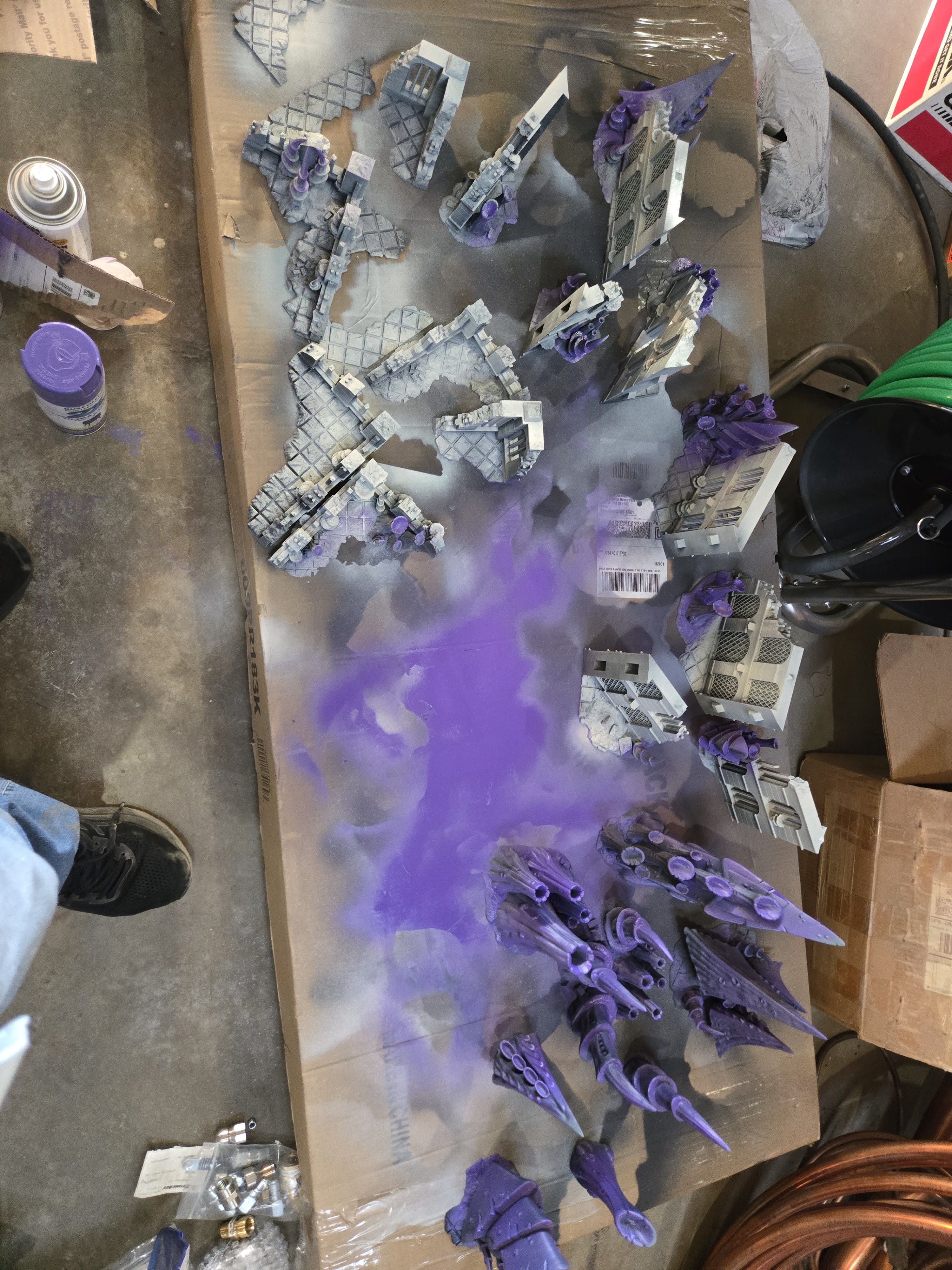
The next step was a dusting of winter grey.

Followed up by a decently large spray of Smokey Beige.

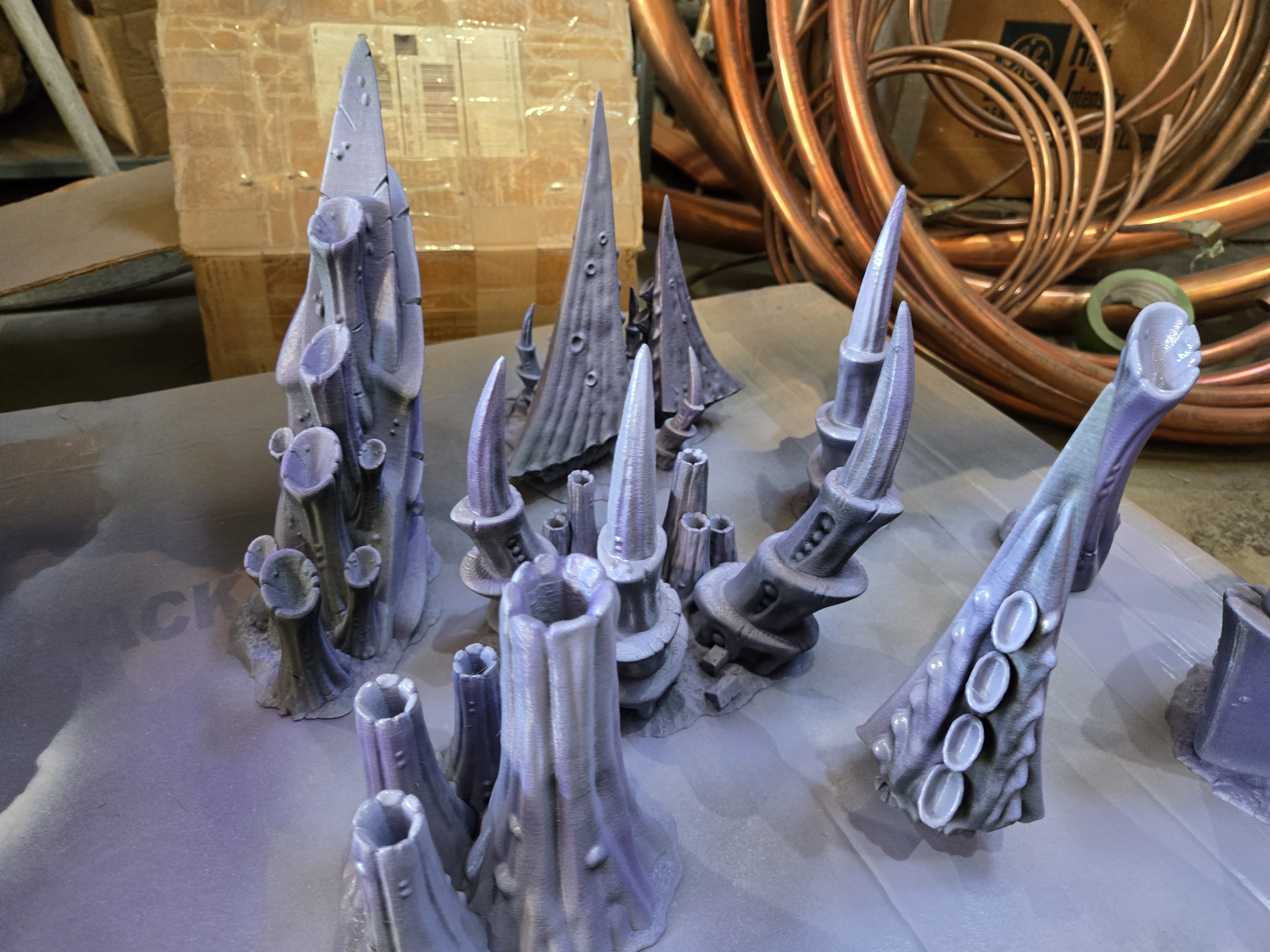
Next, I went to work on the various Tyranid pieces.

They get a solid coat of Grape and then a dusting of French Lilac.

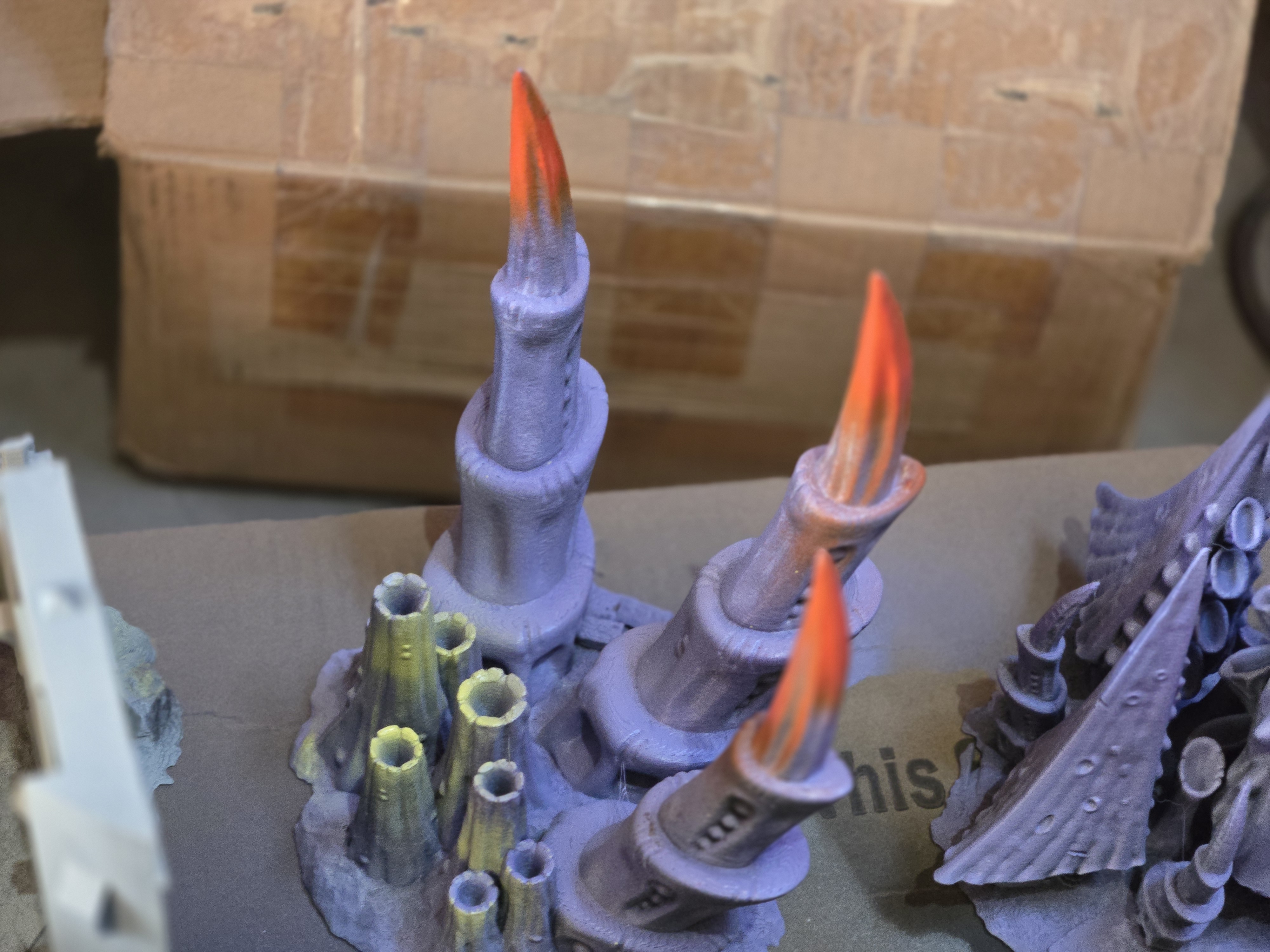
I finished with a splash of fire orange and sun yellow, just for some pop.

I did the same thing with the Tyranid pieces attached to the buildings.

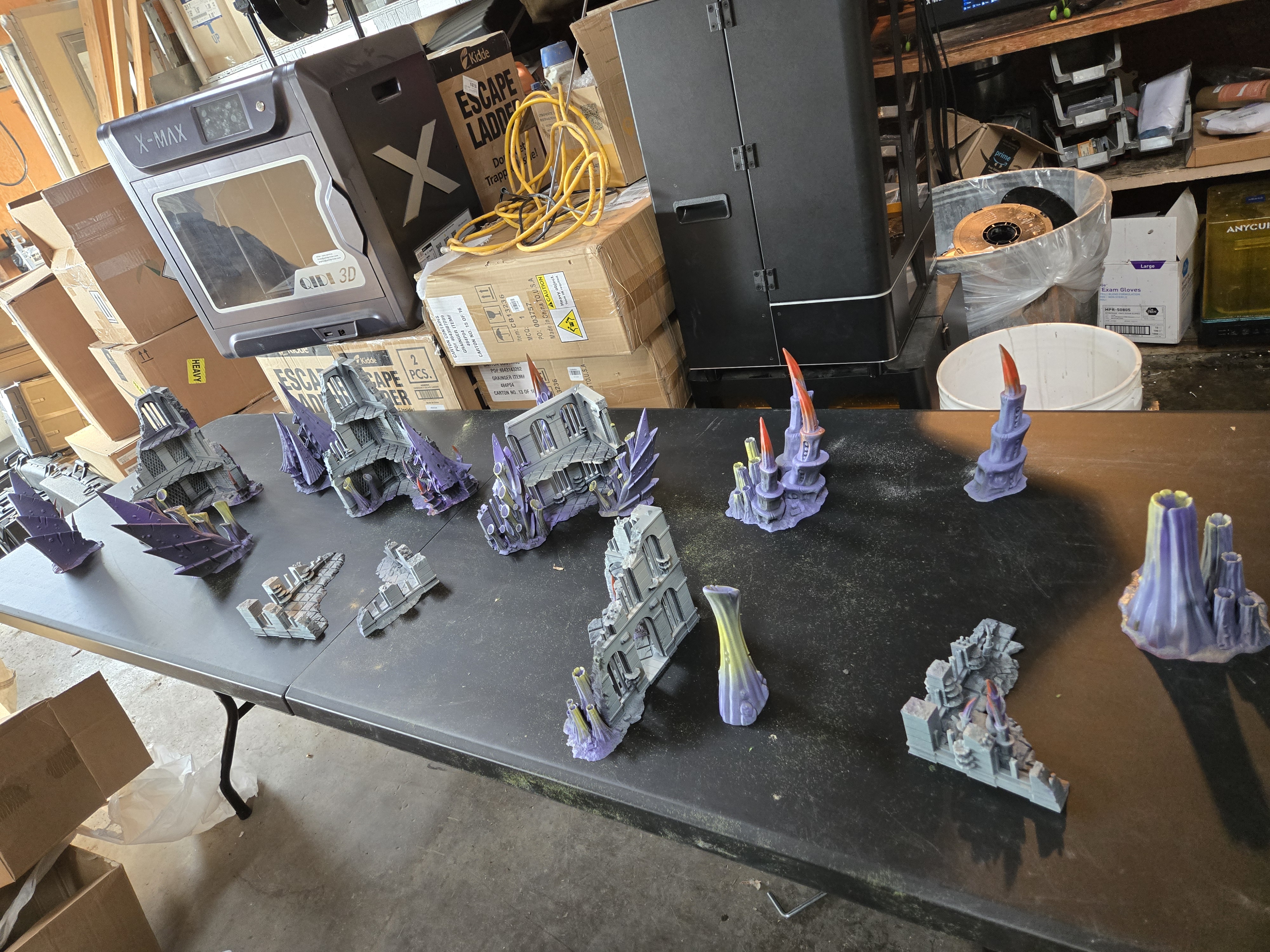
Here is the finished set on a table. I was really pleased, given how much time I took. I will maybe airbrush some of the windows and floors to break them up and potentially add a bit of weathering grime. It looks better than basic grey, and I hope this lesson shows that terrain does not need to be an hours-long endeavor. The table is 8′ by 30″, and you can see it has decent coverage.
The Big buildings are also modular.

Gargants vs Orruks

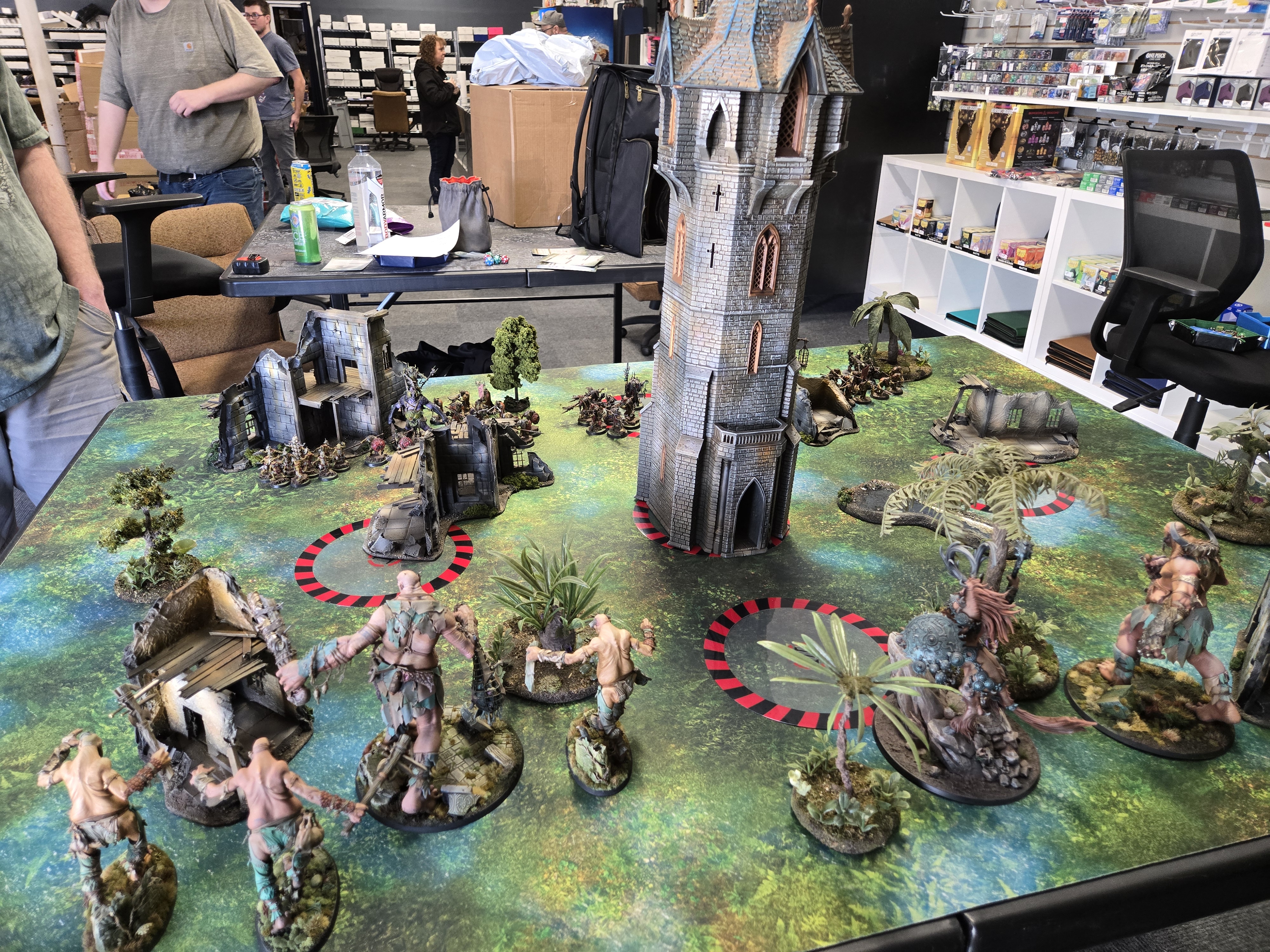
I had a great game with one of my friends this week. He has wonderfully painted Orruk War Klans. I decided to try out my Mega Gargants. My models were all painted by White Metal Studios, and they are absolutely gorgeous. Because I knew how great every model on the table would look, I also brought out some of my Green Leaf Terrain.

Kragnos led the charge, but it was really a great game. I had never actually played with those models before, and my opponent was very experienced with his army, so my butt got utterly destroyed.
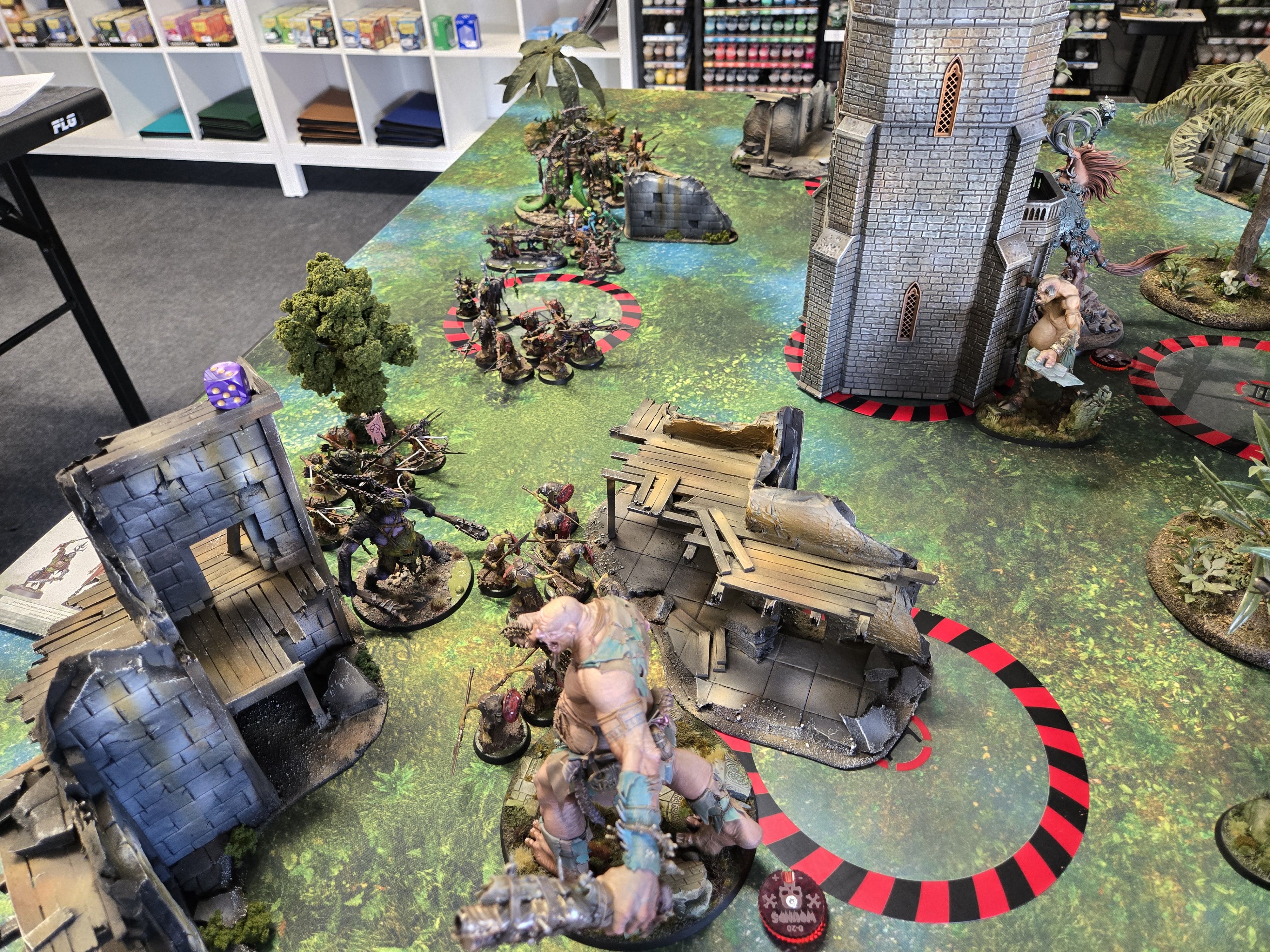
Having done no research. I think the key to giants is making sure your entire army hits the opponent line at the same time. Mine kinda came it at different times and it allowed him to put full firepower into an individual unit.
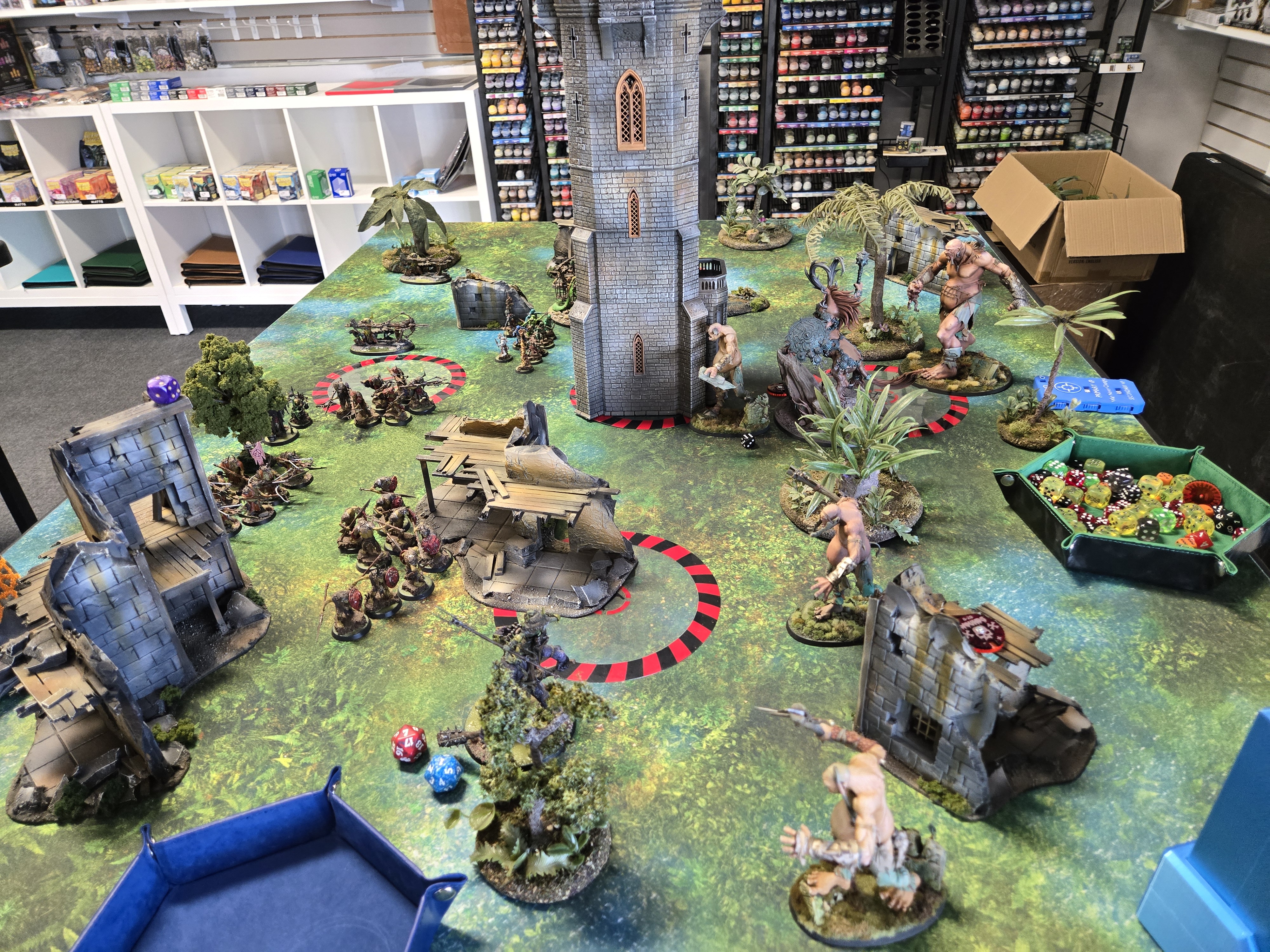
Turn 1 I just pushed up the board.

Turn 2, the game was balanced.

Turn 3, I was skewered.