July 28th 1809 Battle of Talavera Wargame Scenario

My other favorite period of gaming happens to be the Napoleonic era. The Peninsula campaign can make for some great games with epic battles. On July 28th, such a battle took place where Arthur Wellesley began the campaign to retake Spain. Wellesley, as he did famously at Waterloo, forced an engagement, but played a defensive role in the battle.

France
Joseph Bonaparte (41 Battalions, 56 Squadrons, 13 Artillery Batteries)
46,138 Soldiers
80 guns

Britain
Arthur Wellesley
26,641 Soldiers (30 Battalions, 24 Cav Squadrons, 4 Artillery Batteries)
30 Guns
Their Spanish Allies
34,993 Soldiers (34 Battalions, 24 Cav Squadrons, 4 Artillery Batteries)
30 Guns

As usual for the Wargame simulation, I would recommend using this order of battle. https://en.wikipedia.org/wiki/Battle_of_Talavera_order_of_battle
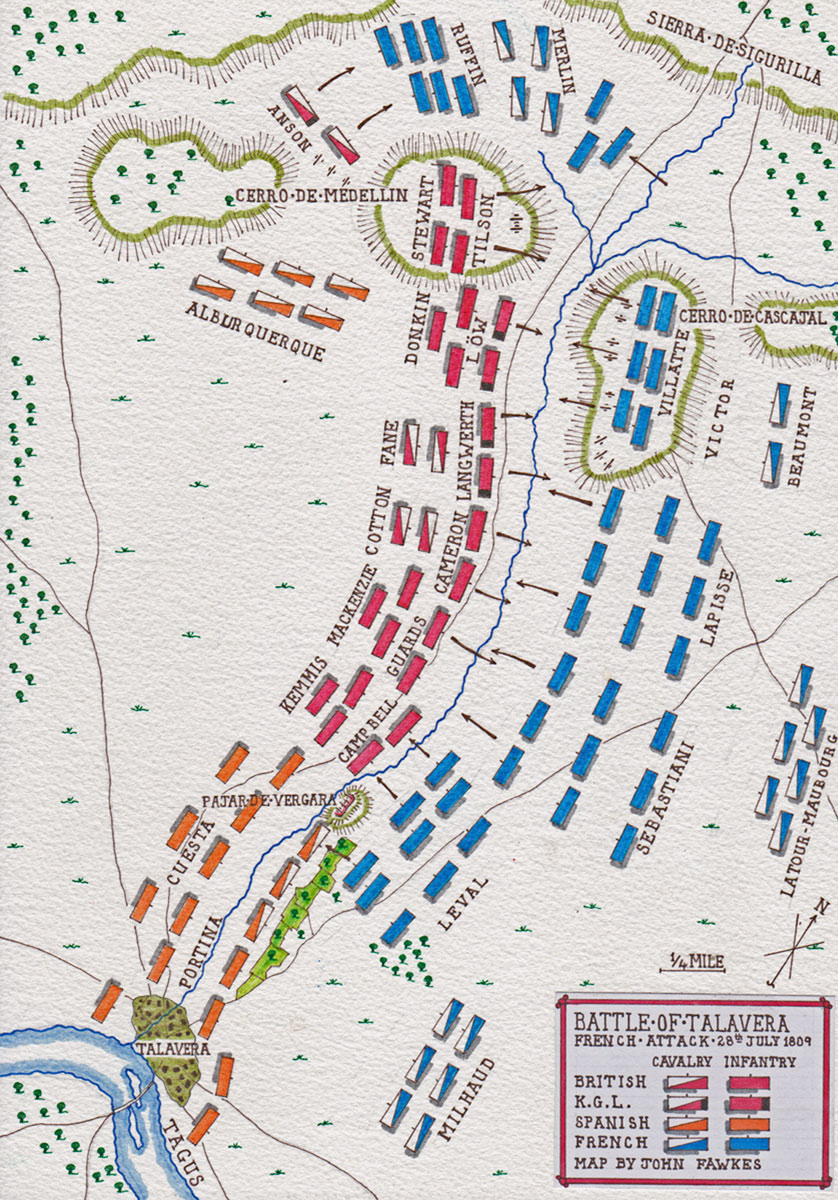
Wargame
2- 20 Players (If more than 3 use an umpire). Each player could easily control a division, corps, or faction.
Rules, General D’Armee, or any other large-format Napoleonic Wargame
Table 16×8 for 15mm, smaller for 6mm
The terrain is arid, with some bluffs; the river did not really apply much.
Use the order of battle to determine troop quality. It could help balance the game by making the Spanish closer to the militia.

Scenario
The French should be the aggressor and attempt to move the British and Spanish forces from a defensible position. The French should have a higher quality of troops than the Spanish.
July 27th 1778 Battle of Ushant Wargame Scenario

My absolute favorite set of wargames to play is fleet-level engagement. In outer space, or WWII, or the Age of Sail, or Galleys. It doesn’t matter, I enjoy fleet battles. When one of the famous naval battles from history hits my calendar, I am going to do a scenario about it.

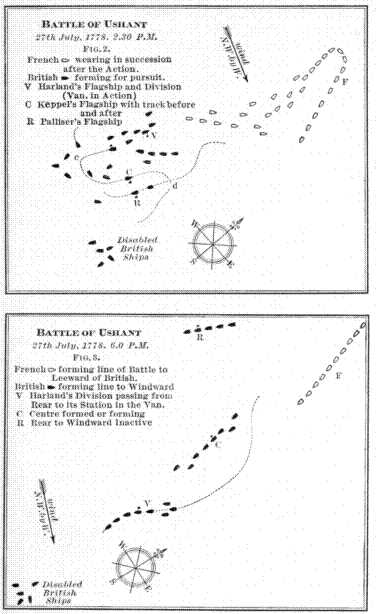
The Battle of Ushant was about as close to a non-battle as possible. The French were instructed to avoid battle at all costs, while the British failed to properly engage. We will simulate what might have happened had the sides actually engaged.

Great Britain
Augustus Keppel 2470 Total Guns
30 Ships of the Line
– 15 74 Third Rates
– 1 80 Third Rate
– 7 64 Third Rates
– 6 2nd Rates
– 1 First Rate
6 Frigates
– 1 32 Gun
– 4 28 Gun
– 1 20 Gun
Two Fire Ships
One Sloop

France
Comte D’ Orvilliers 2322 Total Guns
30 Ships of the Line
– 12 74 Third Rates
– 11 64 Third Rates
– 2 80 Third Rate
– 1 70 Third Rate
– 1 Second Rate
– 1 First Rate
– 2 Fourth Rate
7 Frigates all 32s
6 Corvets Totaling 52 Guns

Wargame Rules
Black Seas or Other Rulset
Table Size 16×8
Players 2-8
No Terrain

Wargame
You can fight this battle two ways, either A go at it as admirals. The French should have superior mobility but inferior firepower.
The other option is that historically, the French needed to tack across the British line of battle to escape to the open ocean. Set the weather gauge between the two fleets, and the French must flee without losing any of their ships of the line.

July 26th 811 Battle of Pliska Wargame Scenario

The worst defeat of the early Byzantine era. The emperor himself was slain in what was more of a slaughter rather than a battle. The Byzantines had just finished sacking the city of Pliska. While they were in the city, the Bulgarian’s hid amongst the narrow mountain passes to ambush the Byzantines.

Bulgarian Empire
Krum
18,000

Byzantine Empire
Nikephoros I
22,000

Wargame Scenario
In this solo wargame you are to prevent the loss of your forces by scouting the woods and valleys up ahead.

Set up a forested area and divide your table into 16 equal sized squares or rectangles. Your scouts must find the enemy and return to your lines to warn your king. You have ten rounds to find the enemy. Each round you can move one square and investigate. Or move two squares. You must be in the same square as the square you want to investigate. Use the joker card to indicate where your forces are located.

Get a standard playing cards, take out a joker, take out all of the hearts (or whatever suit you want) and three cards of a different color aka spades or clubs. The cards of a different color indicate where the enemy is hiding. To investigate you turn over the playing card and if it is one of the cards that is a group of enemies. The enemy can also move two squares. Once you discover one of the enemy cards, reveal all of the facedown cards and the enemy cards are left on the table. Move the enemy cards to try and block your escape. If the enemy is able to pin you in you lose.

July 25th 1467 Battle of Molinella Wargame Scenario

The 1467 Battle of Molinella was one of the most important battles in 15th-century Italy. It is also one of the first battles where firearms and artillery were extensively used. The battle resembled a pike and shot era battle more than a medieval one.

Republic of Venice
Bartolomeo Colleoni
14,000
9,000 Infantry (800 firearms)
5,000 Cavalry
6 Cannons

Republic of Florence
13,000
7,000 Infantry (1200 firearms)
6,000 Cavalry
10 Cannons

Wargame
Use whatever rules you want to. If you have a good late medieval or early Renaissance rule set that incorporates firearms well, that would be my recommendation.
2 Players
8×4 Table
For terrain, the battle was fought on the banks of the Idice River. Some minor hills, some shrubbery, and of course, the river on a short table edge.

Set-Up
The two armies should be relatively balanced; your rules set will have good army lists. The Italian Condotta Army from DBM Book 4 can make some nice lists.

Venice 399

C in C x3Reg Kn (S)105
Condottieri x14RegKn(O)168
Mounted Cross Bows x6RegLH(I)18
Mercenary Pikes x8RegPk (O)32
Militia Pikes x4RegPk(I)12
Handgunners x8RegPs(S)24
Stradiots x6IrrLH(O)30
BombardRegArt(S)10

Florence 400

C in C x3Reg Kn(S)105
Condottieri x14RegKn(O)168
Mounted Cross Bows x6RegLH(I)18
Stradiots x8IrrLH(O)40
Handgunners x11RegPs(S)33
Bombard x2RegArt(S)20
Mercenary Pike x4RegPK(O)16

July 24th 1411 Battle of Harlaw Wargame Scenario

While Scotland was fighting the English for independence, it was also fighting among itself. Similar to Japanese Shoguns, Scottish clans vied for supremacy. Alexander Stewart attempted to take on a numerically superior force. He was confident in his heavily armed knights and men-at-arms.

Scottish Crown and Duke of Albany
Alexander Stewart, Earl of Mar
3,000 Infantry and Heavy Knights

Lordship of the Isles
Donald Islay, Lord of the Isles
10,000 Infantry, mostly peasant militia

Wargame
Use DBA or DBM or similar rulesets.
2 Players

Instead of points, the Lordship of the Isles should have 3x the number of stands as the Scottish Crown. The Scottish crown should have heavy armor and elite knights and infantry, roughly 50% of each, with no archers.

The Lordship of the Isles should have warbands, peasants, and some psioli, such as peasant archers. They could also have a small number of spearmen.

Set the table as you wish; traditionally, the battle took place over open ground in the Scottish highlands, where there would be shrubbery and rocky outcroppings.

The objective for either side is to win the day. This is a simple battle of elite vs. numerical superiority. I did not try to balance the battle based on points.

July 23rd 1952 Egyptian Revolution Wargame Scenario

Today, I wanted to try a slightly different style of game. The Egyptian revolution of 1952 was a coup that ended the Muhammad Ali dynasty. It ended British influence in Egypt. An interesting point is that the United States supported the coup leaders against their British allies. Another interesting fact is that while the United States supported the coup, it was against the wishes of its British allies.

The goal of the game is to secure the exits to the compound so the sitting ruler can flee.

Set-Up

Create a large compound on a 4×4 with at least 8 exits. Lots of hallways, stairs, balconies, walls, and rooms with several exits, and anything else you can think of. As the revolutionary, you have 6 units to secure the 8 exits and pen in the leader. Your units can be placed on any edge of the table. The sitting ruler gets three models; one model should be labeled as the leader, the other two are decoys. This should be kept secret from the revolutionary.

Units can move up to 5″ every turn. The revolutionary can activate 5 units per turn, the sitting ruler can activate all 3. If any of the sitting ruler’s 3 models come within 2″ of a revolutionary unit, they are removed from the game, and it becomes known if they were a decoy or not.

July 22nd 1805 Battle of Cape Finisterre Wargame Scenario

On July 22nd, 47 warships engaged in a battle to determine the future of England. If the British were destroyed, Napoleon would be able to invade. If the French were destroyed, or even thwarted, Napoleon would have to change his plans. Historically, the battle was a win for the British. They, however, were unable to destroy the French fleet.

British Fleet
Robert Calder
15 Ships of the Line (8 3rd Rates, 4 2nd Rate, 3 Small 3rd Rates)
2 Frigates, Egyptienne 40 Gun, Sirius 36 Gun
1 Lugger
1 Cutter

French/Spanish Fleet
20 Ships of the Line (Spain, 4 3rd Rates, 2 Small 3rd Rates) (France 14 3rd Rates)
7 Frigates (2 44 Guns, 5 40 Guns)
2 Brigs

Wargame Scenario
Use Black Seas or another Age of Sail wargame
2-9 Players
16×4 Table no terrain
The Wind should be set to the back of the British Fleet.

Set-Up
The Fleets should be divided into squadrons. The British had three, each headed by a 2nd-rate ship of the line. The Spanish should be their own squadron, and the French should be divided into 3 squadrons, with the ships on the line split into two, and the smaller vessels a single squadron.

Objective
Anything but a complete victory for the French/Spanish is a tactical loss. They must secure the channel.

July 21st 1798 Battle of the Pyramids Wargame Scenario

After a grueling nighttime march in the oppressive Egyptian heat. Napoleon and 25,000 of his soldiers faced off against 35,000 Mamluks of the Ottoman Empire.

France

Napoleon Bonaparte

3,000 Cavalry 20 squadrons

17,000 Infantry 26 battalions

36 guns 3 batteries

Ottoman

Murad Bey

6,000 cavalry 40 squadrons (20 elite)

22,000 infantry 36 battalions (all militia)

1 battery of guns

Wargame

Use general d armee or other corps size Napoleonic wargame

2-4 players

4×8 table covered with sand dunes and a potential oasis.

Special rules

The Napoleonic forces should be regular or better, all of the Ottoman should be militia except the elite mamluk cavalry.

July 20th 1864 Battle of Peachtree Creek Wargame Scenario

Newly in command and with his army nearly surrounded John B Hood of the Confederacy attempted to assault George H Thomas and the Army of the Cumberland.

United States

George Thomas

21,655

Confederate States

John B Hood

20,050

Wargame

2 players

4×8 tables

24 infantry regiments for each side, 2 cavalry regiments each, and 4 artillery batteries each.

River with 2 crossings, woods, fences, two small hills

Set-up

Both sides should start off the table. The union should be attempting to cross the river, while the confederacy wants to attack their positions. the river should be within a few inches of its board edge, while the hills should be middle of the table, but slightly closer to the confederacy.

July 19th 1702 Battle of Kliszow Wargame Scenario

On July 19th 1702, a Swedish army of 12,000 defeated a combined Saxon Polish army of 23,000. The Swedes simply had better soldiery and leadership.

Sweden

Charles XII

12,000 men

4 cannons

18 infantry battalions, 25 cavalry squadrons, and 12 dragoon squadrons.

Saxons

Augustus II

16,500 Saxons

6,800 Poles

50 guns

16 battalions, 44 cavalry squadrons, 24 dragoons, 26 Polish squadrons

Wargame

Use any 1700’s ruleset

2-6 players

4×8 table with lots of woods, swamps, and rivers , one key central hill, one Saxon camp

Objective

The Swedes must either secure the central hill or the Saxon camp. Either is a victory. I’d recommend giving the Swedes slightly improved units.