July 27th 1778 Battle of Ushant Wargame Scenario

My absolute favorite set of wargames to play is fleet-level engagement. In outer space, or WWII, or the Age of Sail, or Galleys. It doesn’t matter, I enjoy fleet battles. When one of the famous naval battles from history hits my calendar, I am going to do a scenario about it.

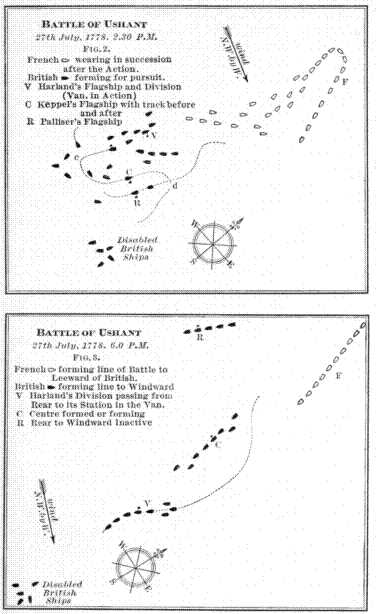
The Battle of Ushant was about as close to a non-battle as possible. The French were instructed to avoid battle at all costs, while the British failed to properly engage. We will simulate what might have happened had the sides actually engaged.
Great Britain
Augustus Keppel 2470 Total Guns
30 Ships of the Line
– 15 74 Third Rates
– 1 80 Third Rate
– 7 64 Third Rates
– 6 2nd Rates
– 1 First Rate
6 Frigates
– 1 32 Gun
– 4 28 Gun
– 1 20 Gun
Two Fire Ships
One Sloop

France
Comte D’ Orvilliers 2322 Total Guns
30 Ships of the Line
– 12 74 Third Rates
– 11 64 Third Rates
– 2 80 Third Rate
– 1 70 Third Rate
– 1 Second Rate
– 1 First Rate
– 2 Fourth Rate
7 Frigates all 32s
6 Corvets Totaling 52 Guns

Wargame Rules
Black Seas or Other Rulset
Table Size 16×8
Players 2-8
No Terrain

Wargame
You can fight this battle two ways, either A go at it as admirals. The French should have superior mobility but inferior firepower.
The other option is that historically, the French needed to tack across the British line of battle to escape to the open ocean. Set the weather gauge between the two fleets, and the French must flee without losing any of their ships of the line.

July 22nd 1805 Battle of Cape Finisterre Wargame Scenario

On July 22nd, 47 warships engaged in a battle to determine the future of England. If the British were destroyed, Napoleon would be able to invade. If the French were destroyed, or even thwarted, Napoleon would have to change his plans. Historically, the battle was a win for the British. They, however, were unable to destroy the French fleet.

British Fleet
Robert Calder
15 Ships of the Line (8 3rd Rates, 4 2nd Rate, 3 Small 3rd Rates)
2 Frigates, Egyptienne 40 Gun, Sirius 36 Gun
1 Lugger
1 Cutter

French/Spanish Fleet
20 Ships of the Line (Spain, 4 3rd Rates, 2 Small 3rd Rates) (France 14 3rd Rates)
7 Frigates (2 44 Guns, 5 40 Guns)
2 Brigs

Wargame Scenario
Use Black Seas or another Age of Sail wargame
2-9 Players
16×4 Table no terrain
The Wind should be set to the back of the British Fleet.

Set-Up
The Fleets should be divided into squadrons. The British had three, each headed by a 2nd-rate ship of the line. The Spanish should be their own squadron, and the French should be divided into 3 squadrons, with the ships on the line split into two, and the smaller vessels a single squadron.

Objective
Anything but a complete victory for the French/Spanish is a tactical loss. They must secure the channel.

July 12th 1801 2nd Battle of Algeciras Wargame Scenario

On July 12th 1801, six British ships of the line pursued and attacked nice French and Spanish ships in the strait of Gibraltar. The French and Spanish were attempting to flee the British but were caught in the middle of the night. The ensuing fighting caused confusion as both sides fired upon their own forces.

To wargame this particular battle will require the use of an umpire or other party to determine who can see whom and what.

Set-up use black seas rules

3 players

2 separate identical tables with a grid clearly marked.

6 British ships of the line and 2 frigates, 9 Spanish and French ships of the line with 3 frigates. plus several extra ships.

No terrain is needed

Light markers

Set-up

Each player should set up their ships on a different table.

The wind should be set with both players sailing with the wind. The Spanish should be spread out with three ships trailing behind the rest of the fleet. The British should be within one move of the Spanish ship.

The umpire should indicate the following, a marker where the closest enemy ship is, and a marker anytime shots are fired. As the battle commences and more ships become involved. The roll of a d6 should be incorporated for friendly shots fired with the 1 indicating the direction to move the marker, and the number of inches away. The goal is to add to the confusion and potentially allied ships being fired upon. Finally if a ship is on fire it should be clearly shown on the opponent board.

An example, the 4th turn of the game a British ship fires where it thinks a Spanish ship is located. The Spanish ship fires where it thinks a British ship is located. The umpire should place two markers on each board. Each marker based on the roll of the dice from the ship that fired.