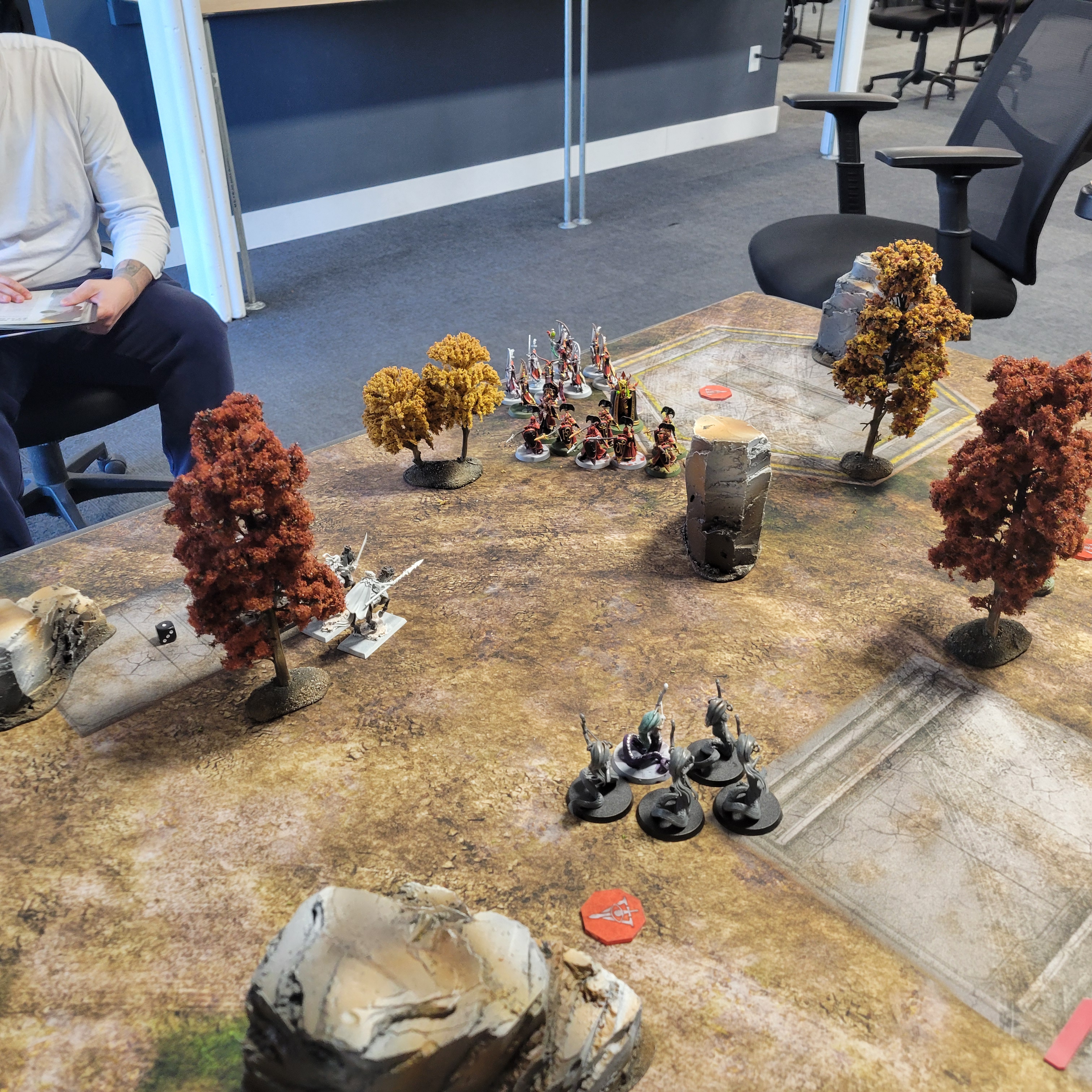
Old World Battle Report Wood Elves Vs Beastmen

The other day, my friend came over and we had a good old-fashioned brawl with our Old World armies. I brought 2500 points of Wood Elves, and they got 2500 Beastmen.
Conclusion

The game was very close. I think the entire game hinged on turn 3 combat. One crucial item is that I turned to flee with my Wild Riders when charged by the Ghorgon. However, I didn’t flee far enough, and the entire unit was run down and destroyed with not a peep. I also didn’t prioritize my shooting well, and I forgot my hagbane arrows, which did much damage. I also didn’t utilize my forest sprites or my spells effectively. Live and learn.

I was happy with my Glade Guard and Glade Riders. The treekin did ok, and the eagles, I think, are essential to screen troubling units. I would have rather had another unit of the Guard rather than the Sisters of Thorn.

The game mat is by FLG, and the terrain was made by Greenleaf

Beastment

272 – Beastlord, Additional Hand Weapon, Heavy Armour, Many-limbed Fiend, Gouge-tusks, General, The Black Maul, The Fur of Sharggu
330 – Great Bray-Shaman, Gnarled Hide, Pelt of Midnight, Wizard Level 4, Dark Magic, Scimitar of Skultar, Full Plate Chaos Armour, Horn of the Great Hunt
210 – 10 Bestigor Herds, Stubborn, Veteran, Gouge-horn, Standard Bearer, The Beast Banner, Musician
177 – 15 Gor Herds, Additional Hand Weapon, True-horn, Great Weapon, Scimitar of Skultar, Standard Bearer, Magic Standard, Vitriolic Totem, Musician
85 – Tuskgor Chariots
77 – 10 Ungor Herds, Shield, Throwing Spear, Half-horn, Standard Bearer, Musician
77 – 12 Ungor Herds, Shortbow, Half-horn, Standard Bearer, Musician
205 – 3 Dragon Ogres, Heavy Armour, Great Weapon, Shartak
100 – Herdstone
329 – 6 Minotaur Herds
• 1x Minotaur, Great Weapon, Musician
• 1x Minotaur, Great Weapon, Bloodkine, Burning Blade
• 1x Minotaur, Great Weapon, Standard Bearer
• 1x Minotaur, Great Weapon
• 2x Minotaur, Great Weapon
215 – Cygor
245 – Ghorgon

WoodElves

Glade Lord w/ Cav Spear, Forest Dragon, Hail of Doom Arrow449
Spellweaver, Level 4 Wizard, Elven Steed, Heartwood Pendant, Lore of the Wilds214
Treeman Ancient265
Glade Captain, Battle Standard Bearer, Elven Steed113
4×10 Units of Glade Guard with Hagbane Tips130×4 520
10 Glade Guard with Moonfire Shot120
10 Dryads130
5 Glade Riders with Trueflight Arrows95
5 Sisters of Thorn with Handmaiden128
5 Wild Riders with Standard142
4 Tree Kin204
2x Great Eagle2×60 120

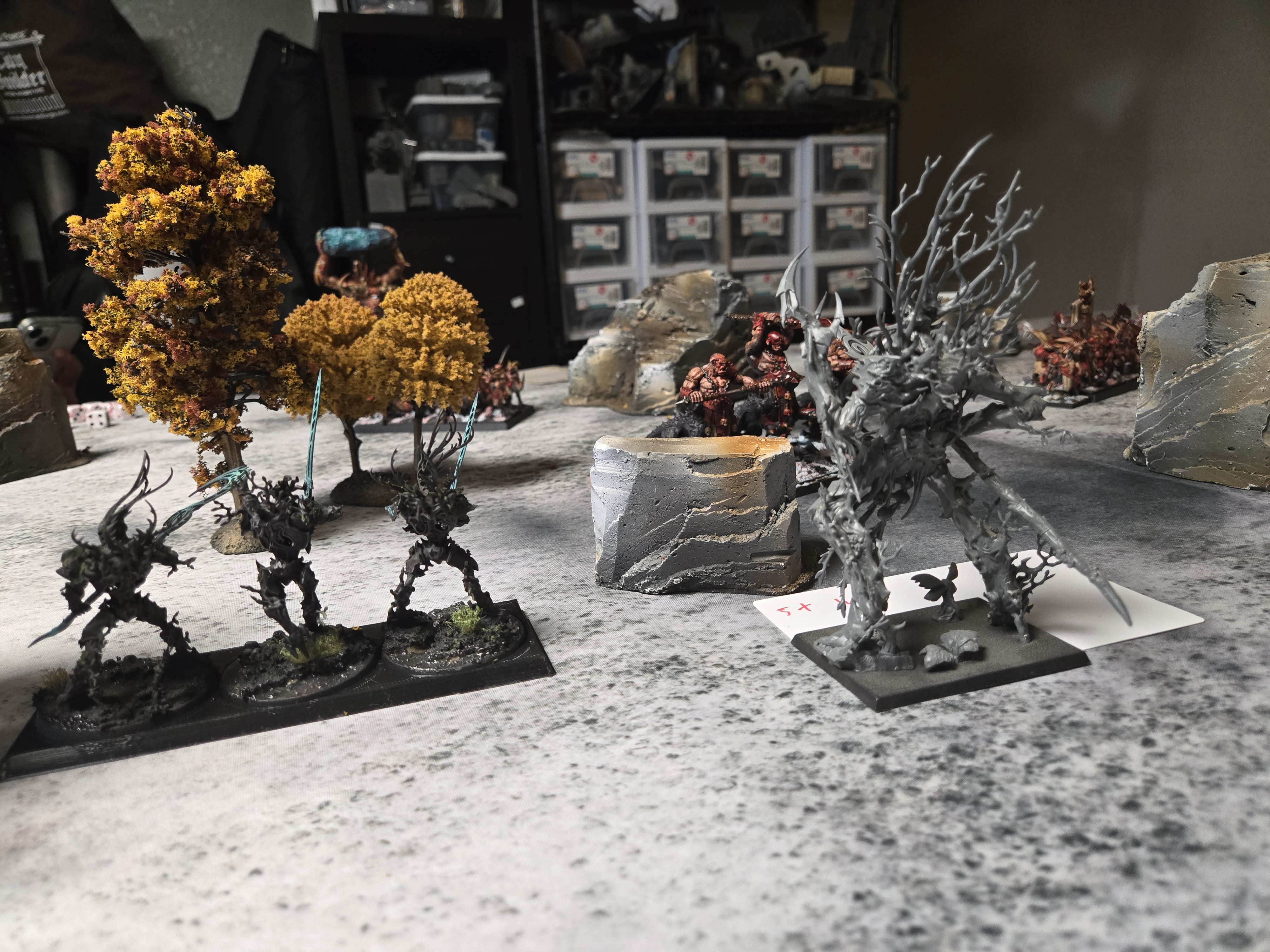
Our initial deployment and round 1. Minimal movement and lots of shooting. The Storm giant in the middle of the picture is my vortex spell.

The right flank looked rough, with me facing down the enemy minotaurs and dragon ogres. I was able to kill 2 minotaurs in the first round of shooting.
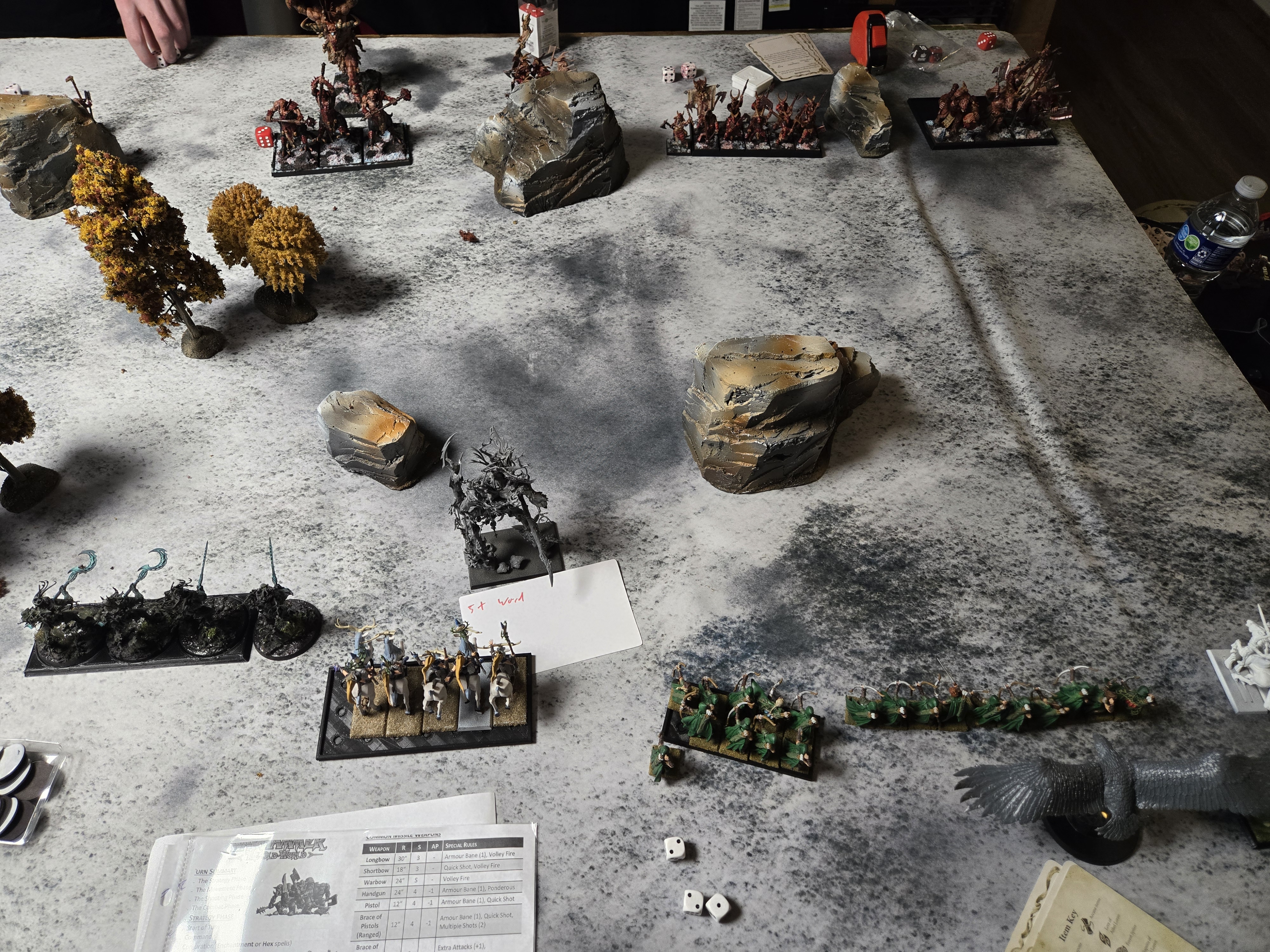
Round 3 resulted in the Ghorgon taking on the Woodelf Dragon. Unfortunately, the single six that was rolled into another six meant the monster slayer, Ghorgon, killed my general.
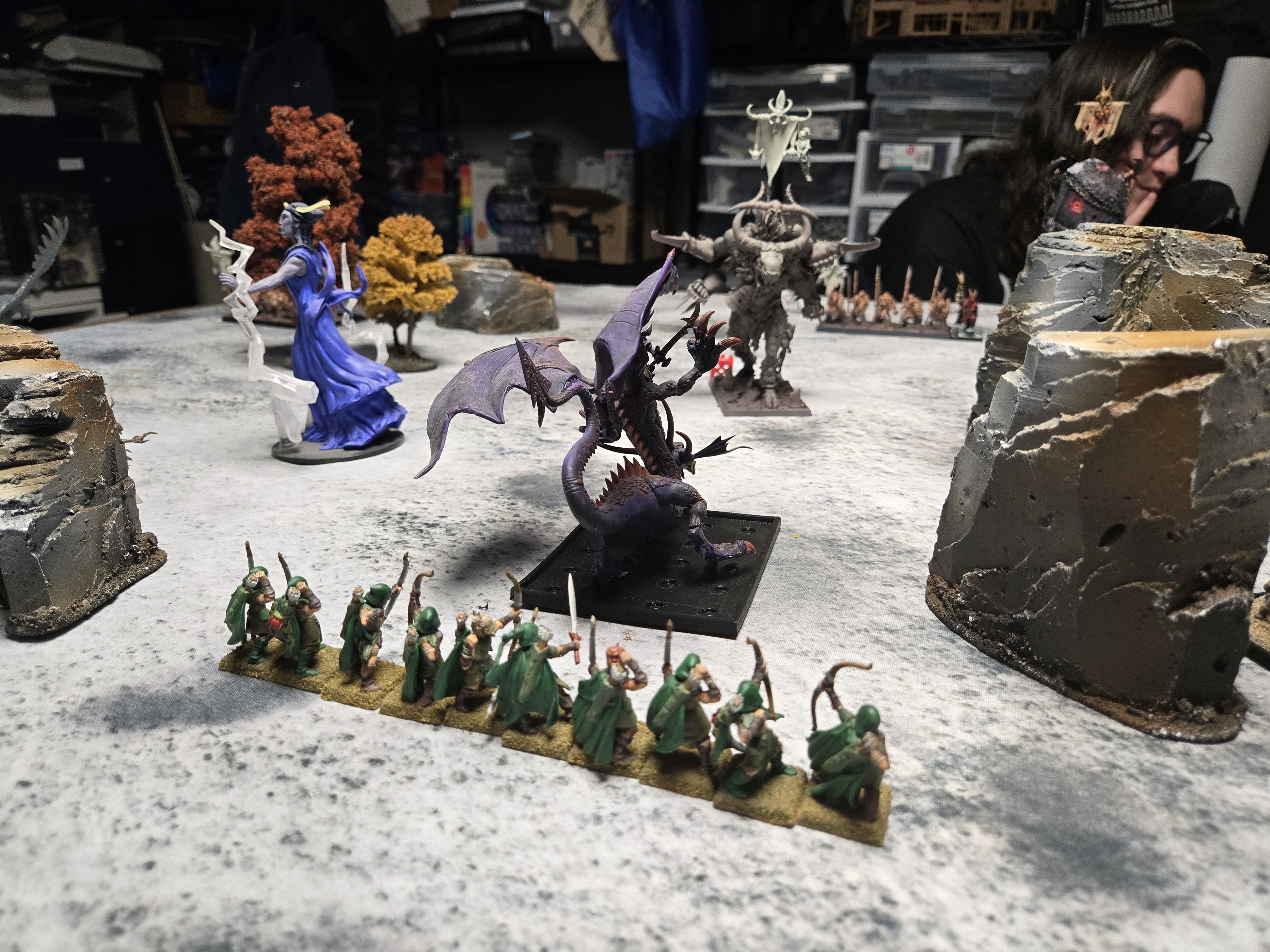
Center of the board after the turn 3 onslaught. My wildriders missed their charge.
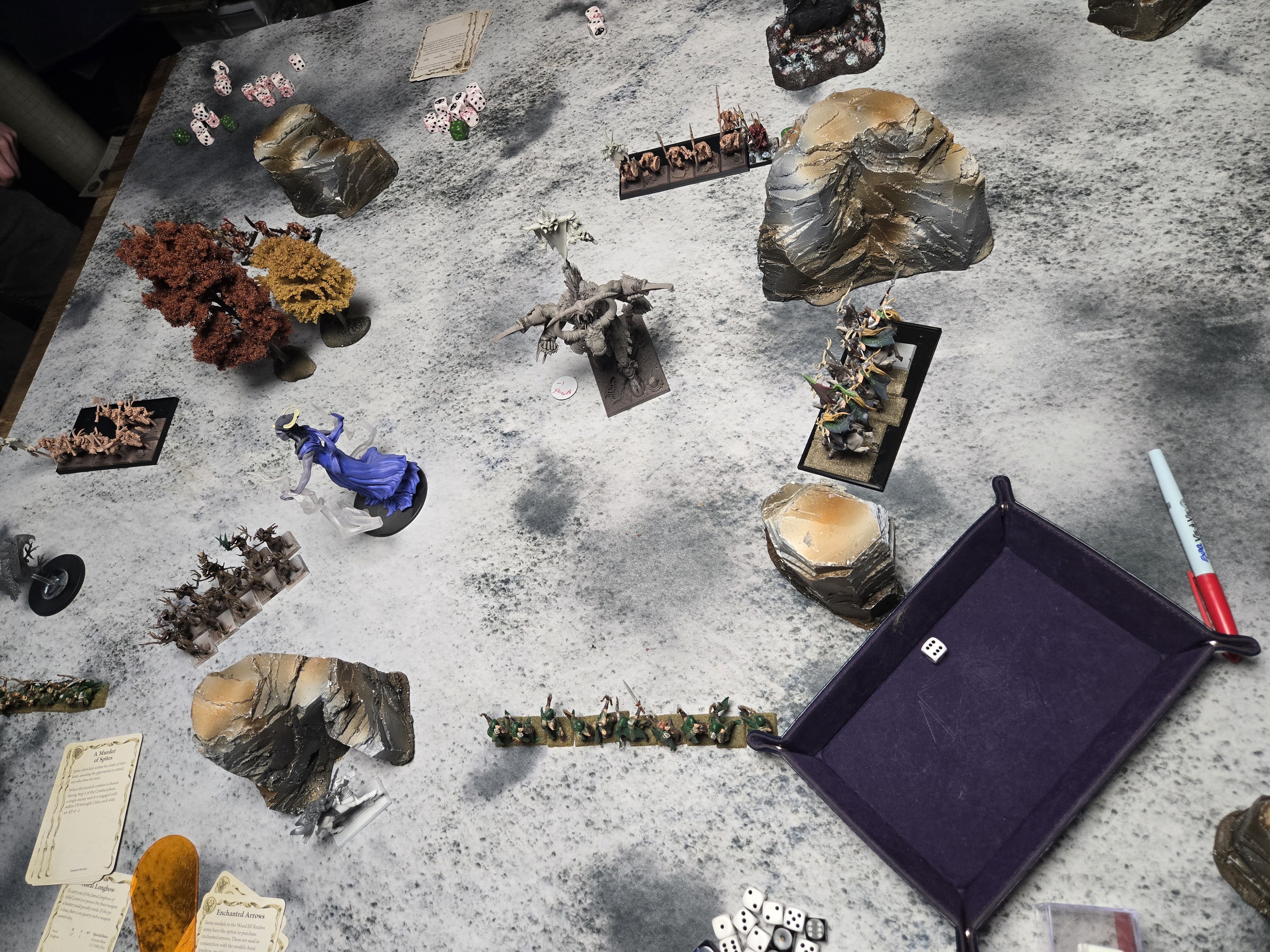
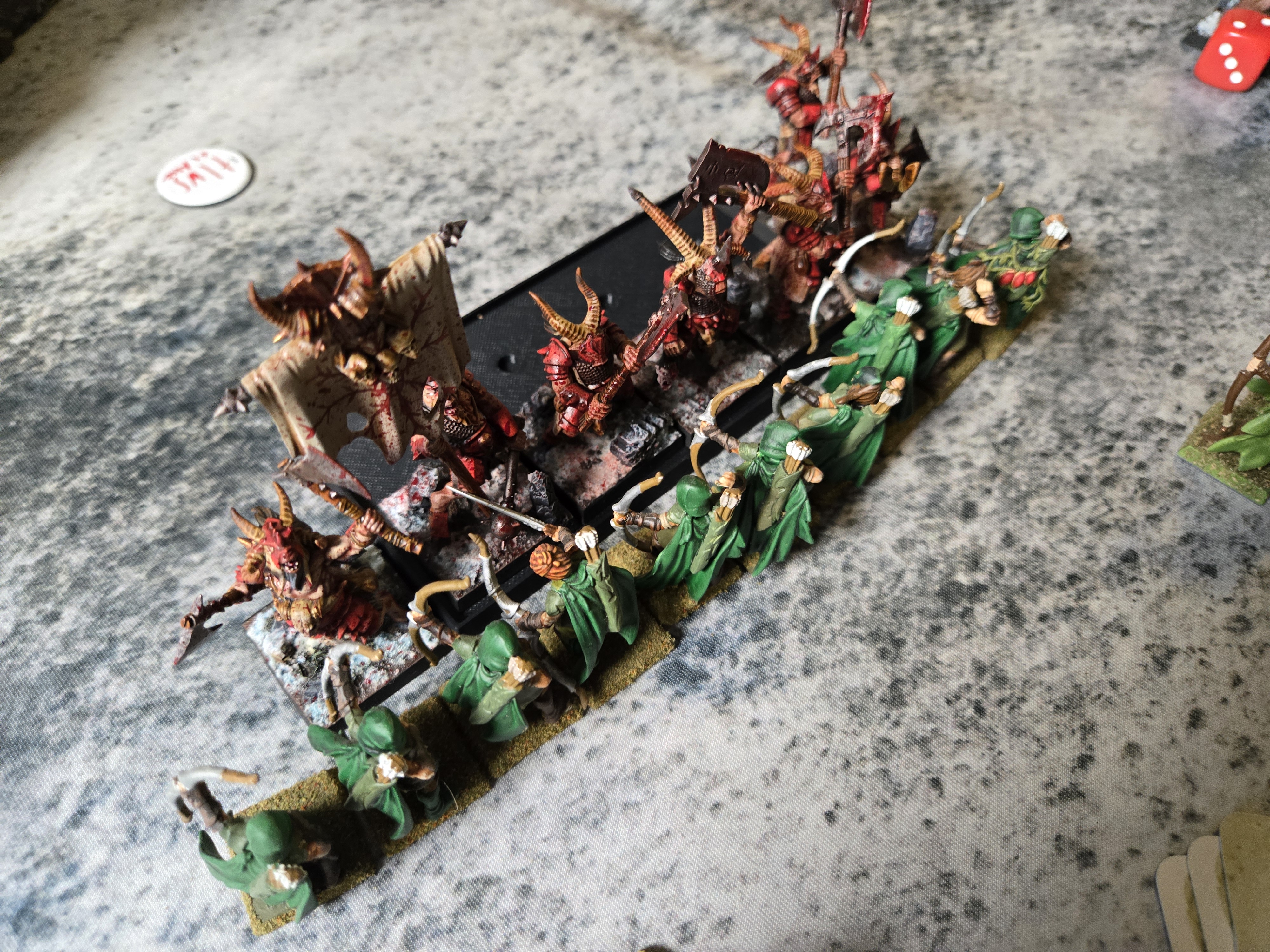
Turn 5 meant their main lines could finally get to my bladeguard. It wasn’t pretty.
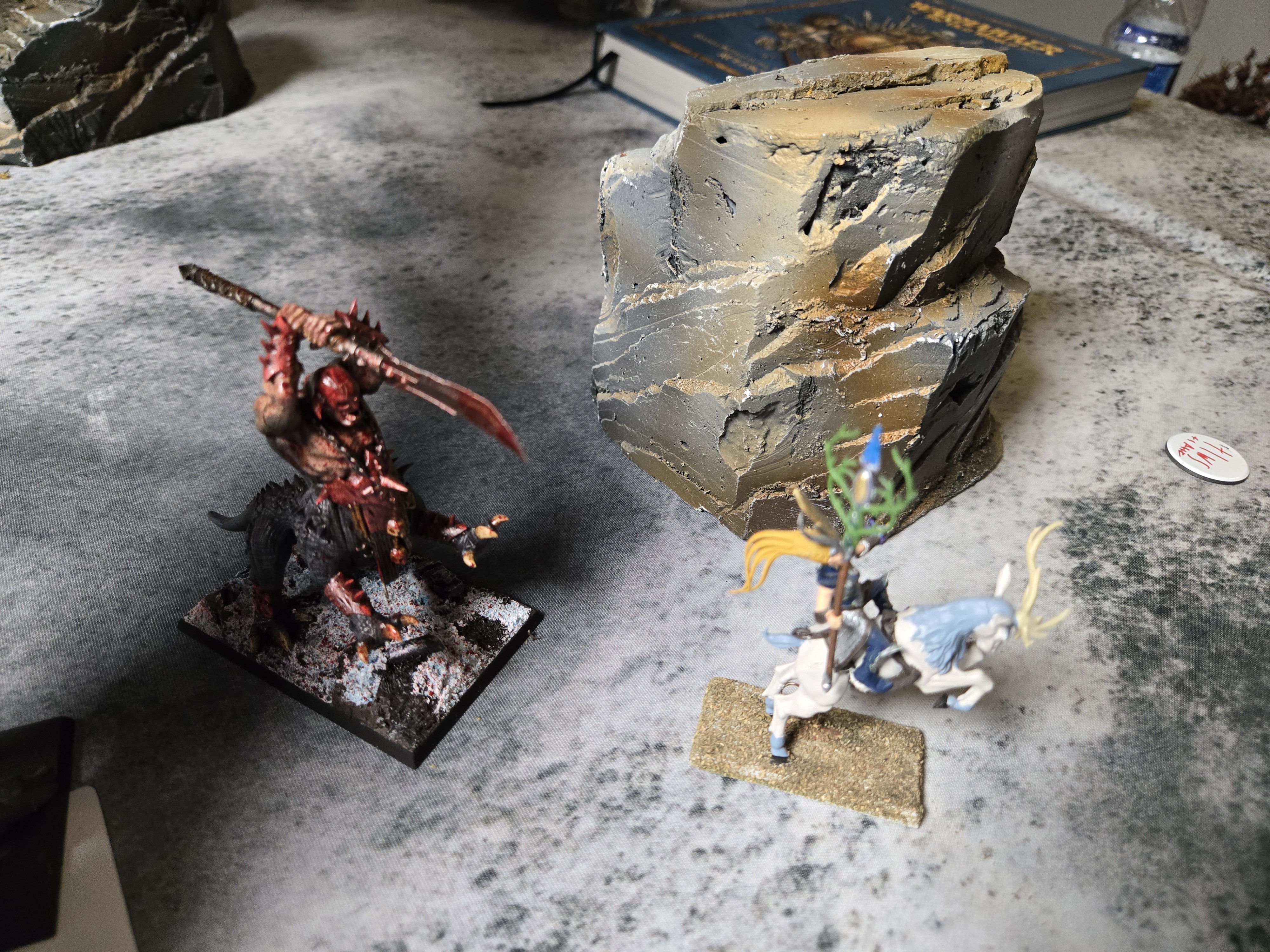
A rather funny image of his final dragon ogre chasing my final sister of the thorn.
A Comprehensive Guide to Wargame Terrain Part 8 (Final Part)

For the first 7 parts of this series, click here.

Today, I want to discuss the most expensive aspect of wargame terrain. Premium options. These come in several flavors.

Overall, I have enjoyed writing this series. If you want more in-depth reviews of any products, let me know.

Games Workshop Kits

Why am I putting GW kits here? I think they are overpriced. They look absolutely stunning on the tabletop, but the amount of detail that goes into a simple GW kit you have to paint is astounding. Price per item, GW is the worst option.

The simple GW landing pad, as simple as it gets, is $80. The same terrain piece can be 3D printed from Etsy or another source and shipped to you for $30. GW has to be careful or they will price themselves out of the hobby altogether.

Enough on my rant now, to other premium options I actually use.

Rampart Terrain

Instead of buying overpriced GW crap, I love using the fully modular Rampart terrain system. It can be magnetized, has nearly as much detail as GW kits, and is far more functional. The biggest challenge with Rampart is using your imagination to create amazing builds.

Kallistra

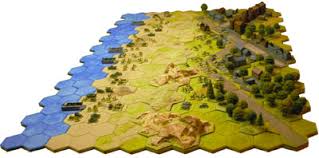
You can’t go wrong with the Kallistra system for creating historical battle boards. It’s a custom hex battlefield with numerous surface types: hills, mountains, rivers, craters, roads, and bridges. I use Kallistra hexes in most of my historical conflicts and am happy to do so. I have an epic D-Day battle planned one day, and Kallistra Terrain will be the star.

Dwarven-Forge

It is the cream of the crop for terrain. Its modularity is fantastic, and it is stunning on the table. However, I can’t recommend it for most wargames. The scale is just a little off. It is wildly expensive. I have, I think, every set they ever produced. I love my Dwarven Forge. Price is getting to be an issue with their latest sets.

Green Leaf Terrain

A custom terrain building from Canada. I have personally commissioned 5 projects from Green Leaf. His creations are often shown on MiniWargaming. They are some of the best custom terrain set-ups around. Send him a project and he will make something special.

Table-Top World

It’s not as diverse as some of the other options. The creators at Tabletop World put together some stunning resin pieces. Unfortunately, they are no longer producing models. If you can find them, buy them.

Custom Etsy Creators

The rise of Etsy has been huge for the wargaming hobby. I use Etsy for many of my unique pieces. You can spend as much or as little as you want. You can acquire whatever you want. It also helps small hobbyists like ourselves. Just be aware that sometimes what is sold isn’t what you expected.

Gamemat EU

I only have one set from these guys, but they are highly regarded and reviewed.

Tabletop Titans

The first of two pop-up terrain options. I prefer Acidhouse for its modularity. But there is a place for a fully functional battlefield in a few seconds that packs beneath a bed. I personally own every single set and enjoy using them on the table.

Acid House Terrain

My other flatpack option for wargame terrain. It is highly modular, but durability can be questionable. I think I own every set they have ever produced.

Tenfold Dungeon

Tenfold has decent terrain for Dnd or Boarding actions. I wouldn’t build a table with it, though.

Up-Zone

My final option for a pop-up terrain. It’s fine, just not special.

Pre-Painted MDF

One premium option I don’t like to use, but I acknowledge is a popular item, is pre-painted MDF terrain. I find MDF finicky and fragile.

https://www.deepcutstudio.com/product-category/scenery/
https://blacksitestudio.com/collections/mdf-terrain?srsltid=AfmBOooOCvpg6VhRo6SWBtgnIrfW2Ry17oeULgyOcQpKcGNNUBxfXrrX
https://store.frontlinegaming.org/collections/flg-full-color-terrain?srsltid=AfmBOoqBOqrofvrbrnTbQTT8ORmSpMQcylLIxBkG-V6a_ruFBsnx-OX4

A Comprehensive Guide to Wargame Terrain Part 2

You have played a few games, enjoy the hobby, and want to improve your tables.

Hooray. Terrain, as I will say, 100 times makes the game better. It is not required, but it sure is fun.

At this stage, I will avoid discussing 3D printing. I know what is out there and how amazing it is, but we are beginning hobbyists.

A Note on Scale

Wargames can use a variety of scales. Scale is determined by the height of a figure from the bottom of its feet to eye level. Warhammer models are about 32mm, so they are 32mm scale. Bolt Action is closer to 28 mm, while Marvel Crisis Protocol is 40mm. (aka Captain America is 40mm from his feet to his eye)

Scale matters when it comes to terrain. If a standard rifleman can stand, look over a building, and shoot, it detracts from the immersion. Consider this if you make or buy your own terrain. The type of game you are playing also matters. Epic Battles from Warlord games is about 10mm scale, designed for large, medieval conflicts with a couple thousand figures on the table. Narrow streets and cramped buildings wouldn’t be fun to play on.

The same can be said for Bolt Action, a 28mm WW2 game. The average army has about 30 figures and a vehicle. This game plays much better with more terrain, buildings of different heights, etc. It does not play well on an open plain with a small river.

If purchased for Epic Battles, the same river might be the width of a battalion, 150 or so yards across. In Bolt action, that same battalion is shorter than a typical Tiger Tank and little more than a stream.

It’s just something to think about. Most players I know won’t care if the house is about the same size as a Landraider or if their noble knight is just a little bigger than the door he is guarding.

What Terrain do I need?

This entirely depends on what game you are playing. Rivers don’t make sense if you play Battlefleet Gothic, a game in outer space. Like Grimdark Gothic ruins don’t make sense in the Wild West.

I always recommend starting with the basics. Roads are universal, and scale doesn’t matter much. You can buy some fabric from a local store and cut them out yourself (the cheapest option). You can paint and use cardboard, buy the neoprene roads from Amazon (my top choice), or even look at premium custom-made or 3D-printed options.

The entire above paragraph can also be said about rivers. Add a bridge, and you can have an exciting engagement. Most games allow faster travel along roads, and rivers are always an effective barrier or defensive structure.

Next time, I will add some vegetation; hedgerows and trees are universal among the wargames I played. Star Wars Legion, Flames of War, and Napoleonic all need some vegetation. Adding cover and breaking the line of sight always looks good. I have some expensive custom-crafted trees. I prefer trees for your Christmas village or the bulk boxes of fake trees you can buy on Amazon.

Hedges have always seemed a little trickier. These matter for scale, as a soldier shouldn’t be able to see over one, but a vehicle or mounted knight should. They are also a little harder to find. My favorites are plastic and 3D printing, but you can also find premade ones on Etsy. If you want to try making your own, a few YouTube videos and a trip to a craft store should yield good results.

I also think stone walls are reasonably universal. I use mine in dozens of games; they never go to waste. I buy mine on Etsy, but Amazon and 3d print shops also yield good results.

More Specific Terrain

At last count, I have armies for 47 different miniature wargames. I strive to make my terrain as universal as possible. I don’t add Soviet propaganda to my 15 mm buildings because I also used them in the Napoleonic and Ancient periods. If you’re just starting out, I recommend building one table first.

When building a table, look below at the types of games and terrain needed. Don’t worry about walls, fences, or many buildings if you are playing 15 mm Napoleonics with 400 figures on the table. Instead, focus on hills, fields, and forests. If you bought a kill team and want to expand into an entire 40k army, a grimdark ruin (3d print please) with several floors and bits of scatter is more thematic.

As always, buildings and vegetation are unnecessary if you are playing a space game like Billion Suns or a water game like Black Seas.

Types of Games

I classify boots-on-the-ground Wargames into four categories: Squad Actions (10-14 Figures), Skirmishes (20-50 Figures), Army Actions (100 figures plus), and ranked soldiers. There are other categories for naval, space, and airplanes, but that’s how I do it for boots-on-the-ground.

I know you may balk at this, but think: A squad of 10 men may fight over a house, a platoon of 60 men may fight over a compound, large structure, hill, or bridge, and an army will fight over a town or range of hills.

In squad actions, scatter terrain is vital. Broken furniture, light poles, crates, rubble, craters, computer terminals, and market stalls. When you only have 10 figures on the table, you can take your time to enhance some of the details. It generally leads to much more interesting games.

In skirmish games (think Age of Sigmar), you have a force of units on the table and generally move a few models around as a unit. No one would consider your 40-man army a full invasion force, but they look great on the table and strike a nice balance of hobby and playtime. Scatter is less critical here than elevation and line of sight. It rarely comes into play and is often just inconvenient.

In my book, army actions are typically reserved for historical events. I rarely consider using figures larger than 15mm in an army action game. This is when actual land features start to play: hills that hold entire battalions and dozens of cannons. A single fence or wall is inconsequential; the layout is more important. A forest that hides 3,000 troops, a river you can’t just walk across. A hill is several hundred feet high that overlooks a large camp. These are the types of terrain you should be working on. Unfortunately, most of these need to be crafted.

Finally, there are rank-and-file games: Warhammer Fantasy Battles, A Song of Ice and Fire, Kings of War, and Conquest. They want to act like army games, have the model counts of skirmish games, and are exceptionally difficult to move around. I treat them like army games, but I also push for utterly flat terrain. It doesn’t look as nice, but functionality is most important for the game’s playing.

Conclusion

Hopefully, this guide will help. Stay tuned for part 3.

A Comprehensive Guide to Wargame Terrain

Greetings, new (or seasoned) wargamers, and welcome to my guide on wargame terrain. I want this guide to be very in-depth but spread over multiple parts. I love the terrain. It is wargaming, more so than the models themselves. I have spent fortunes on terrain that I am proud to have on the table. Click here for the rest of the series.

What is Terrain

In Wargaming, terrain is simply something we use to avoid battles on flat surfaces. Looking back through historic battles, terrain plays a starring role in how the battle shapes out: Germanic tribes ambushing Roman legions in dense forests, fierce fighting in Stalingrad over a grain elevator, and even the shallows at the Battle of the Nile.

When we play wargames, depending on the game, the terrain will change how our models move about the battlefield. There are games where terrain is a significant part. Rules for elevation, river crossings, and trenches all factor into our generalship. Hours are spent discussing target priority, strategic usage, and ideal lists, but using terrain is even more critical.

Getting Started

There are levels upon levels of terrain available for purchase. You can make it yourself, 3d print it, buy 3d prints, complete terrain kits, fully painted items, use non-traditional items, get fully custom-made-to-order commissions, purchase modular build kits, and endless other options.

But let’s say you bought a starter set, and you are tired of your miniatures shooting at each other across empty space. Maybe you have watched a video online about how to play your newest game, and they have these handcrafted realistic buildings, luscious grass, LED lights, flowing rivers, and jungle canopies. You look on Etsy and see this terrain set for $1,000. You put your miniatures away in a box, ending your wargame experience.

You don’t have to have beautiful terrain to wargame. If you are so overwhelmed by your first games by the sheer amount of options and all the shit you have to buy, it’s impossible to love the hobby.

In fact, if you are curious about wargaming, I would advise printing out paper models and paper terrain and getting a game started for $20 and an hour of work rather than $2,000 and 100 hours. Most games have a free ruleset available as a PDF for starters. See if you enjoy the game part. Then maybe visit a local game store. (My town of 7,000 has one; I’m confident the internet can help you.) Most stores have terrain you can use and tables to play.

Your First Terrain Set-Up

More people play casually at their kitchen table with their kids and friends than in a store with dozens of others. Stores are intimidating. You don’t want to ask for help or feel clueless. Gamers will walk in with backpacks filled with the latest and most fantastic devices and commission-painted armies, and you have a mound of grey plastic. It’s ok.

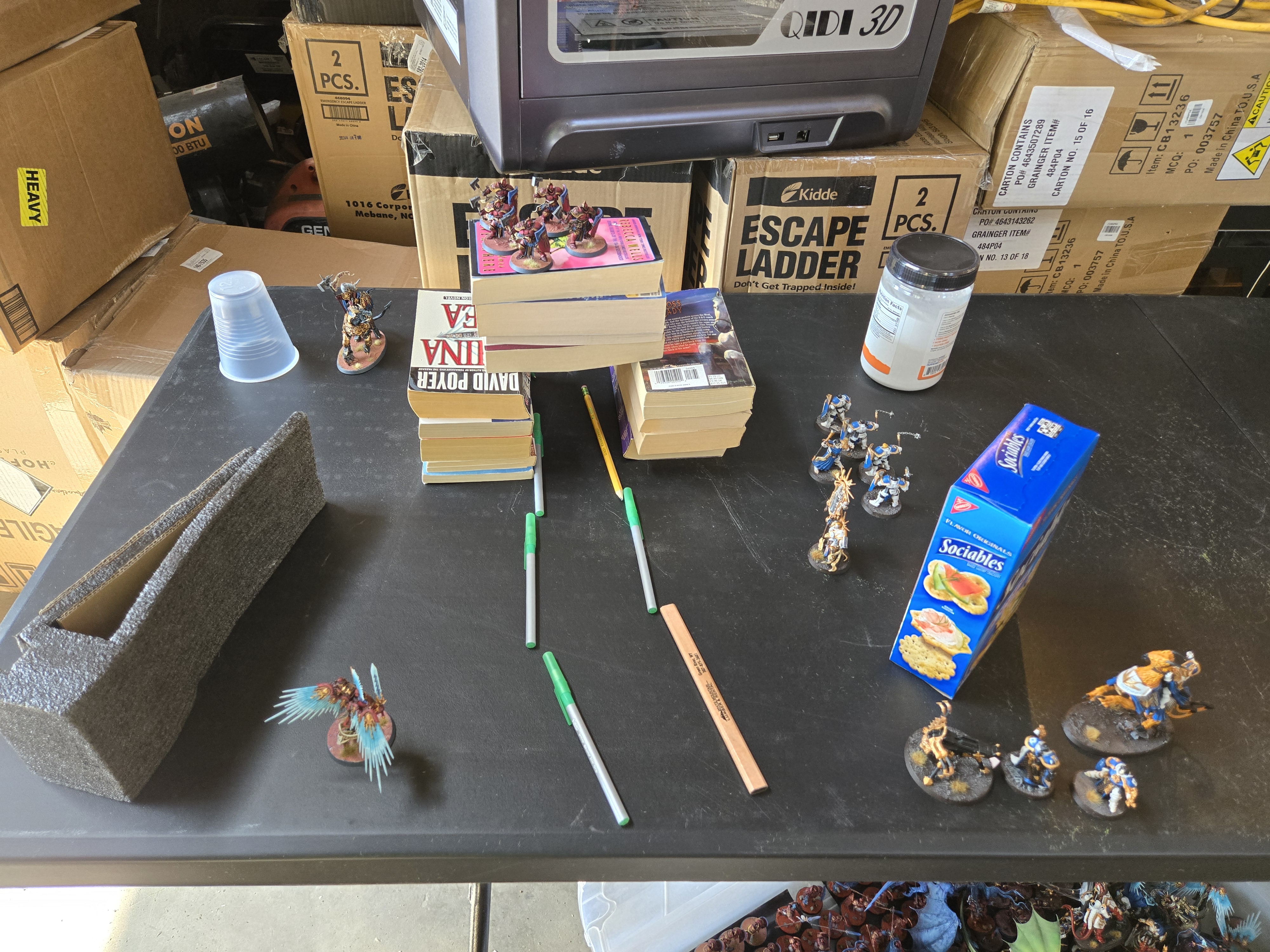
Feel free to use books, pots and pans, CD cases, cups, and mugs when playing at home. Break out a piece of paper and draw a river. It will serve its use, and honestly, books as buildings and hills are far more functional than most wargame terrain you may buy.

You want your terrain to be varied but balanced, not giving one side an advantage. One side has a stack of books overlooking the entire battlefield; the other should also. One side has a mousepad minefield, and maybe the other has a blue dinner plate used as a lake to restrict movement. You want your space between terrain to be large enough for the most prominent units to pass through most areas. You want a few areas with long sightlines so your snipers and other shooty units can shine. You want others with tight corridors so melee units can charge and have a go.

The models with the most significant footprint tend to be the most important. It wouldn’t be a fun game if your shiny new tank couldn’t drive anywhere. Below is a setup I did while writing this article in my shop with stuff from my desk.

It looks just fine and is more functional than many of the fancy boards I have played on.

A Table

Warhammer, Marvel Crisis Protocol, Bolt Action, all have a recommended table size. Here is the kicker; it’s not required. Any coffee table, kitchen counter, or floor is acceptable. The most critical piece is to play the game and have fun. If we are not enjoying ourselves, then why waste our time.

If you really, really, really, want to buy a table, to start, buy the 30″ by 30″ folding card table for $15 at Walmart. It’s functional, large enough to play 750 points on, and if you decide against gaming long-term, you can use it for something else.

I prefer a table you can sit at. Also, this is just me. Having alternate surfaces to store dice trays, rulebooks, army boxes, and other items that we wargamers seem to think we need to successfully eliminate the enemy.

Daughters of Khaine Vanguard Battles

The hobby room continues its long, arduous completion process. My desk is ready and fit for work; now, I am just putting items away.

In the meantime, I entered into a Vanguard League. My FLGS saw how many people wanted to try Age of Sigmar, so they created a league. The gist is that everyone purchases a Vanguard box. You get bi-weekly pairings and progress through the various missions. In total, there are eight participants. I have fought two battles thus far.

Final Thoughts on Vanguard

For the battle reports see below. The quick summary is I think Vanguard games are just a little small. They work great as an introduction to the game and really allow new players to use and practice the new abilities, but balance wise they just aren’t quite there. I routinely have command points I can’t use and the many obectives and battle tactics are not achieveable. Unit balance is also off. Some large units while points wise are not out of line, when faced with other options, they are just inferior in every way.

I picked the Daughters of Khaine. I was the last to pick, and I wanted a faction no one else was really talking about. The Vanguard list is below.

1 Mulusai Ironscale with Arcane Tome and Master of Poisons
5 Blood Stalkers or Blood Sisters
10 Witch Alves or Sisters of Slaughter
5 Doomfire Warlocks

My first battle I faced Kolten and his Seraphon. His list is below;

1 Sarus Oldblood on Carnosaur
3 Kroxigor
10 Sarus Warriors

We played the first battleplan, Frontal Assault. I have a decent amount of AOS expierence. My opponent had zero. The game started very slow. Getting the opponent used to Grand Strategy’s and Battle Tactics took a significant amount of time. Once those were arranged I won the roll and elected to go 2nd. I felt like a round 2 double turn on the small table could be decisive.

Kolten advanced up the board, but was unable to get a charge in based on my deployment. My round I used my warlocks and archer to eliminate his entire unit of warriors. I then positioned myself to have the witch aelves charge the oldblood my next turn. I wanted to avoid the Kroxigors at all costs until we met on my terms.
Turn 2 the battle went to shit for me. I did win the double turn, and I threw everything I had at the Oldblood. I should have killed it twice according to mathhammer. Timely rolls, timely saves, I reduced him to exactly one wound with all my units execept the Blood Stalkers engaged with it. His turn he was able to withdraw then charge again, plus got a charge in with his Kroxigors, plus healed the maximum with his heroic ability. My Witch Aelves and Warlocks were elminated. I was able to kill his Oldblood leaving only the Kroxigor, but my Blood Sisters were cornered. At this point he managed to get both of his Battle Tactics and Grand Strategy so I was going to have a tough time coming back on points.
Turn 3 I tried to force my way out. But his unwounded Kroxigors took out my Ironscale. I was left with 3 Blood Stalkers against his 3 Kroxigors.

By turn 5 I had whittled down 1 Kroxigor but he still had two left and I was behind by 4 points. Had I gone second I would have tried to charge my unit into his, but because of the turn structure I would have been tabled going first. I think with shooting and charging I could have gotten him down to 1 Kroxigor, but if I missed I would have been completely tabled.

My second game I went against Eric, he and I have played several times in the past, I never faced his Lumineth.

Same list for me. While his list was:

1 Scinari Cathaller
5 Bladelords
10 Wardens
10 Sentienls

The amount of magic he could must scared me, but I also knew how squishy his army was. We played Burn and Pillage. He placed almost all of his units in a single corner of the field. His archers were kind of out in the middle rather than behind his lines which suprised me.

I was able to take the first turn, and put everything I had into the blade lords. I felt like this was the most dangerous unit on the field to me. They were killed on the With Aelves charge.

I only lost one elf for one of his command abilities and I took out two Wardens as well. In the bottom end of the first he wiped out my aelves using his phalanx and killed a single Warlock. I was able to shoot with my Warlocks and do a couple damage to his Wardens.

I picked off a few of his wardens and took three objectives to his zero. I also completed one battle tactic and elimnated his grand strategy so I felt good about where I was.
Turn three I finished off all but one warden and he eliminated my warlocks. I also killed 2 more sentinels.
Turn four I finished off his commander and wardens and put him down to 5 sentinels. He killed my Ironscale and 2 blood stalkers. To be able to kill my blood stalkers he had to move his sentinels forward, a big moment and what I thought was a mistake. I was also 1 VP behind and handnt completed my grand strategy.
Turn 5, I couldn’t get him off the objective by just shooting, my grand strategy was every unit fights and my stalkers hadn’t. I needed my +1 buff and a roll of 8 to get the charge off. Missed my first roll and used my only command point to try again, got an 8. He killed one of my stalkers on overwatch, but after my round of shooting I had him down to 4 models. The sisters did glorious, he was down to one, I had my two snakes left. They struck, he saved one and missed one tabeling his army and earning me the victory.