June 16 1487 Battle of Stoke Field Wargame Scenario

On June 16, 1487, the House of Tudor and the House of York took to the field for the final major battle in the War of the Roses. The rebel Earl of Lincoln took the high ground with his 8,000 troops, essentially mercenaries. The more experienced Royalists, with 12,000 troops led by Henry VII, were ready to end the protracted, bloody conflict.

Many wargamers have recreated the battle of Stoke Field. A quick Google search offers two or three dozen just on the first page. We will provide an alternate battle situation where the Rebels are supported by Scottish rebels from the north. It is not inconceivable, as Scotland long wanted independence, and perhaps for their assistance in helping the Earl of Lincoln lift the crown, Scotland would be granted its sovereignty.

Order of Battle
Rebels House of York, Earl of Lincoln

I think we should keep the number of troops and the deployment the same. Instead of bringing 4,000 poorly armed Irish Kerns, let’s add 4,000 Scottish Pikes plus a commander.

1 Stand Knights As General 32
1 Sub General 32
1 Ally General 22
5 Retinue Billmen 35
20 Retinue Archers 140
20 Scottish Pikes 80
13 Northern Border Foot 39
4 French Crossbows 20

Royal House of Tudor, Henry VII
1 Knight as Royal General 35
2 Knights as Sub Generals 64
3 Stands Royal Body Guards 45
6 Stands as Men at Arms 60
10 Retinue Billmen 70
10 Retinue Archers 70
4 Javelines 32
6 Stands German Pikes 24

Wargame
Ruleset DBM, DBMM, or any other large-scale medieval ruleset
2 Players
Forces Needed are Listed Above
For terrain, a large grassy hill with enough room for the Yorkists to deploy on top.

Objecitves
Each army must destroy the other.

To set up, the Yorkists should take up a formation and position themselves at the top of a large hill, while the Tudors are at the bottom. The Tudors attack.

No Special Rules, unless you want to give the Tudors a Bombard or two.
June 15th 486 Battle of Soissons Wargame Scenario

On June 15th, 486, the Western Roman Empire was in its final stage of collapse. Syagrius of Rome was the son of Aegidius, who was preserving what was left of the Soisson region. The Franks utterly destroyed the tired Romans, who never again controlled any part of modern-day France.

This will be a straight-up engagement. Both sides had around 6,000 troops, and there are too few details to create a unique situation. This battle was wildly essential and led to the creation of the Frankish Empire, which still exists today.

Romans 6,000 soldiers commanded by Syagrius.

Franks 6,000 commanded by Clovis I Ragnachar.

Wargame
For use with DBMM, Hail Caesar, or any other large-format Dark Ages ruleset.
2 Players
6×4 Table

Army Lists for DBMM 400

Romans DBMM 2-83

C in C x1 Reg Kn 28
Sub General x1 Reg Kn 28
Equitates x4 RegCv 32
Legionarii x 8 Reg Bd 56
Auxilia Palatina x10 RegAx 50
Garrisson x6 RegAx 24
Foederati x21 Reg Ax 105
Foederati x7 RegKn 77

Franks DBMM 2-72

C in C x1 Irr Cv 17
Sub General x2 Irr Cv 34
Noble Cavalry x 10 Irr Cv 70
Foot Warriors x81 Irr Wbb 243
Skirmishers x8 Irr Ps 24
Archers x6 Irr Ps 12

No special rules, follow your standard historical wargame rules for this one.

June 14th 1800 Battle of Marengo Wargame Scenario

On June 14th, 1800. The Austrian forces of General der Kavallerie Michael von Melas attempted a surprise attack on Napoleon’s troops across the Bromida River. The Austrians, being numerically superior at the start of the battle, forced back the French. However, a well-timed assault from an incoming French division turned the tide of battle to the French.

Order of Battle (Wikipedia has a very nice, detailed list if you are interested)

French 29,942 soldiers 33 guns
General Napoleon Bonaparte
Corps Lannes
12 Battalions
6 Horse Artillery Cannons
5th Dragoon Regiment

Corps Victor
9 Battalions
4 Horse Artillery Cannons
3rd Cavalry Regiment

Corps Desaix
8 Battalions
4 Foot Artillery Cannons
1 Hussar Regiment

Cavalry Reserve
28 Total Squadrons

Reserve
2 Battalions Genadiers
2 Squadrons of Horse Guards
8 Cannons

Austrians
General der Kavallerie Michael von Melas
30,379 Soldiers, 92 Cannons


Advanced Guard
4 Light Infantry Battalions
4 Cavalry Squadrons
6 Cannons

Right Wing
5 Battalions
6 Squadrons
6 Cannons

Center
24 Squadrons
20 Battalions
8 Cannons

Left Wing
12 Battalions
6 Squadrons
12 Cannons

Wargame Scenario
For use with General D’Armee, Black Power, or any other large-scale Napoleonic Wargame
2-8 Players, players can take control of the entire army on either side, or each Corps/Wing could have a commander as well
French Players will need 31 Battalions, 36 Cavalry Squadrons, and 5 Artillery Batteries
Austrian Players will need 41 Battalion,s 40 Cavalry Squadrons, and 6 Artillery Batteries
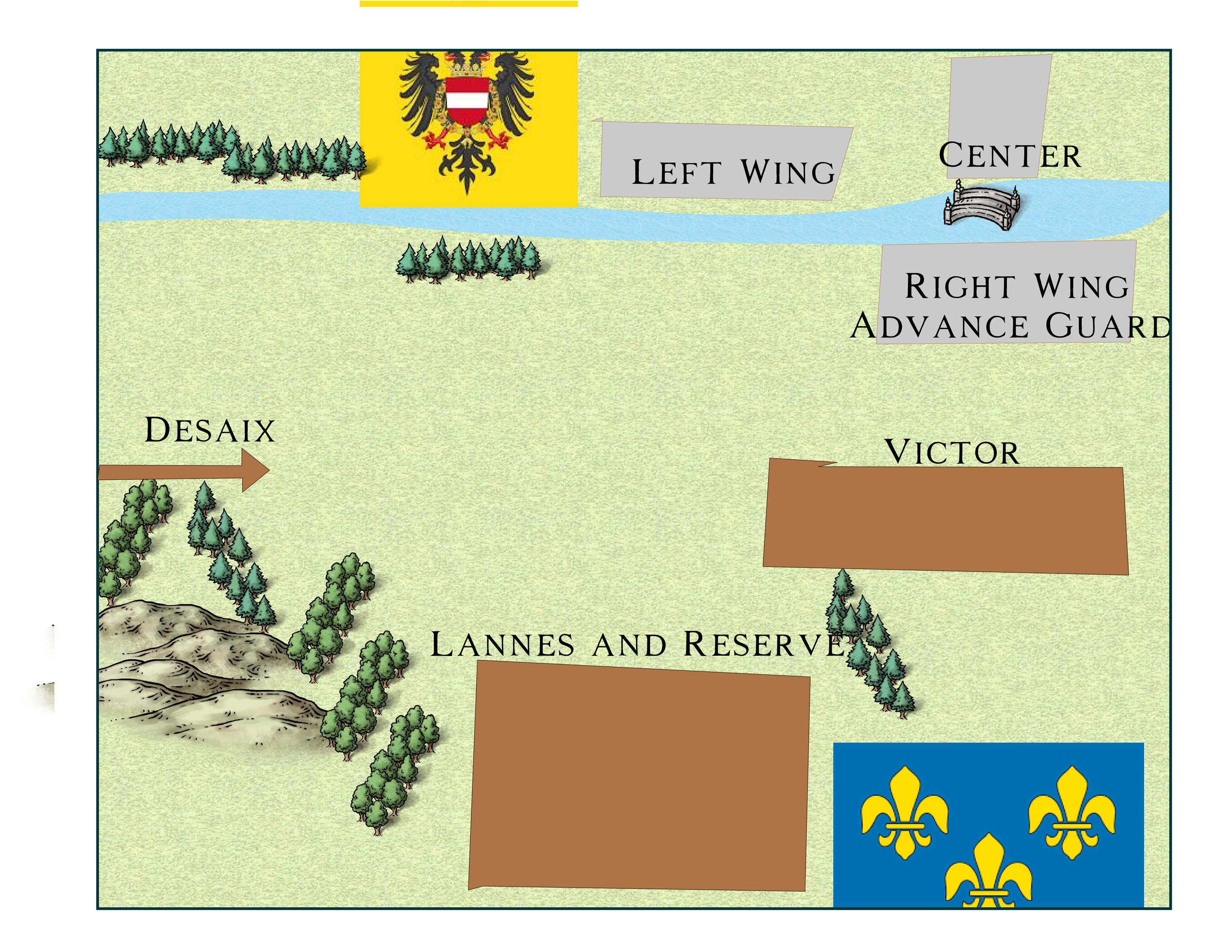
Terrain should have a river near one field edge with a bridge crossing the river. There should be several forested areas and a large hill opposite the edge where the bridge stands
Table Size 8×4 or even 10×4

Objective

The Austrians want to use their numerical advantage to break the French before the French forces can flank them. The French want to hold until Desaix arrives, then break the Austrians using a hard flank attack.

Set Up

During the battle, the Austrians struggled to mobilize all their forces against the French. The Austrians should start with their advanced guard and right wing on the French side of the river, holding a bridgehead while the Center and Left wings continue to cross.

The French should start with the Victor Corps engaged with the advanced guard of the Austrians. Lannes and the Reserve Corps to the rear, and Desaix corps off the table to arrive at turn 10

June 12th 910 Battle of Lechfield Wargame

The first battle of Lechfeld on June 12th, 910, was pivotal during the early Hungarian invasion of Europe. The Hungarians were in their third year of invading the Kingdom of East Francia. HistroyMarche on Youtube has a very nice video and summary of the battle with preludes and after effects.

The battle turns out to be a very nice wargame. We start the game with the Francia army beginning to feel confident and the horse archers tired.

Ruleset DBMM
Table 6×4
Terrain Trees and Forests on the outskirts, the battle should be played lengthwise rather than widthwise.
Models Needed (see below)

Francia Louis the Child DMBB 3-53

15-17,000 men.
10,000 Spear Infantry
4,000 Archers
2,000 Cavalry

3 C in C 57pts
10 Milities Irr Kn 90 pts
72 Spearmen 216 pts
12 Archers Irr BW 36pts


Hungarians (Maygar) DBMM 3-30

No defined commander
8,000 Light Horse Archers

3 C and C or Sub Generals 57 pts
86 Bases of Irr Light Horse 344 pts

Set Up

The Francis army should be set up entirely on the field in a formation of the players’ choosing. The Hungarian army should have 50% of its army deployed near the Francia lines, with the remaining 50% hidden in the trees. The trees should gradually close in. The Hungarian player should select a point between 18″ and 12″ from his table edge, so that once the Francia player crosses that point, he can spring his ambush. Once the Francia player crosses that point, the other 50% of Hungarian forces will appear on either long table edge.

Objectives

The Francis army should do everything it can to win the battle before being ambushed. The Hungarian player must try to draw the Francis player in.

June 10th 1358 Battle of Mello Wargame

During the 100 Years’ War, French peasants attempted to rise up and remove the nobles in the Northeast of Paris. 4,000- 5,000 lightly armored peasants attacked noble houses and castles, stealing their wealth. The Nobles of the region responded in force. In real life, the French killed the peasant leader, and the lines broke nearly instantly. What if they hadn’t?

Wargame;
Game System DBMM
Players 2
Table Size 4×4
Models Needed Peasants 30 Elements of horde, 8 elements of archers 1 command (cavalry), for the nobles 10 elements men at arms 4 elements dismounted knights 2 commanders, and 4 elements crossbows.

Set-Up
The peasants should be at the top of a hill, with archers in front, infantry behind, and the cav unit acting as a reserve. They should be in a strong position.

The French should set lines and approach as necessary.

Objectives

Kill or break the opposing army.

June 8th 793 Lindisfarne, Viking Invasion of England Wargame Scenario

On June 8th, 793, three Viking ships landed on the coast of the remote island of Lindisfarne. Lindisfarne was famed for its library and riches, making it a prime target for Viking raiders. The island was relatively undefended. This raid marked the beginning of the Viking Age in England.

Wargame Scenario should work nicely with the Barons War or even Warcry style games.

2 Players
50 Viking Raiders
20 Defending Men-at-Arms
40 Defenseless monks
Flat grassy terrain with a stone building and a central monastery.

Objective

The Vikings’ goal is to steal as many treasures as possible. Their secondary goal is to kill as many monks as possible who are hiding treasures.

The defender aims to save everything they can, fleeing to the opposite edge of the table as the Viking raiders.

Set-Up,

Place a large monastery in the center of the table with a surrounding wall. The only gate should face the shoreline from which the raiders are arriving. Place a village outside the walls near the coastline. The rest of the table should be covered in random fields and orchards. There should be 10 defenders in the village itself and 10 more in the monastery. All 40 monks should be in the monastery.

The monks must flee from the gate and run to the opposite edge of the Viking raiders. Five holy relics should be placed on the field. Three in the monastery and two in the village. The monks are the only defenders who can move the relics. The Vikings will know who carries the treasures.

June 6th 1944 D-Day Wargame

If you are a wargamer, you know about D-Day. We aren’t going to wargame the most famous invasion in world history. We will wargame a special operation, the assault on the Merville gun battery by the 9th British Parachute Battalion.

Wargame

Rules Bolt Action or Command Decision
Players: 2
Models Needed: (bolt action) 1,000 points of British Infantry. No tanks or other vehicles are allowed, but they do get their free artillery observer.
650 points of Germans, again, no tanks, only 2 MMGs are permitted, no mortars.
Table 4×4
Terrain, a German bunker with trenches surrounding it, barbed wire, and an antitank ditch

Objective: The Germans must hold the gun battery inside the bunker, while the British must capture and destroy it. The game should last 6 turns. After turn 6, roll a D6 on a 4+, and we play a 7th turn.

Set Up: The British forces should be randomly distributed using a dice. This signifies the scattered nature of the parachute drop. For each unit, roll a D6. On a 1, remove one model at random from that unit.

The German forces should be dug into the trenches and prepared for battle.

The terrain should have the bunker surrounded by trenches, barbed wire, and an antitank ditch, then open ground with small bits of scattered cover, such as a shed, a small hedge, some rocks, etc. The bunker should face one edge with a semicircle of trenches surrounding it.

If you are struggling as the British player, add more troops or subtract a few Germans. Historically, the British could never capture this battery, and the Germans occupied it until they withdrew from France.