August 7th 1942 Guadalcanal Wargame Scenario

The Guadalcanal campaign of WWII featured air, land, and sea battles from August 7th, 1942, until the Japanese evacuated their forces on February 7th, 1943. One of the first actions of the campaign involved United States Marines seizing the Henderson Airfield on Guadalcanal.

United States
Robert L Ghormley
11,000 Marines (Initial invasion of Guadalcanal)

Japan
Isoroku Yamamoto
1,000 Garrison Defenders

Wargame
Bolt Action or other similarly scaled WW2 Game
2 Players
US forces 2,000 points, no armour should be taken
Japan 1,000 points, with heavy point defense and a free air observer

The US forces must use beach landing forces; all troops should arrive in landing craft, and there should be a beach with an airfield just beyond.

The Japanese should defend the airfield to the last man as is historic; only when the last defender is killed can the US hold the airport. Darkness is in 7 turns; if the battle is not won, Japanese reinforcements may arrive.
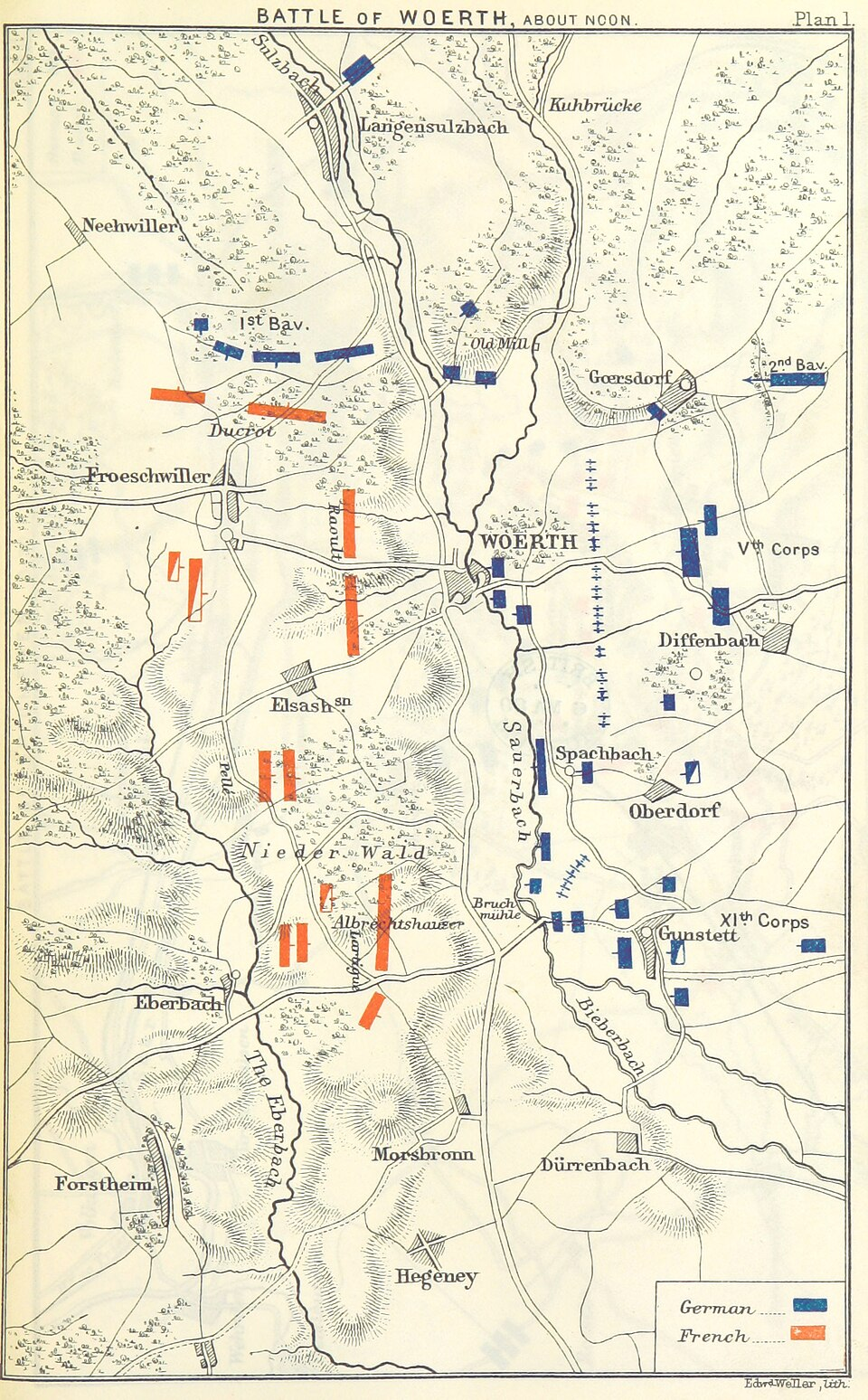
August 6th 1870 Battle of Worth Wargame Scenario

Warfare in the late 1800s differed significantly from that in the early 1800s. The technological advances in explosive artillery, rifling, mass production, and railroads enabled armies to move faster with greater firepower. The battle of Worth resembled a WWI battlefield more than a Napoleonic one.

North German Confederation
Frederick William
75,000 Infantry
6,000 Cavalry
300 Guns

France
Patrice de Mac-Mahon
32,000 Infantry
5,000 Cavalry
100 Guns

Wargame

Rules for this period are tough to find. Potentially American Civil War rules or Blue Bonnets and Tricornes.

Models Needed
25 Regiments of Germans, 10 Regiments of Cavalry, and 15 Gun Batteries
18 Regiments of French, 10 Regiments of Cavalry, and 5 Gun Batteries

For the Terrain, standard mid German terrain, fields, some boccage, small rivers and creeks, maybe a hill.

The French army should be deployed as one, whereas the Germans should be spread out throughout the area. However, when a German infantry unit is destroyed, then a new unit should be sent in from reserves.

The French should aim to inflict more damage on the Germans, while the Germans must consolidate their forces to achieve victory over the French.

August 4th 1796 Battle of Lonato Wargame Scenario

From August 3rd to 5th, it was a crucial week of action for Napoleon in Northern Italy. Nearly a dozen actions were fought, and at Lonato, Napoleon was almost captured. On August 4th, Napoleon was positioned near the rear with approximately 1,200 men. Austrian forces were moving to reinforce their positions when 3,000 stumbled upon Napoleon’s position. With a successful ruse, Napoleon forced the Austrians to surrender.

The actions of August 3rd and 4th allowed Napoleon to put his full force of 30,000 against the smaller Austrian force of 25,000.

France
Napoleon Bonaparte
20,000

Austira
Peter Quasdanovich
15,000

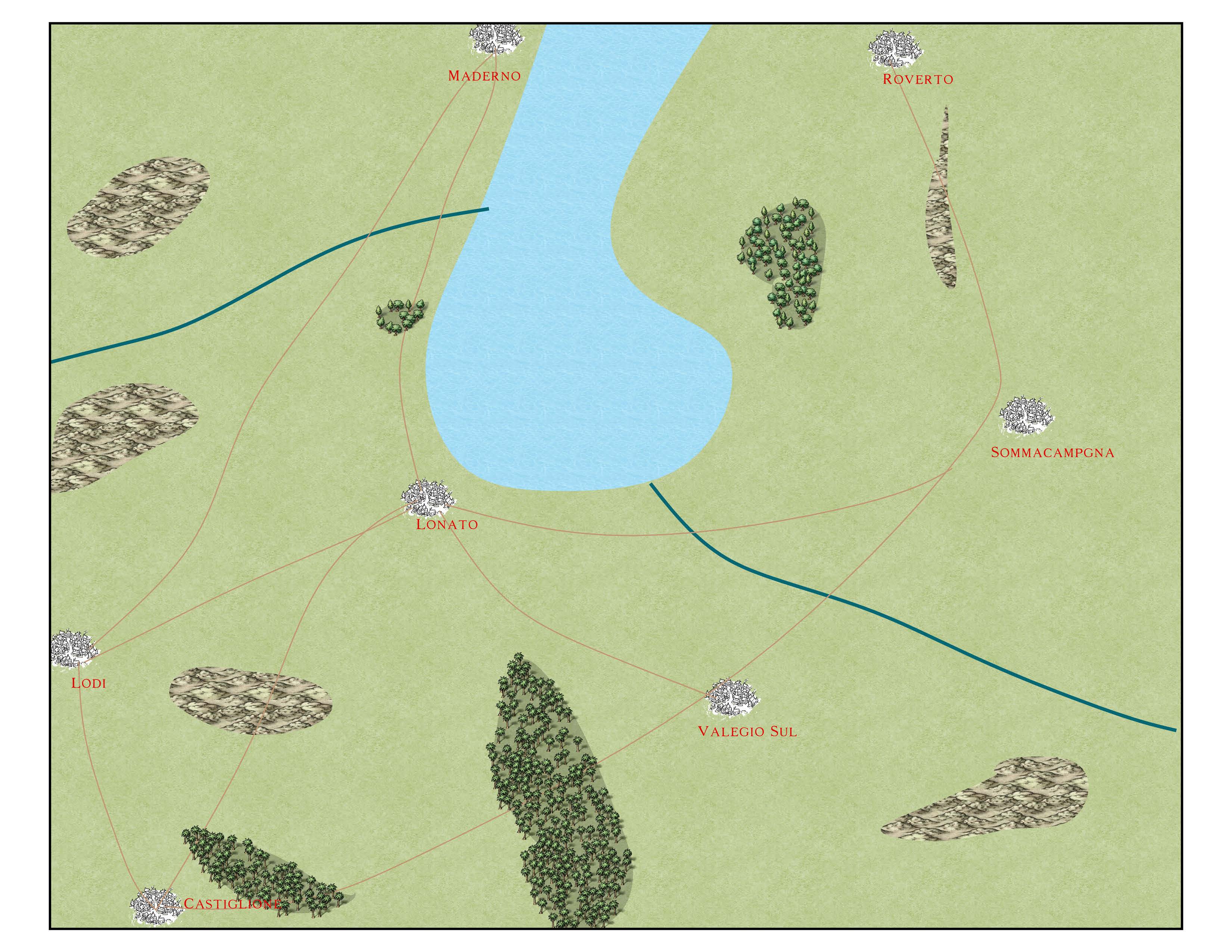
The actions at Lonato were spread over several miles, with divisions facing divisions rather than the whole Corps.

Table 16×4
French Forces 20,000 24 Battalions, 20 Squadrons, 4 Artillery Batteries
Austrian Forces 15,000 18 Battalions 16 Squadrons, 3 Artillery Batteries

The purpose of this battle is to know which objectives to secure or which to abandon. The map above is how the table should be set. There are 7 cities on the map; France must own 5 to win the battle and consolidate its forces for tomorrow’s battle.

The table should feel substantial, and it should be a challenge for different brigades to support each other on both sides.

August 3rd 881 Battle of Saucourt-en-Vimeu Wargame Scenario

I had two good options for August 3rd. There was the battle of Nordingen in 1645, but I felt like that would just be another Pike and Shot style battle. Instead, we went with the Battle of Saucourt-en-Vimeu. A fight between the Franks and Louis the Younger vs Viking invaders. The battle was memorialized in an old poem called Ludwigslied. The battle was one of the few pitched battles fought by the Vikings of that era, and according to sources, 9,000 Vikings were killed.

Phase 1: The Raids
We are unsure of the number of the battle, but I think a Saga Age of Vikings game would work nicely here. Set up your French village/countryside, complete with residents whom the raiders are terrorizing.

Balance the two forces evenly.

Objectives
The Vikings are raiders attempting to steal the goods/women from the town. The Franks are trying to prevent the theft. The Vikings must reach a home or a resident to seize the valuables, then retreat to the edge of the table.

Phase 2: Due to the Viking raiders, the Franks established an army to counter the invaders.

For this phase, use Hail Caesar or other DMBB wargame Rules
The terrain has heavy woods. Then set up a river with several longships that the Vikings must defend.

Establish two equally sized armies. The shield wall was the tactic of the day. The Vikings must defend their longships, the Franks must destroy them.

August 2nd 338BC Battle of Chaeronea Wargame Scenario

Before Alexander the Great took the ancient world. The Macedonian empire was already beginning to expand. Alexander’s predecessor, Philip II, grew to dominate ancient Greece. In one of his final battles, Philip faced off against an alliance of Athens and Thebes for the freedom of Greece.

The battle was decisive; the forces of Thebes and Athens were destroyed, and the war came to an end.

Macedonia
Philip II
30,000 Infantry
2,000 Cavalry

Athens/Thebes
Demosthenes
35,000 Infantry

Wargame
The Game is simple: use DBMM or another similarly balanced wargame. For the game, Alexander should take charge of the left flank with all of his companions deployed there, and Philip should have the right.

I built the Greeks with two principal commanders, one for each wing, as they had historically. The Athenians should take up the left, while the Thebans should take up the right.

DMBB Book 2 Alexandrian Macedonian400
C-in-C RegKn(F) (Philip)31
Sub-General RegKn(F) (Alexander)31
Companions RegKn(F) x666
Prodromoi RegLH(O) x210
Thracians IrrLM(O) x210
Pezetairoi RegPk (O) x40160
Pezetairoi W/ Javelines Reg Ax (O) x1248
Greek Allie Hoplites Reg Sp (I) x728
Greek Peltasts Reg Ax (O) x416
DBMM Book 2 Later Hoplite Greek400
Theban Reg Sp (S) 27
Athenian Reg Sp (O) 25
Hoplites IrrSp(O) x 70280
Javelinmen IrrPs (I) x3030
Slingers IrrPs(O) x510
Sacred Band RegSp(S) x428

Use the DBMM rules for terrain; however, the left flank of the Macedonians should have a river.

August 1st 1759 Battle of Minden Wargame Scenario

The United States knows it as the French and Indian War. Europe calls it the Seven Years’ War. From 1756 to 1763, a global conflict with battles fought across Europe, Asia, South America, Africa, and North America. The conflict pitted Britain, Prussia, Portugal, and Russia against France, the Holy Roman Empire, Spain, and Sweden. Both sides had over 1 million soldiers involved in the conflict.

The Battle of Minden wasn’t the largest, but it was pivotal in determining the victor of the war. Before the battle, France was in control of Hannover, and Prussia, along with the rest of their coalition, was on the brink of surrender. If Minden doesn’t happen, the world would be a much different place.

Great Britain
Hanover
Led By Prince Ferdinand
37,000

France
Led By Louis de Contades
44,000

Our wargame will focus on the center of the battle. During the actual fight, six British regiments (14 battalions) advanced on the main line of French Cavalry. Our wargame will cover this action.

Models Needed
British 14 Battalions, 2 should be light infantry, 2 should be grenadiers
French 6 Units of Hussars, 3 Units of Dragoons, 2 Units of Curiassiers

Wargame
2 Players
I used General D’ Armee
The British should not be allowed to form a square
Terrain, open flat ground with small hills

Objectives
Both sides, rout or destroy 50% of the opponents forces

July 31st 1917 Battle of Pilckem Ridge Wargame Scenario

On July 31st, 1917, the Allies made a Western Front push to seize the city of Ypres in West Flanders. The first part of the offensive was the Battle of Pilckem Ridge.

British Empire
Douglas Haig
13 Divisions

Germany
Erich Ludendorff
7 Divisions

Wargame
I would use a skirmish game, Through the Mud and the Blood, for a skirmish-level battle.
For a large-scale Great War Spearhead

Models needed – this depends on your collection, but ensure you have approximately twice as many British attackers as German defenders.

Terrain- Standard WWI Terrain with trenches, gun emplacements, no man’s land, barbed wire, muddy ground, building ruins, and rubble.

Table- 6×4 or 8×4

Scenario

The Germans have a small hill filled with defensive emplacements as a defensive line. The defenses have several layers. Place your British force on one table edge and the German trenches about the middle of the table. The German Trenches should have layers.

The British must seize the German defenses. The Germans should counterattack at any and all oppurtunity.

July 30th 1609 Beaver Wars Wargame Scenario

Most people are unaware of the brutal battles that occurred in North America during the height of the fur trade. Europeans exploited Native Americans across the continent to hunt, trap, and export valuable furs across the ocean. Various European countries allied with different tribes, providing them with weapons and armour to make war against one another.

The Beaver Wars were a series of skirmishes that occurred over approximately 100 years in the Great Lakes region. It pitted the English-backed Iroquois League against the French and Huron.

Wargame Scenario

I would use A Few Acres of Snow, Sharp Practice, One Brain Cell Rules, Blood and Steel

Set up, create a 4×4 board with 7 or 8 models per side. Fill the board with trees, lakes, ponds, rivers, streams, a cabin or two, and place fur markers or objectives around the map.

Models, Warlord has some native American skirmishers to paint and such. You can also use the generic plastic native american models you get from the dollar store.

Each side must identify the objectives and escort them off the table. You could randomly assign a value to each objective, and whoever wins the most value wins the scenario.

July 29th 1148 Storming of Damascus Wargame Scenario

On July 29, 1148, Crusader Armies fell back from Damascus instead of taking the city due to differences among the Crusaders. We are going to storm the city instead.

Siege battles are a challenge to wargame. You can never bring the whole situation to the table, considering all the walls, gates, towers, fatigue, starvation, civilians, and so on, into play.

Crusaders
Kingdom of Jerusalem
Byzantine Empire
Holy Roman Empire
Kingdom of France
50,000
Led By:
Baldwin III
Everard des Barres
Conrad III
Louis VII
Thierry, Count of Flanders

Muslims
Burids
Zengids
Led by:
Mu’in ad-Din Unur
15,000 Defenders

Wargame
Men of Iron, or The Art of Siege, or other Medieval Wargame that has good siege rules
2-5 Players
4×8 Table
Terrain, build a city with a second set of defenses. The weakest wall, according to historical records, is not a standard straight wall, but instead has several jags and curves to accommodate the landscape. The streets should be narrow, at most 1BW, and also not straight.
Models, build armies as they would have been historically; there should be a 2.5:1 advantage for the crusaders. Also, ladders and rams would be the primary siege equipment due to the short timeline.

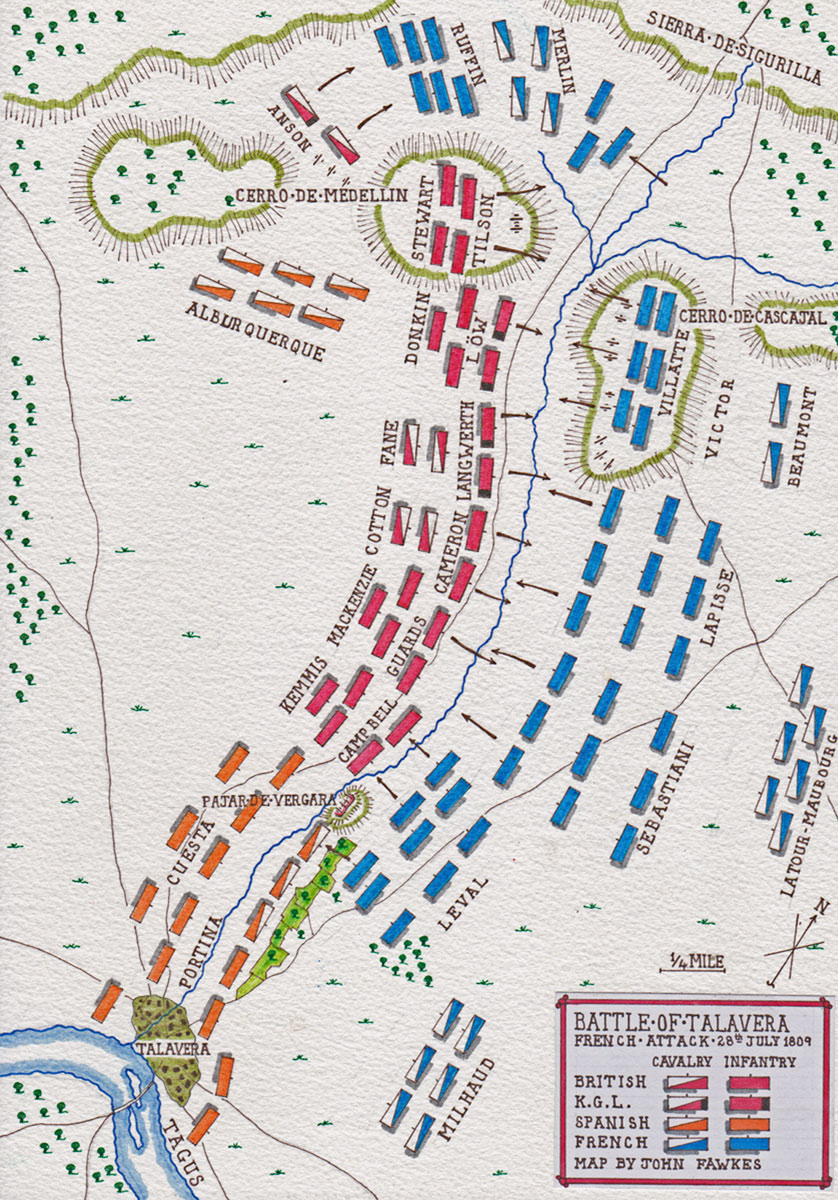
July 28th 1809 Battle of Talavera Wargame Scenario

My other favorite period of gaming happens to be the Napoleonic era. The Peninsula campaign can make for some great games with epic battles. On July 28th, such a battle took place where Arthur Wellesley began the campaign to retake Spain. Wellesley, as he did famously at Waterloo, forced an engagement, but played a defensive role in the battle.

France
Joseph Bonaparte (41 Battalions, 56 Squadrons, 13 Artillery Batteries)
46,138 Soldiers
80 guns

Britain
Arthur Wellesley
26,641 Soldiers (30 Battalions, 24 Cav Squadrons, 4 Artillery Batteries)
30 Guns
Their Spanish Allies
34,993 Soldiers (34 Battalions, 24 Cav Squadrons, 4 Artillery Batteries)
30 Guns

As usual for the Wargame simulation, I would recommend using this order of battle. https://en.wikipedia.org/wiki/Battle_of_Talavera_order_of_battle

Wargame
2- 20 Players (If more than 3 use an umpire). Each player could easily control a division, corps, or faction.
Rules, General D’Armee, or any other large-format Napoleonic Wargame
Table 16×8 for 15mm, smaller for 6mm
The terrain is arid, with some bluffs; the river did not really apply much.
Use the order of battle to determine troop quality. It could help balance the game by making the Spanish closer to the militia.

Scenario
The French should be the aggressor and attempt to move the British and Spanish forces from a defensible position. The French should have a higher quality of troops than the Spanish.