July 6th 1809, Battle of Wargram Wargame Scenario

The Battle of Wagram was one of the largest battles of the Napoleonic Wars. Napoleon took six weeks to prepare his offensive against Vienna, assembling an army of French, German, and Italian troops, 150,000 strong. Austria responded in kind, fielding 170,000 soldiers with 388 guns.

The battle was costly on both sides, with over 80,000 total casualties. Day two featured an interesting early engagement. An Asutiran column with 32 battalions, 40 squadrons, and around 60 cannons attacked the French flank. The French III Corps under Davout commanded 31,600 soldiers, 6,200 cavalry, and 120 cannons.

Both sides were to call reinforcements to the area. Our game will start in the early hours of the morning and proceed.

Rules: Use any corps-level Napoleonic Wargame Rules, ours is set for General D’Armee

2-4 Players

Models Needed: 34 French Battalions and 50 Squadrons. 50 Austrian Battalions and 40 Squadrons. 10 French artillery stands, and 8 Austrian Artillery Stands

Table Size 12×4

Terrain. Generally flat. The French should start with a height advantage while the Austrians assault.

Objectives

The Austrians surprised the French in the early morning hours, but underestimated the French numbers. Their goal will be to seize a French command post behind the French lines. The French must counterattack or the Austrian reserves will come into the field and overwhelm them. The French goal is to push the Austrian forces back to the heights.

Set-Up

The French should be in two separate commands, one for each Flank. Each command should have 12 battalions and 10 squadrons with four batteries. The remaining battalions should be in reserve. The Austrians should start on the offensive with 32 battalions in two columns on the table, along with the 40 squadrons. Each column should have three batteries for support. The remaining Austrian forces should be in reserve.

Special Rules

Reserves. Napoleon noticed the threat of the flank attack and sent over his heavy cavalry reserve. These should begin to enter the table after the 4th turn on a 6, then a 5, and so on.

After the 7th turn, Austrian reserves should enter the fray.

June 21st 1529 Battle of Landriano Wargame Scenario

From 1494 until 1559, the Italian wars raged across central Europe. Two major powers, France and Spain, each claimed the various Italian Kingdoms. In 1529, the French were near defeat, and the decisive engagement at Landirano ended the French efforts until 1536.

French
Comte de Saint-Pol
12,000 soldiers and cavalry

Holy Roman Empire and Spain
Antonio de Leyva
16,000 soldiers and cavalry.

Wargame.

It is tough to research to get an exact order of battle, but I would recommend using the following: the list gives you a cavalry-heavy list vs an infantry-heavy list.

French Army; 134

4 Units of Capagnie d’Ordonnance (heavy cavalry) 32
3 Units of Ordonannce Archers (lancers) 12
2 Units of Stradiots (scout cavalry) 8
2 Units of Argoulets (melee cavalry) 8
6 Units of Aventuriers (skirmishers) 18
6 Units of Bandes Francaises (Pike and Shot) 48
2 Medium Guns 8

Holy Roman Empire 133
3 Units Gentes d’armas (heavy cavalry) 24
6 Units Spitz (Traditional German Pike and Shot) 42
2 Units Jinets (scout cavalry) 10
2 Units Colunela (Spanish pike and shot) 18
2 Units Veteran Colunela 22
2 Units Spanish Arquebusiers 10
2 Medium Guns 8
1 Heavy Gun 5

Wargame Rules, Tilly’s very bad day, or Renatio Et Gloriam, or any other mass Pike and Shot wargame.

Set-Up,
8×4 Table
Up to 4 Players
The table should have two rivers that merge into a delta on one short edge. Both rivers should have multiple crossings and fords, with one main road and bridge connecting the hamlet. Between the rivers should be a large hill, where the primary fighting took place historically. The rivers should have ample vegetation along their banks.

Objective

The French Army is on the retreat, and the Holy Roman Empire forces have maneuvered to cut off their retreat to Pavia. The Holy Roman Army should be moving from the table’s edge away from Pavia, while the French should be attempting to reach it.

A Comprehensive Guide to Wargame Terrain Part 8 (Final Part)

For the first 7 parts of this series, click here.

Today, I want to discuss the most expensive aspect of wargame terrain. Premium options. These come in several flavors.

Overall, I have enjoyed writing this series. If you want more in-depth reviews of any products, let me know.

Games Workshop Kits

Why am I putting GW kits here? I think they are overpriced. They look absolutely stunning on the tabletop, but the amount of detail that goes into a simple GW kit you have to paint is astounding. Price per item, GW is the worst option.

The simple GW landing pad, as simple as it gets, is $80. The same terrain piece can be 3D printed from Etsy or another source and shipped to you for $30. GW has to be careful or they will price themselves out of the hobby altogether.

Enough on my rant now, to other premium options I actually use.

Rampart Terrain

Instead of buying overpriced GW crap, I love using the fully modular Rampart terrain system. It can be magnetized, has nearly as much detail as GW kits, and is far more functional. The biggest challenge with Rampart is using your imagination to create amazing builds.

Kallistra

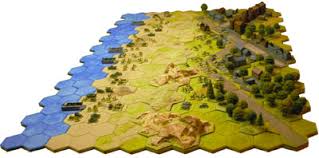
You can’t go wrong with the Kallistra system for creating historical battle boards. It’s a custom hex battlefield with numerous surface types: hills, mountains, rivers, craters, roads, and bridges. I use Kallistra hexes in most of my historical conflicts and am happy to do so. I have an epic D-Day battle planned one day, and Kallistra Terrain will be the star.

Dwarven-Forge

It is the cream of the crop for terrain. Its modularity is fantastic, and it is stunning on the table. However, I can’t recommend it for most wargames. The scale is just a little off. It is wildly expensive. I have, I think, every set they ever produced. I love my Dwarven Forge. Price is getting to be an issue with their latest sets.

Green Leaf Terrain

A custom terrain building from Canada. I have personally commissioned 5 projects from Green Leaf. His creations are often shown on MiniWargaming. They are some of the best custom terrain set-ups around. Send him a project and he will make something special.

Table-Top World

It’s not as diverse as some of the other options. The creators at Tabletop World put together some stunning resin pieces. Unfortunately, they are no longer producing models. If you can find them, buy them.

Custom Etsy Creators

The rise of Etsy has been huge for the wargaming hobby. I use Etsy for many of my unique pieces. You can spend as much or as little as you want. You can acquire whatever you want. It also helps small hobbyists like ourselves. Just be aware that sometimes what is sold isn’t what you expected.

Gamemat EU

I only have one set from these guys, but they are highly regarded and reviewed.

Tabletop Titans

The first of two pop-up terrain options. I prefer Acidhouse for its modularity. But there is a place for a fully functional battlefield in a few seconds that packs beneath a bed. I personally own every single set and enjoy using them on the table.

Acid House Terrain

My other flatpack option for wargame terrain. It is highly modular, but durability can be questionable. I think I own every set they have ever produced.

Tenfold Dungeon

Tenfold has decent terrain for Dnd or Boarding actions. I wouldn’t build a table with it, though.

Up-Zone

My final option for a pop-up terrain. It’s fine, just not special.

Pre-Painted MDF

One premium option I don’t like to use, but I acknowledge is a popular item, is pre-painted MDF terrain. I find MDF finicky and fragile.

https://www.deepcutstudio.com/product-category/scenery/
https://blacksitestudio.com/collections/mdf-terrain?srsltid=AfmBOooOCvpg6VhRo6SWBtgnIrfW2Ry17oeULgyOcQpKcGNNUBxfXrrX
https://store.frontlinegaming.org/collections/flg-full-color-terrain?srsltid=AfmBOoqBOqrofvrbrnTbQTT8ORmSpMQcylLIxBkG-V6a_ruFBsnx-OX4

A Comprehensive Guide to Wargame Terrain Part 5

Feel free to look back at parts 1,2,3,4. Part 5 will focus on scatter terrain and other enhancements.

Scatter terrain is simply items scattered about the battlefield that add flair but not much to gameplay.

Scatter terrain has a special place in my wargaming soul. For photo-realistic games, scatter terrain is crucial to what we do as gamers. Why would we have a ruined structure with no rubble around its base? A WWII Battlefield with no impact craters? Fences and hedges in the Civil War and European battlefields.

The other aspect of scatter terrain is how it impacts gameplay. In 40k, a Land Raider can’t end its turn on top of a piece of terrain. If we add too much scatter, the game stops working. The same works for your rank and flank games; a fence is hell when dealing with a movement tray.

Why Use Scatter Terrain

As challenging as the scattered terrain is, it looks good on the table. Broken bits of concrete with rebar sticking out, damaged furniture, burned-out cars, and an upturned cart with a dead horse are all staples in cinematography. If you want a gorgeous table, scatter terrain is a must.

Scatter is also amazing in small skirmish games. A couch in the middle of the street becomes a cover piece in Bolt Action. Marvel Crisis Protocol lives or dies on scatter terrain pieces. A new flair is added to a caved-in ceiling on a boarding action board.

I swear by adding telephone poles and street signs to any battlefield. It just adds that extra something.

Where not to Use Scatter

Any large-scale wargame designed to be more competitive struggles with a ton of scatter added. Even less competitive but still large-scale don’t work well. Flames of War, Genera D Armee, Across a Deadly Field, DBMM, The Old World, Conquest, Age of Sigmar, and 40k don’t need scatter terrain. Stick with what the rules call for.

Best Types of Scatter

You really have to think about how you want your game to feel. Scatter that doesn’t interfere, but also has to have a purpose. Hay bales and wood piles provide cover. The same with burned-out cars. Piles of bricks just get in the way and are difficult to clean up post-game. Small, fully-painted flower gardens look nice, but don’t add to gameplay. However, a concrete sidewalk next to a city street in a modern zombie game adds so much to the feel of your table and doesn’t hinder gameplay in the slightest.

Street signs can be removed if hindering, but they look nice for photos.

My ultimate pick for scatter terrain is stuff that can be easily set up and cleaned up.

I generally only set a table for two or at most three games. I have full respect for players who go all out and spend 100 hours creating a custom table for Lord of the Rings or World War Z or whatever else. Every piece of terrain and scatter is meticulously painted, and the photo ends up in some magazine.

That’s not me. I want a functional table to play on that looks nice. End of story. If you are the type of player who wants a photoshoot-quality table, this isn’t the best guide for you. If you just want to level up your table from bleh to meh. Take my advice.

A Comprehensive Guide to Wargame Terrain Part 3

Now that you have played a few games, are tired of stacks of books and hardboard cutouts, and want to take the next step, I still don’t recommend breaking the bank; let’s look at budget starter terrain.

Most of this terrain will come pre-painted, limiting your upfront time and money investment. This gives you more time for gaming.

My #1 recommendation will always be aquarium terrain.

Rocks, ruins, castles, and plants—all for less than you will spend on two or three paint bottles. Ten or so good pieces will give a very nice-looking 6×4 table with interesting and varied terrain. The biggest con is that aquarium terrain is rarely thematic or scales with the models on the table. (table cost $140)

My following recommendation is to go take a walk. Find some public property along a riverbank or in the woods, grab 10 or 12 interesting rocks/pinecones/logs, and place them on a table. This terrain setup can actually be very thematic and fit your table. (table cost $0)

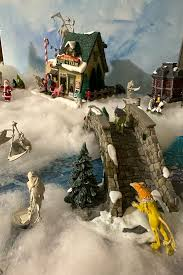
Another budget item is to visit thrift shops and church stores and look for Christmas village items. This is a great way to get a handful of buildings, perhaps a bridge, and some trees.

The terrain tends to look okay. Your battles can be pretty interesting, and you can even do fun missions, such as escorting Rudolph to the flying sleigh. The biggest downside to Christmas terrain is that it is primarily sealed, and your troops cannot occupy the buildings. (table cost $30-$200)

Trees for Christmas villages could be a category of their own. Often, these are the only trees I use. They look far better than I can make, and they fit the scale wonderfully.

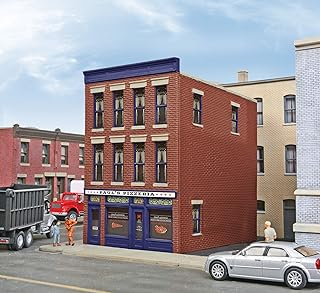
My final recommendation would be to buy model railroad building kits.

Many buildings can be had for $15 or less. You can paint them however you like. They are very accurate to scale if you buy the correct scale. There are endless possibilities. My most significant downside to model railway items is there is a time investment and a hobby side. Most buildings require assembly and painting. The other con is durability. The model railway is for building models that sit and look pretty, not for gaming with frequent movement and other forms of abuse. (table cost $200-$400)

That is just a quick look at the options for terrain on a budget, for a burgeoning wargame. Tune in next time for information on gaming mats and other 2d terrain.

A Comprehensive Guide to Wargame Terrain Part 2

You have played a few games, enjoy the hobby, and want to improve your tables.

Hooray. Terrain, as I will say, 100 times makes the game better. It is not required, but it sure is fun.

At this stage, I will avoid discussing 3D printing. I know what is out there and how amazing it is, but we are beginning hobbyists.

A Note on Scale

Wargames can use a variety of scales. Scale is determined by the height of a figure from the bottom of its feet to eye level. Warhammer models are about 32mm, so they are 32mm scale. Bolt Action is closer to 28 mm, while Marvel Crisis Protocol is 40mm. (aka Captain America is 40mm from his feet to his eye)

Scale matters when it comes to terrain. If a standard rifleman can stand, look over a building, and shoot, it detracts from the immersion. Consider this if you make or buy your own terrain. The type of game you are playing also matters. Epic Battles from Warlord games is about 10mm scale, designed for large, medieval conflicts with a couple thousand figures on the table. Narrow streets and cramped buildings wouldn’t be fun to play on.

The same can be said for Bolt Action, a 28mm WW2 game. The average army has about 30 figures and a vehicle. This game plays much better with more terrain, buildings of different heights, etc. It does not play well on an open plain with a small river.

If purchased for Epic Battles, the same river might be the width of a battalion, 150 or so yards across. In Bolt action, that same battalion is shorter than a typical Tiger Tank and little more than a stream.

It’s just something to think about. Most players I know won’t care if the house is about the same size as a Landraider or if their noble knight is just a little bigger than the door he is guarding.

What Terrain do I need?

This entirely depends on what game you are playing. Rivers don’t make sense if you play Battlefleet Gothic, a game in outer space. Like Grimdark Gothic ruins don’t make sense in the Wild West.

I always recommend starting with the basics. Roads are universal, and scale doesn’t matter much. You can buy some fabric from a local store and cut them out yourself (the cheapest option). You can paint and use cardboard, buy the neoprene roads from Amazon (my top choice), or even look at premium custom-made or 3D-printed options.

The entire above paragraph can also be said about rivers. Add a bridge, and you can have an exciting engagement. Most games allow faster travel along roads, and rivers are always an effective barrier or defensive structure.

Next time, I will add some vegetation; hedgerows and trees are universal among the wargames I played. Star Wars Legion, Flames of War, and Napoleonic all need some vegetation. Adding cover and breaking the line of sight always looks good. I have some expensive custom-crafted trees. I prefer trees for your Christmas village or the bulk boxes of fake trees you can buy on Amazon.

Hedges have always seemed a little trickier. These matter for scale, as a soldier shouldn’t be able to see over one, but a vehicle or mounted knight should. They are also a little harder to find. My favorites are plastic and 3D printing, but you can also find premade ones on Etsy. If you want to try making your own, a few YouTube videos and a trip to a craft store should yield good results.

I also think stone walls are reasonably universal. I use mine in dozens of games; they never go to waste. I buy mine on Etsy, but Amazon and 3d print shops also yield good results.

More Specific Terrain

At last count, I have armies for 47 different miniature wargames. I strive to make my terrain as universal as possible. I don’t add Soviet propaganda to my 15 mm buildings because I also used them in the Napoleonic and Ancient periods. If you’re just starting out, I recommend building one table first.

When building a table, look below at the types of games and terrain needed. Don’t worry about walls, fences, or many buildings if you are playing 15 mm Napoleonics with 400 figures on the table. Instead, focus on hills, fields, and forests. If you bought a kill team and want to expand into an entire 40k army, a grimdark ruin (3d print please) with several floors and bits of scatter is more thematic.

As always, buildings and vegetation are unnecessary if you are playing a space game like Billion Suns or a water game like Black Seas.

Types of Games

I classify boots-on-the-ground Wargames into four categories: Squad Actions (10-14 Figures), Skirmishes (20-50 Figures), Army Actions (100 figures plus), and ranked soldiers. There are other categories for naval, space, and airplanes, but that’s how I do it for boots-on-the-ground.

I know you may balk at this, but think: A squad of 10 men may fight over a house, a platoon of 60 men may fight over a compound, large structure, hill, or bridge, and an army will fight over a town or range of hills.

In squad actions, scatter terrain is vital. Broken furniture, light poles, crates, rubble, craters, computer terminals, and market stalls. When you only have 10 figures on the table, you can take your time to enhance some of the details. It generally leads to much more interesting games.

In skirmish games (think Age of Sigmar), you have a force of units on the table and generally move a few models around as a unit. No one would consider your 40-man army a full invasion force, but they look great on the table and strike a nice balance of hobby and playtime. Scatter is less critical here than elevation and line of sight. It rarely comes into play and is often just inconvenient.

In my book, army actions are typically reserved for historical events. I rarely consider using figures larger than 15mm in an army action game. This is when actual land features start to play: hills that hold entire battalions and dozens of cannons. A single fence or wall is inconsequential; the layout is more important. A forest that hides 3,000 troops, a river you can’t just walk across. A hill is several hundred feet high that overlooks a large camp. These are the types of terrain you should be working on. Unfortunately, most of these need to be crafted.

Finally, there are rank-and-file games: Warhammer Fantasy Battles, A Song of Ice and Fire, Kings of War, and Conquest. They want to act like army games, have the model counts of skirmish games, and are exceptionally difficult to move around. I treat them like army games, but I also push for utterly flat terrain. It doesn’t look as nice, but functionality is most important for the game’s playing.

Conclusion

Hopefully, this guide will help. Stay tuned for part 3.

A Comprehensive Guide to Wargame Terrain

Greetings, new (or seasoned) wargamers, and welcome to my guide on wargame terrain. I want this guide to be very in-depth but spread over multiple parts. I love the terrain. It is wargaming, more so than the models themselves. I have spent fortunes on terrain that I am proud to have on the table. Click here for the rest of the series.

What is Terrain

In Wargaming, terrain is simply something we use to avoid battles on flat surfaces. Looking back through historic battles, terrain plays a starring role in how the battle shapes out: Germanic tribes ambushing Roman legions in dense forests, fierce fighting in Stalingrad over a grain elevator, and even the shallows at the Battle of the Nile.

When we play wargames, depending on the game, the terrain will change how our models move about the battlefield. There are games where terrain is a significant part. Rules for elevation, river crossings, and trenches all factor into our generalship. Hours are spent discussing target priority, strategic usage, and ideal lists, but using terrain is even more critical.

Getting Started

There are levels upon levels of terrain available for purchase. You can make it yourself, 3d print it, buy 3d prints, complete terrain kits, fully painted items, use non-traditional items, get fully custom-made-to-order commissions, purchase modular build kits, and endless other options.

But let’s say you bought a starter set, and you are tired of your miniatures shooting at each other across empty space. Maybe you have watched a video online about how to play your newest game, and they have these handcrafted realistic buildings, luscious grass, LED lights, flowing rivers, and jungle canopies. You look on Etsy and see this terrain set for $1,000. You put your miniatures away in a box, ending your wargame experience.

You don’t have to have beautiful terrain to wargame. If you are so overwhelmed by your first games by the sheer amount of options and all the shit you have to buy, it’s impossible to love the hobby.

In fact, if you are curious about wargaming, I would advise printing out paper models and paper terrain and getting a game started for $20 and an hour of work rather than $2,000 and 100 hours. Most games have a free ruleset available as a PDF for starters. See if you enjoy the game part. Then maybe visit a local game store. (My town of 7,000 has one; I’m confident the internet can help you.) Most stores have terrain you can use and tables to play.

Your First Terrain Set-Up

More people play casually at their kitchen table with their kids and friends than in a store with dozens of others. Stores are intimidating. You don’t want to ask for help or feel clueless. Gamers will walk in with backpacks filled with the latest and most fantastic devices and commission-painted armies, and you have a mound of grey plastic. It’s ok.

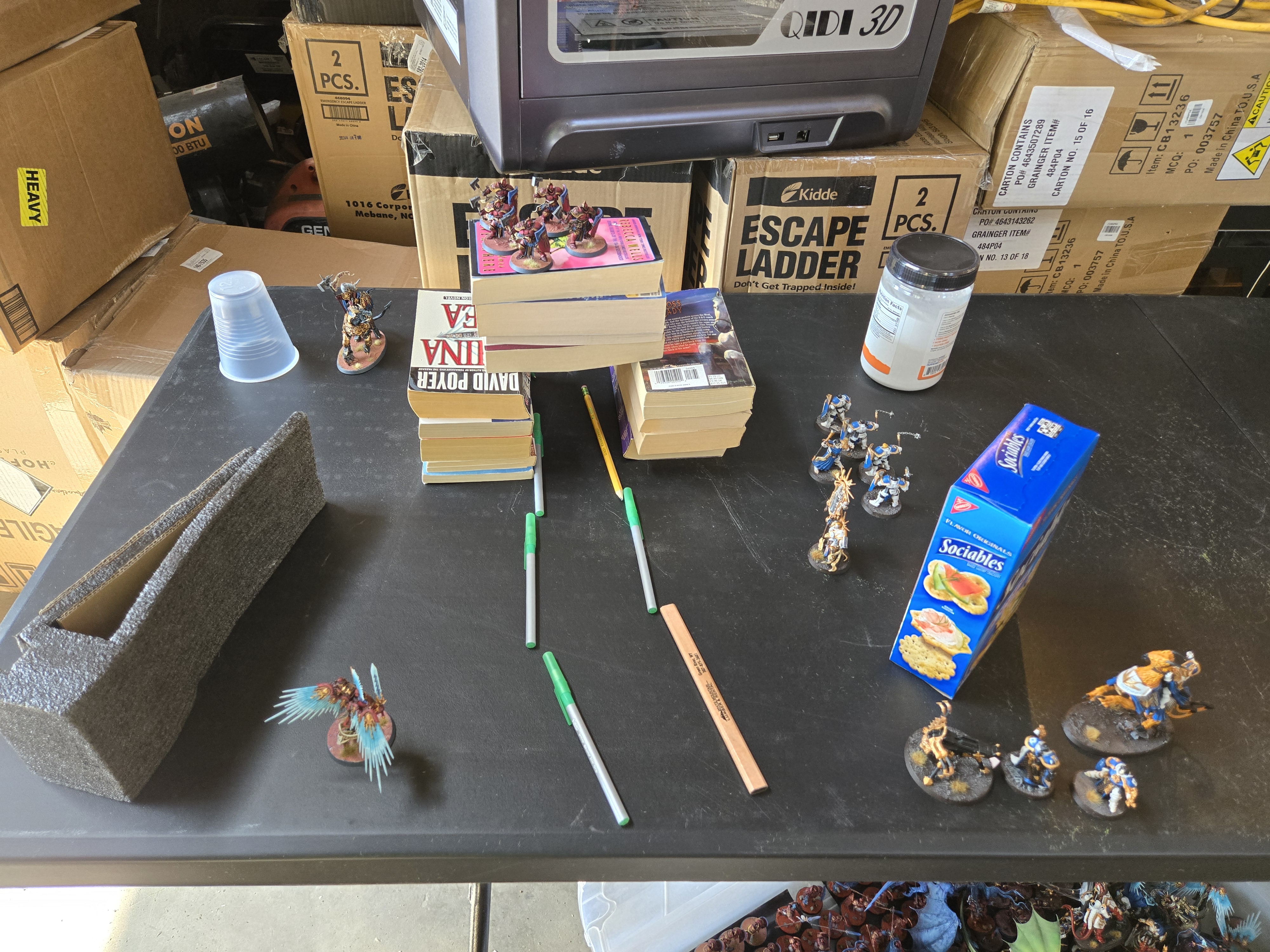
Feel free to use books, pots and pans, CD cases, cups, and mugs when playing at home. Break out a piece of paper and draw a river. It will serve its use, and honestly, books as buildings and hills are far more functional than most wargame terrain you may buy.

You want your terrain to be varied but balanced, not giving one side an advantage. One side has a stack of books overlooking the entire battlefield; the other should also. One side has a mousepad minefield, and maybe the other has a blue dinner plate used as a lake to restrict movement. You want your space between terrain to be large enough for the most prominent units to pass through most areas. You want a few areas with long sightlines so your snipers and other shooty units can shine. You want others with tight corridors so melee units can charge and have a go.

The models with the most significant footprint tend to be the most important. It wouldn’t be a fun game if your shiny new tank couldn’t drive anywhere. Below is a setup I did while writing this article in my shop with stuff from my desk.

It looks just fine and is more functional than many of the fancy boards I have played on.

A Table

Warhammer, Marvel Crisis Protocol, Bolt Action, all have a recommended table size. Here is the kicker; it’s not required. Any coffee table, kitchen counter, or floor is acceptable. The most critical piece is to play the game and have fun. If we are not enjoying ourselves, then why waste our time.

If you really, really, really, want to buy a table, to start, buy the 30″ by 30″ folding card table for $15 at Walmart. It’s functional, large enough to play 750 points on, and if you decide against gaming long-term, you can use it for something else.

I prefer a table you can sit at. Also, this is just me. Having alternate surfaces to store dice trays, rulebooks, army boxes, and other items that we wargamers seem to think we need to successfully eliminate the enemy.

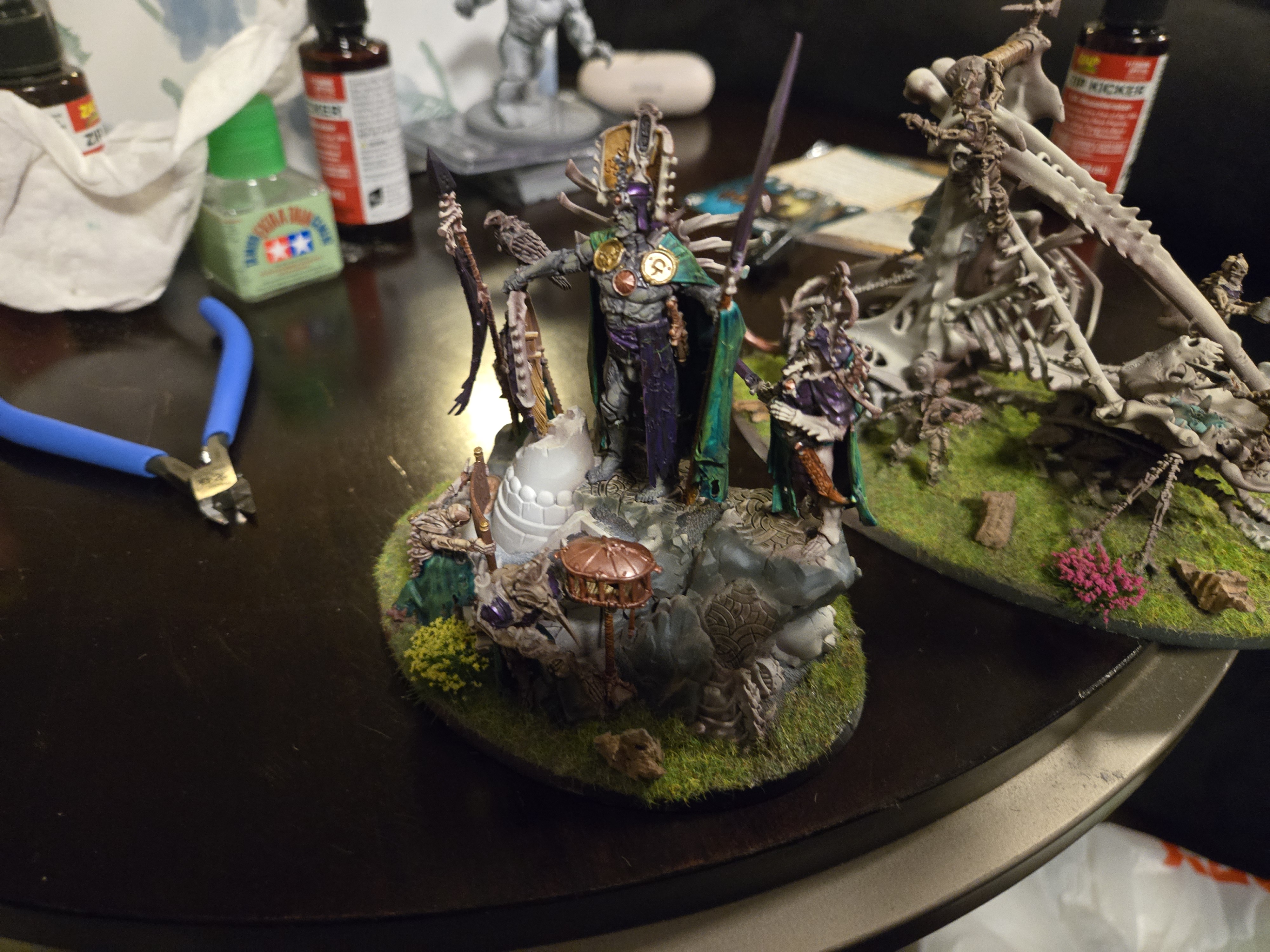
Bonereapers Painting Project

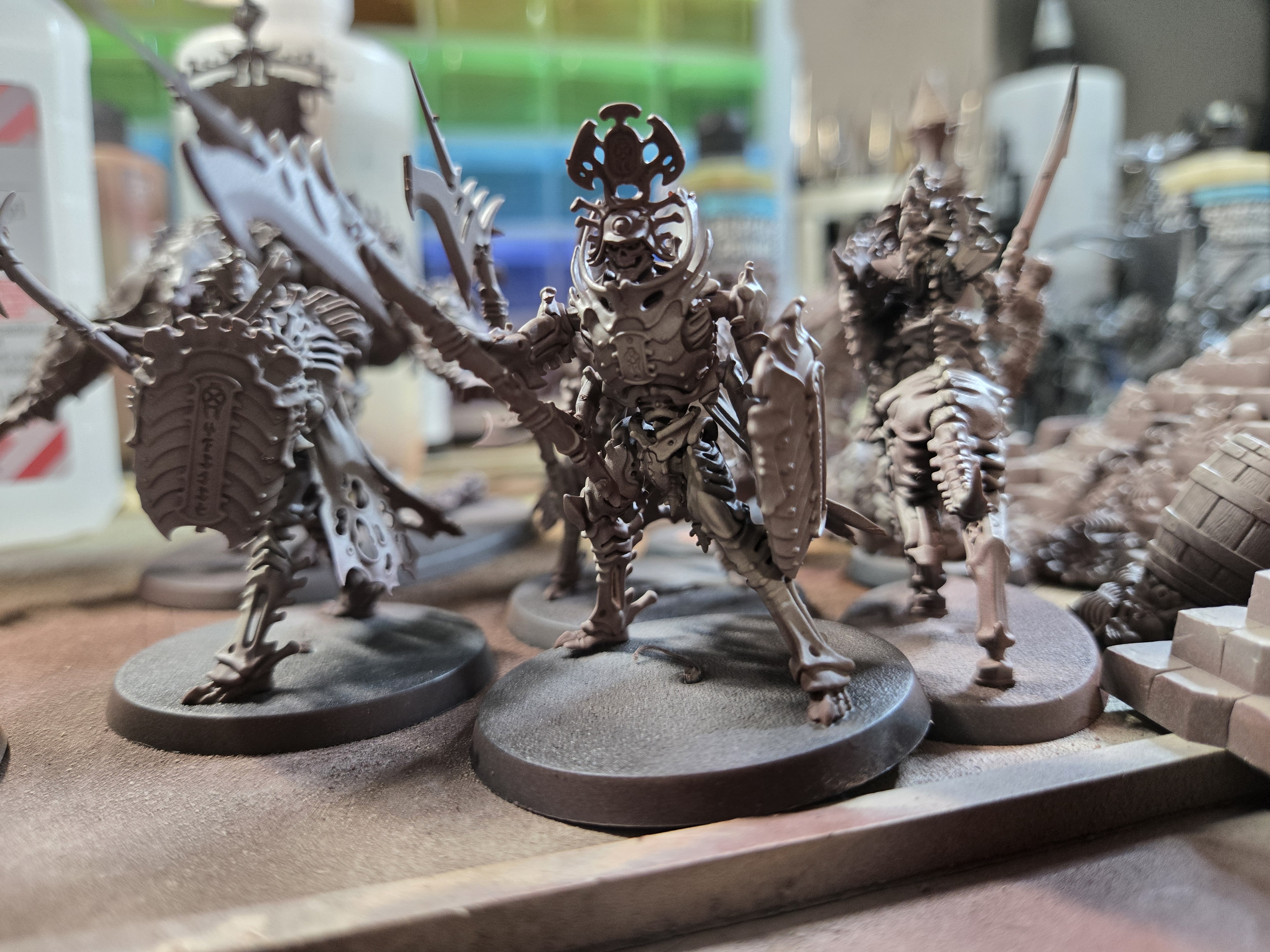
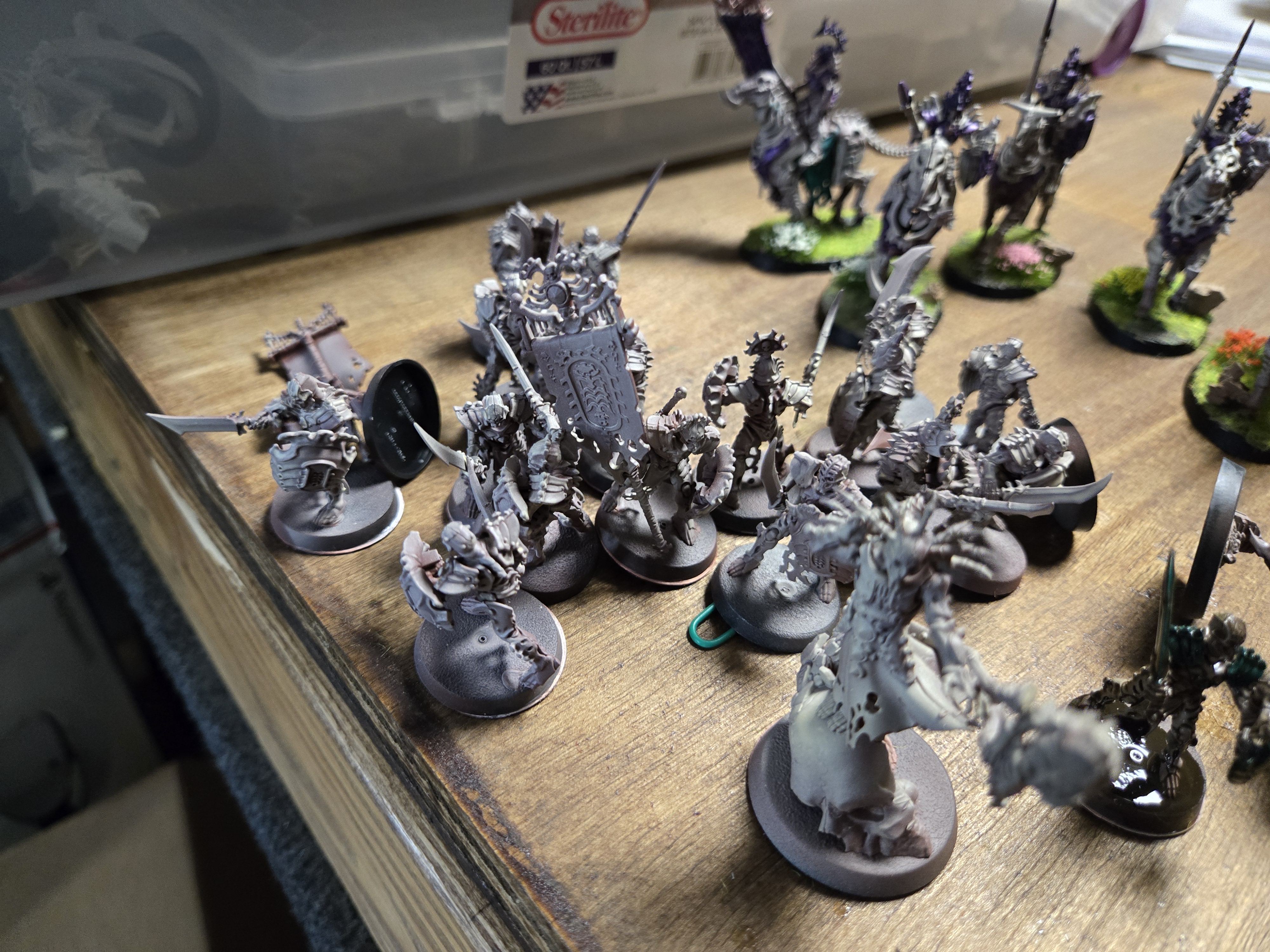
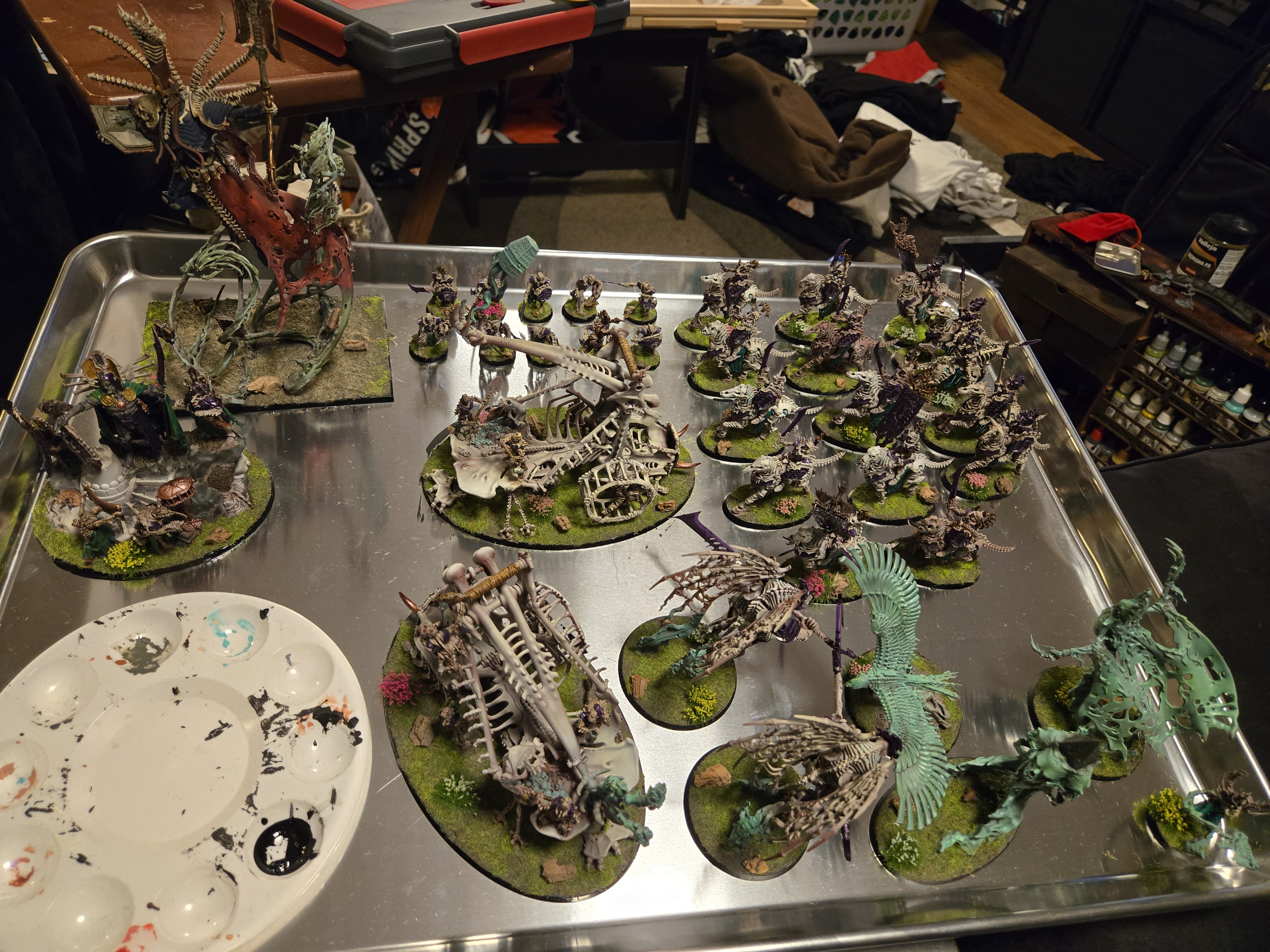
My local gaming store wanted us to do an Age of Sigmar league. One of my goals for the year was to get more Sigmar models on the table and painted. This was a prime opportunity to move on from some of my pile of shame. Many of my armies have 500-1000 points; some even have 2k points. The Bonereapers were 100% grey.

This project has been fun to work on. I plan to bring a different 2k list for each round. Just to give me more opportunity to fill out the model selection.

All models started with a prime of Vallejo Primer German Red Brown. I then zenithaled with a desert tan.

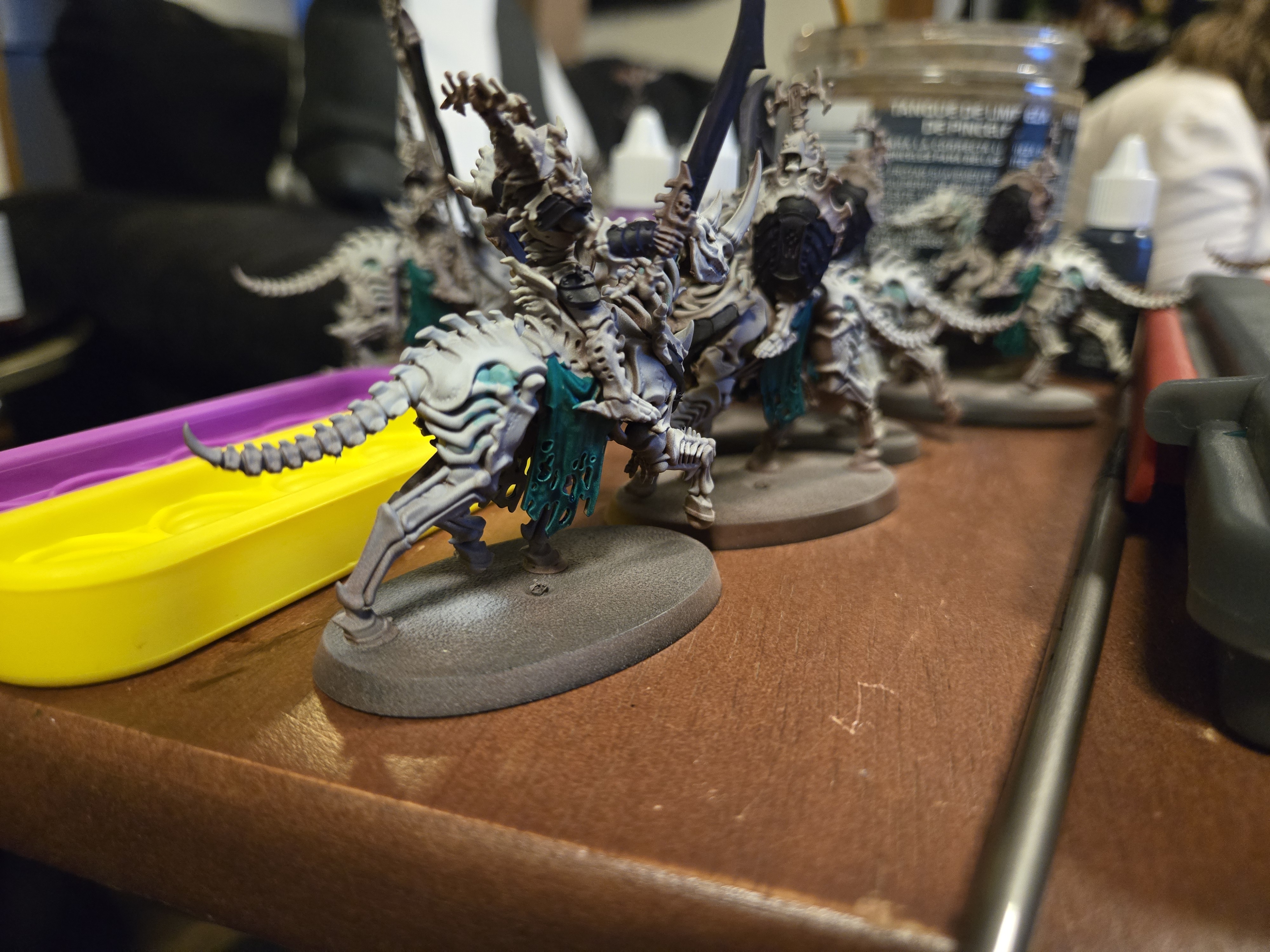
I am happy so far. I wanted to follow Kenny Bouche and take it up to 11 with the airbrush. After one batch of Deathriders, I decided that the bone didn’t pop enough. So, I took all the bone I could and mixed half desert tan and half white to brighten the effect. After that, I just applied a dab of white ink to most of the models from directly above.

You can see a little difference here where I hit the models with the white vs. just leaving them desert tan.

Many of the models have cloth that hangs off the saddle or dangles between their legs. I wanted a contrasting color but didn’t want to spend much time on it, so I used contrast paint Aeldari Emerald with a dry brush of Talisman Green.

Between the bones, I just dabbed a bit of Citadel Nihil Oxide. It’s the same color on my night haunt, and I appreciated the spooky effect.

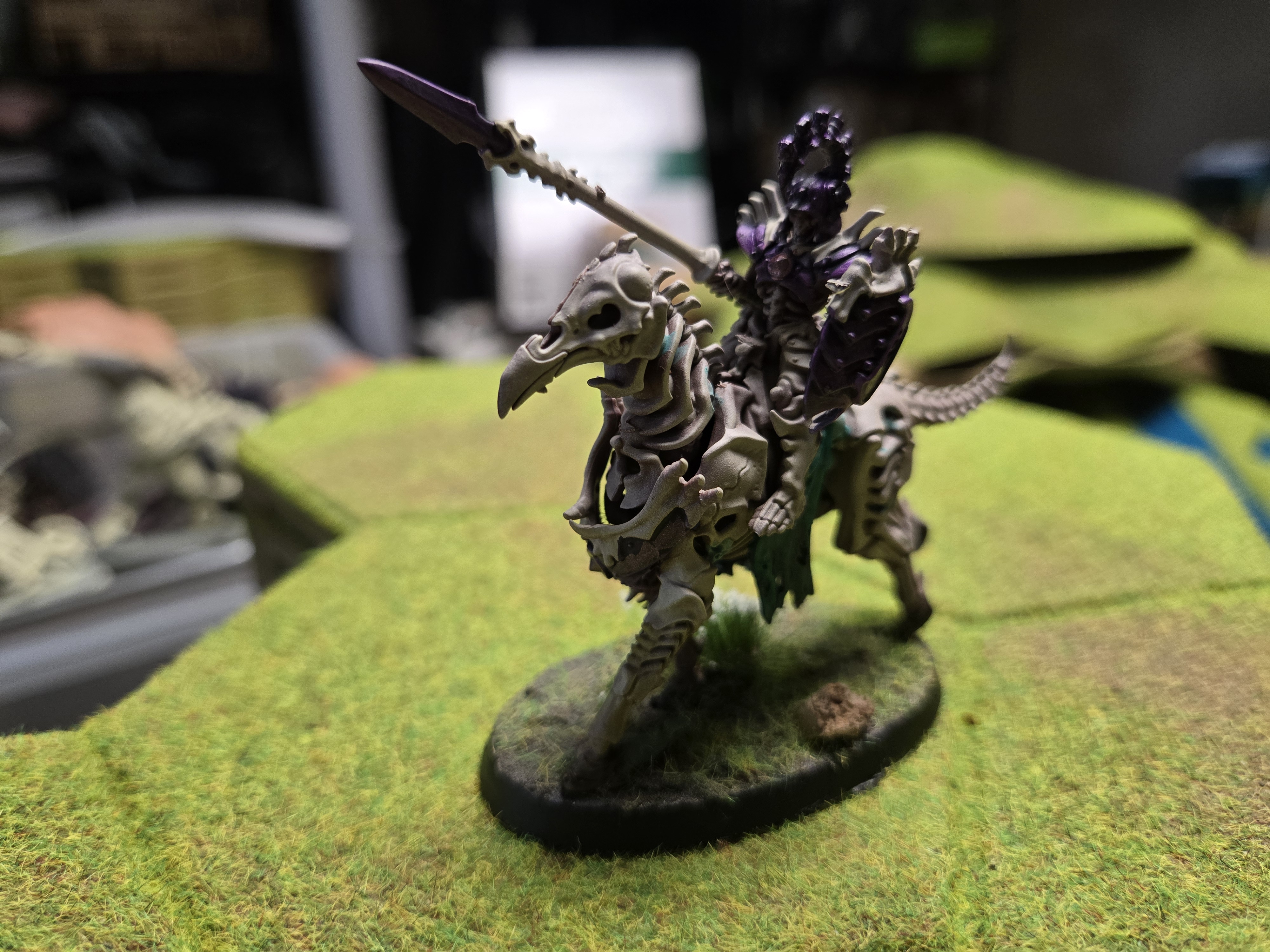
I wanted to take my time on the purple. I haven’t ever enjoyed layering or edge highlighting and these seemed like lovely models to try it on. All purple used the Two Thin Coats. Shadow Von Evil Purple, mid-tones were Emperors Purple and edged using Spectral Purple. The colors gave a nice metallic finish.

For basing I wanted the models to look like they were running through a meadow.

Simple mud texture paste, some flowers and cork rocks and flocked with a strong green grass. The only model I didn’t do this for was Nagash. I took a circle around his model and used a dead flock, and then on the edges of the circle, it was green.

Very happy with Katakros.

This image shows the difference the white highlight made on the bones. Look at the cavalry at the top right.

On the crawlers, I actually washed the skeletons that were manning the catapult just to give them an obviously different color, and help them stand out.

The endless spells were 100% airbrushed. Not sure of the recipe, but absolutely love how they turned out.

2024 Year in Review

Wow, has it really been 2 months since I posted last. I have not been idle. Just lazy on the writing front. Sometimes, I think I get anxious about not doing what I am supposed to have done, and then I fall further behind. I will make several posts showcasing my accomplishments over the last two months. A half a dozen games and a fully painted Tyrranid list.

My resolutions for 2024 were;

  1. Complete Horus Heresey Word Bearers Army
  2.  Complete through scenario 15 of the Stalingrad campaign
  3.  Complete a Warhammer Fantasy Army, either high elves or Beastmen
  4.  Inventory my terrain
  5.  Spend less money and focus more on 3d printing
  6.  Paint 6 Skirmish forces, either Warcry, Necromunda, Carnivale, Malifauxe, Kill Team, etc. 6 of them.
  7.  100 Blog Posts

I completed the Word Bearers Army with 3500+ points. I still have quite a bit of work to do. I need two more Terminator squads, another couple of dreadnaughts, and new tanks.

I did not even get close to scenario 15. In fact, I only got to 5. I gave up on this as, quite frankly, I just got bored with it. As a plus, I painted 2k points of Soviets and 1500 points of Germans.

I completed a fantasy army, which consisted of the dwarves rather than the high elves, but it was completed.

My terrain was inventoried, kinda, no, not really, I did look at what I have.

However, I did spend less money; I did not do more 3d printing. This year should be better for 3d printing. I am getting much better at it, and the new printer is fantastic. I need to do a review.

I painted 4 skirmish forces. One Blood Bowl Team, One Marvel Crisis Protocol Group, 10ish Harry Potter Figures, and One Warcry Warband.

100 Blog Posts, 33%, are not good but not bad. Considering there were 4 months with zero posts. It seems a weekly post would be more effective.

Other Things
Complete the Black Seas ships (thank you, Kevin Bush)
Completed armies for the 100 Years war
Completed Mancrusher Gargants

How to improve;

I was actually more successful than I thought I would be. The thought this weekend of completing the review was it would be abysmal. Instead, I was a little encouraged.

Review My Goals
It seems like I tend to get bored quickly with a project. The Stalingrad project, for example, was exciting for a few weeks, then a chore for a few more weeks, then a burden. Hobbying should never be a burden. If I had looked at the list of hobby goals, I would have grabbed a Kill-Team, Warband, or other item and given myself a break.

Understanding Limits
I just don’t get enough hobbying done in a week to get enough content for two posts. I may do one battle every two weeks and complete one or two units every two weeks. People don’t care much about my thoughts, but I could review more products. This year, 50 posts seem more reasonable.

Also, to understand my limits, I must understand my attention span. I have three rulesets I have been working on for various games and a dozen campaign and army ideas; traversing from one to another will be necessary.

Have Fun

This hobby should not be a chore or a burden. If I am not having fun, do something enjoyable.

Until 2025.

Bolt Action Stalingrad Box Review

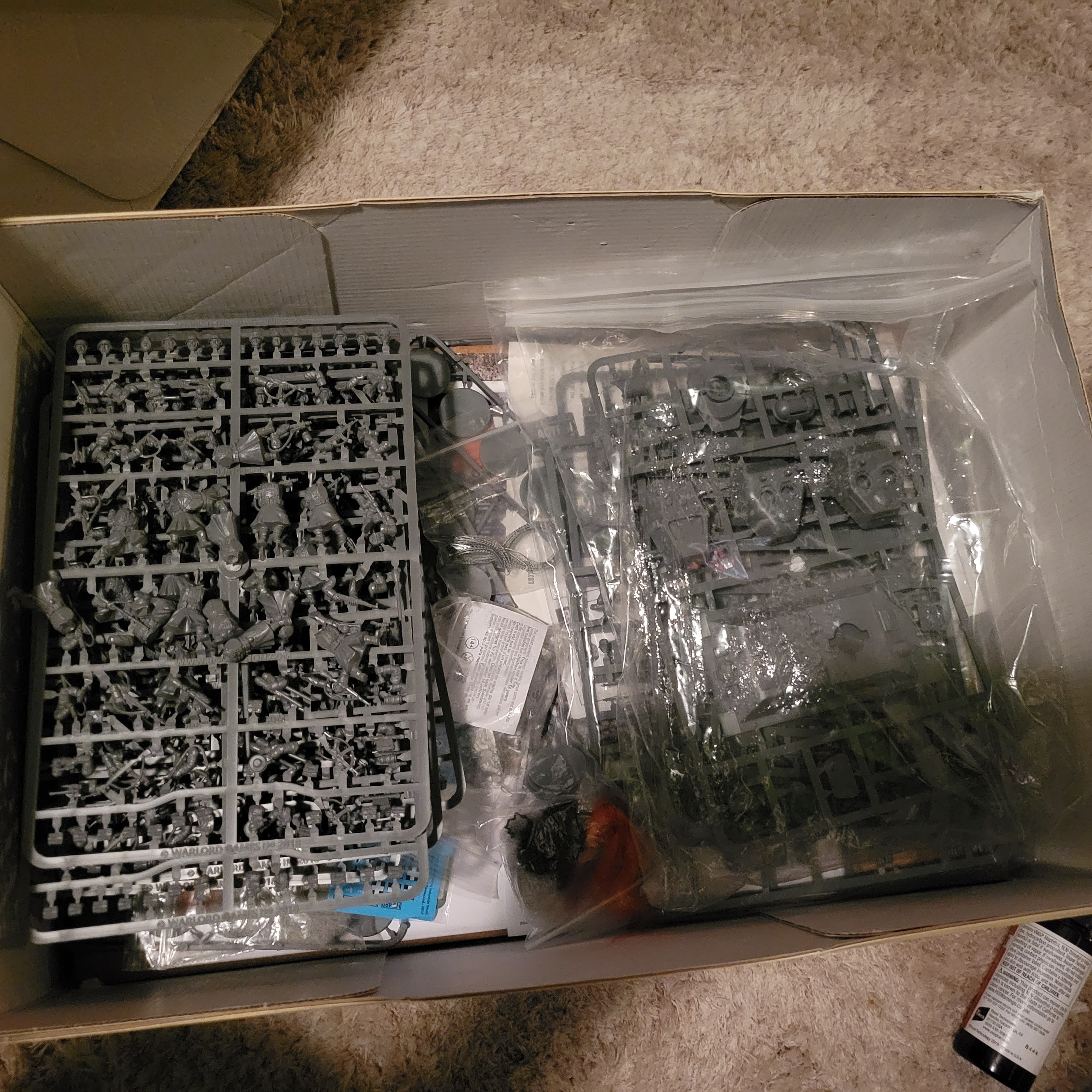
Yesterday, I received a massive haul of miniature plastic from Amazon. The Stalingrad 2-player set from Bolt Action. Wow, there is a ton of toy soldiers in this box. Here is what Warlord Games includes.

  • Ruined MDF factory
  • Barmaley Fountain
  • 5 resin craters/shellholes
  • 3 resin barricades/rubble
  • 3m of barbed wire
  • Sd.Kfz 139 Marder III
  • T34/76
  • Soviet Sniper team
  • 56 plastic Soviet infantry
  • 42 plastic German Army infantry

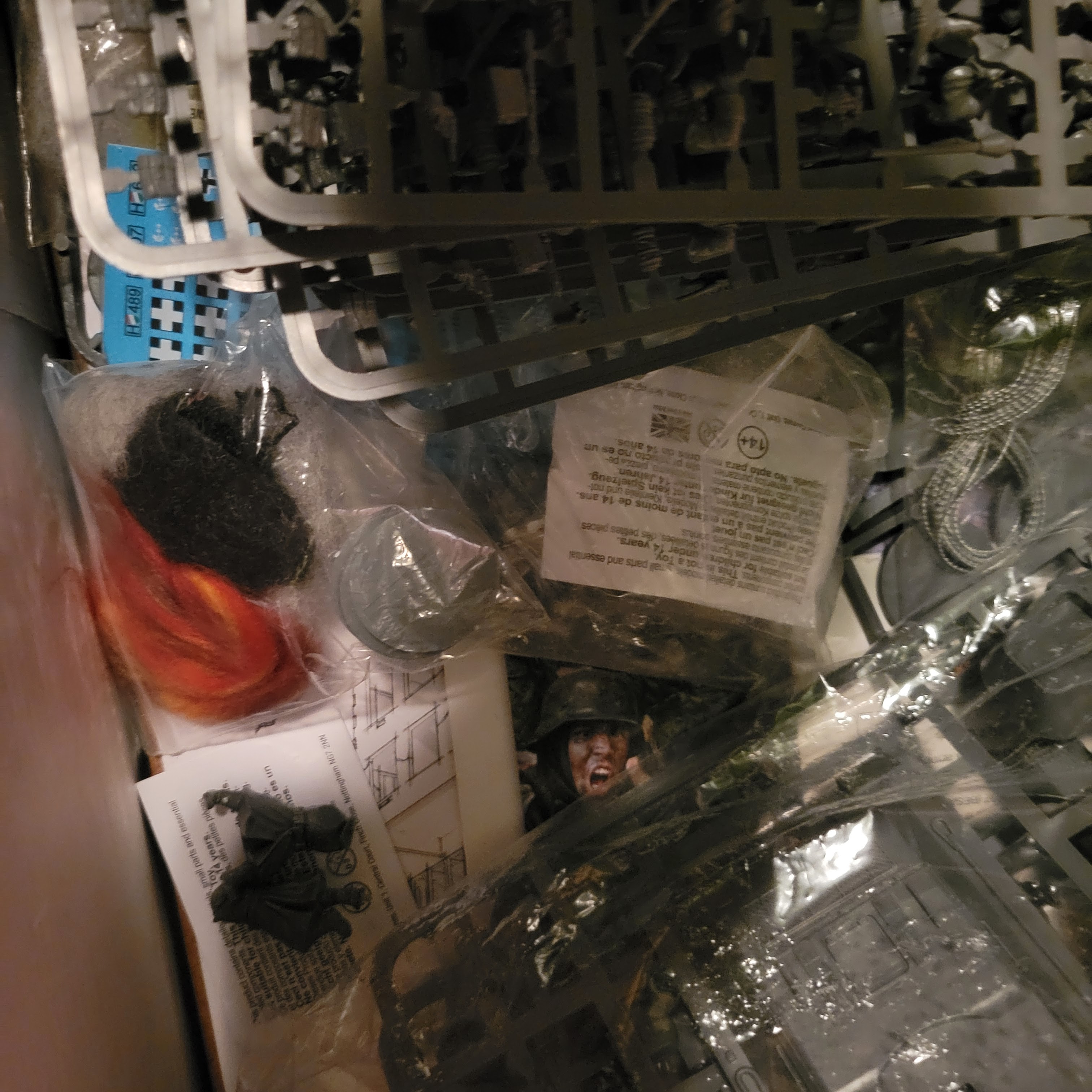
Also included were a couple rule and scenario books, build instructions and some unit cards to ease play, some decal sheets and damaged vehicle markers.

The contents of the box were as advertised. Although the sprews were not bundled together and my German and Soviet troops were thoroughly mixed together. The resin pieces were nicely covered in bubble wrap for protection. The MDF securely covered the bottom of the box. My biggest complaint came from the items in the box not fitting tightly. Part of the mixing of factions but it also caused several torsos for the German winter troops to fall from the sprew and just be loose in the box. I was a little annoyed that there were 6 sets of winter Germans but 4 sets of Winter Soviets and 2 sets of regular.

One of my favorite parts of Warlord Games models is the clearly labeled sprew. Each section had German Infantry (winter) or Soviet Weapons clearly stamped into the sprew. Something very consistent across all Warlord Games lines. Compared to a Games Workshop or Atomic Mass Games this is really helpful when leaving a project and returning to it weeks or months later.

Best Parts of the Box

Terrain. The MDF ruined buildings are way more sturdy than you would think. The resin barricades are nice, and the fountain is cool. I wish there was a little more elevation or platforms in the buildings.

The scenario book is nice and unexpected. The scenarios are designed to be used with the box and is a nice touch.

Worst Parts of the Box

German unit variety, no HQ’s or MMGs, or Flamethrowers. A huge miss here that I think really hurts the new player. Especially the lack of a machine gun when that is a German special rule.

Soviet Winter/Summer split. I get having all German units as winter garb, but the Soviets should have followed suit instead of being split.

Building instructions. I play a ton of Games Workshop, and their instructions are typically easy to follow. These were not especially for the infantry.

Packing quality. The items need to be secure in the box. They just do.

Who is This Box For

While typing this review, I have to say this is my biggest question mark. It is not good for the New Hobbyist; the instructions are far from clear and instead of saying piece one glues to piece two etc it gives you a sprew with torsos legs, arms and weapons and says glue together. I think someone brand new to the hobby would really struggle with this product. It kinda seems designed that way as well because it is a battlefield in a box and the included scenarios are very simple.

The Stalingrad box set is also not good for new players. On the Bolt Action website, you are encouraged to build a platoon with MMGs, Snipers, Anti Tank teams, mortars etc. This box doesn’t include any of those. No artillery, no HQs it is just infantry. I think this is a real miss for Warlord because it seems like this is a box that is designed to be open and play for two players.

Stalingrad is also not a great box for returning veterans of Bolt Action. Generally you buy two boxes of 30 troops each, a tank and the weapons teams when you are starting out. I have I think only needed more than 60 infantry twice playing Bolt Action. One was a simulation of D-Day on a 20ft long table with 10 players and 3,000+ models. The other time a friend wanted to do a Thin Red Line style game where half the Soviets didn’t have guns and they simply rushed the German entrenched lines. Long story short, most seasoned players don’t need gobs of riflemen.

Verdict

I have a tough time recommending this box to anyone. If you want the MDF buildings and could use the troops or have someone split them, go for it. If you are really into Stalingrad, by all means. Otherwise, I would have to suggest a pass. There are better options for your money. Even the terrain, you can just go on Etsy and buy what you need fully painted for less.