On June 7th, 1917, the British Second Army, led by General Herbert Plumer, began a costly assault on fortified German positions near Messines in Belgium. The British objective was to cut the Germans off from many ports they were using for resupply.
The British began the assault by detonating mines beneath the German lines, followed by a crawling artillery barrage. The infantry advanced with support from tanks, airplanes, and cavalry.
British Commander
Herbert Plumber 12 Divisions of 16,000 men each Cavalry, Air Patrols, Tanks
German Friedrich Sixt von Armin 5 Divisions of 18,000 men each.
Wargame
For use with Bolt Action WW1 or any other WW1 Wargame
Players: 2-4 Forces Needed: 1200 points or 2 platoon equivalents for the British and 800 points or 1 reinforced platoon equivalent for Germany. The British should have one tank, and both sides should have access to artillery and machine guns. Terrain Needed: A small hill with no man’s land before it. Table Size: 8×4
Set-Up
Place the small hill in the center of the table near one of the long edges. Fortify the hill with trenches, craters, barbed wire, and broken ground. That hill and that side of the table will be the Germans.
All forces should be placed on the table; the British should have the opposite table edge. Broken ground, crags, etc., should provide some cover for advancing British forces. All German troops should be dug in.
Objective
The British must take the hill, the Germans must defend it.
Special Rules
The British should get one artillery barrage at some point during the game.
The Battle of Jutland was the largest naval engagement of World War I and the last battleship-on-battleship engagement in history. Like most major naval engagements, it was indecisive. Both sides claimed victory. Germany sank more ships by 2:1 and killed more men by 3:1. The British were able to limit German access to the North Sea.
RuleSet Broadside Table Size 8×4 or larger. Number of Players 2-7 Models needed, 100 give or take.
Set-Up
I would advise using 1:1800 scale ships for this encounter. Most ships are available as 3d prints. This scenario should be played on a large table. If a large table is unavailable, reduce the range of various ships. Maybe the maximum range of a battleship is 6″ and the ideal range is 4″.
You do not need most of the destroyers and light cruisers. If you choose to use them, they should be kept in squadrons of 4 to 6 for scouting or anti-submarine activities. The core of the action is the dreadnoughts and battlecruisers.
The main crux of a game like Jutland is to balance the two forces, even with the numerical difference. At Jutland, the British were disorganized and out of formation, while the Germans were prepared for battle.
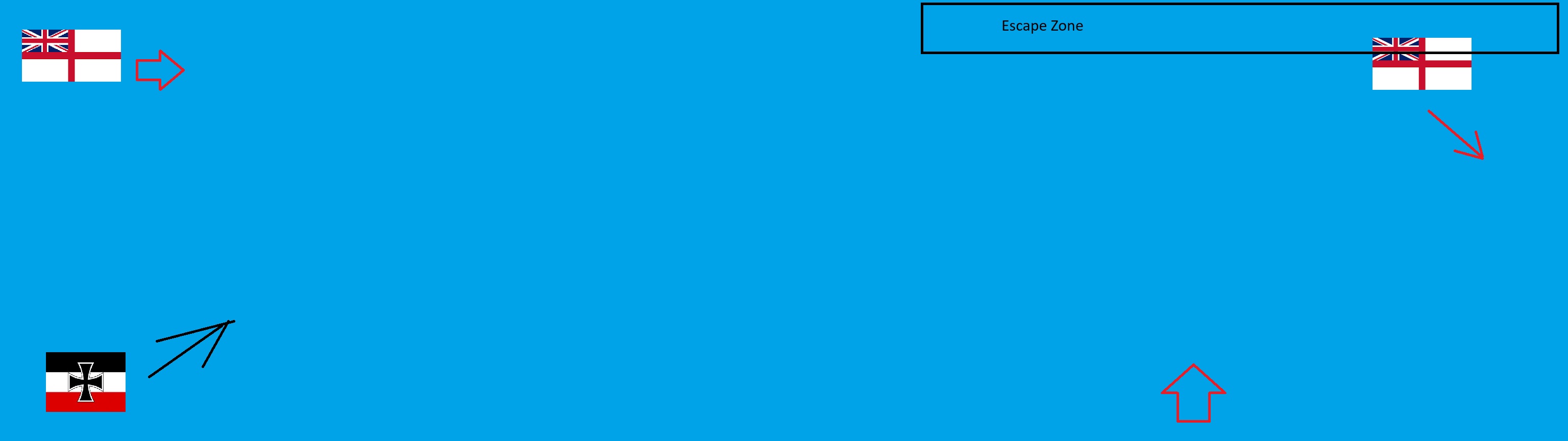
For the setup, the British should be divided into three squadrons of 8 dreadnoughts, and 2 armoured cruisers with support ships, similar to the actual engagement. If you have more players, the British should have up to five commanders while the Germans should stick with two. The Germans should also be broken up into three, eight-ship squadrons with three or four lighter ships each. However, these should enter much closer together in a more traditional Vanguard, Center, Rearguard scenario.
One British squadron should be about 10% away from each edge, with the Germans engaging from the bottom left. One British Squadron should be kept in reserve and begin entering the fray after an adequate number of turns. Depending on your system, it should be the middle of the game, so if a typical game is 20 turns, they should enter around turn 11.
The scenario’s challenge involves doing enough damage to the British squadron nearest the German fleet before the reserve squadrons can turn around and engage. The Germans must also escape the topmost table edge.
The British must quickly bring their forces to bear. Due to their spacing, the British should not allow their commanders to communicate with one another.
Victory;
The British will win if they inflict more damage on the Germans than the Germans inflict on them. The Germans will win if they inflict more damage or cause less damage, but every dreadnought and battlecruiser escapes.
Additional Rules The Germans had submarines in the area; they could place torpedo markers that forced British ships to change course. British scouts could eliminate these markers if needed.
Fog played a significant role in the battle, as visibility was limited. This can be gamed by having the British reserve commander be in a different room and only communicating with one-line telegrams.
Scout forces also engaged and caused minor damage. Based on the scouting results, a pre-battle scouting game could take place, with the sides getting better positioning.

 stonewalljackman